

3.1 miRNA Quantification Techniques
qPCR, microarray and NGS are the most commonly used methods for miRNA
quantification and profiling. They provide sensitivity and reproducibility and have
become more cost-effective and easier to perform as a result of improved strategies
and an increase in their global application.
3.1.1 qPCR
qPCR is currently the gold standard for miRNA quantification. Basically, miRNAs
are amplified with reverse transcription (RT)-PCR to generate cDNA, and the
miRNA of interest is then amplified and quantitatively measured in real time using
fluorescent probes. SYBR Green and TaqMan (ThermoFisher Scientific) are two
widely used systems. Although TaqMan technology offers greater miRNA detection
sensitivity and specificity, qPCR procedures should avoid primer dimers and increase
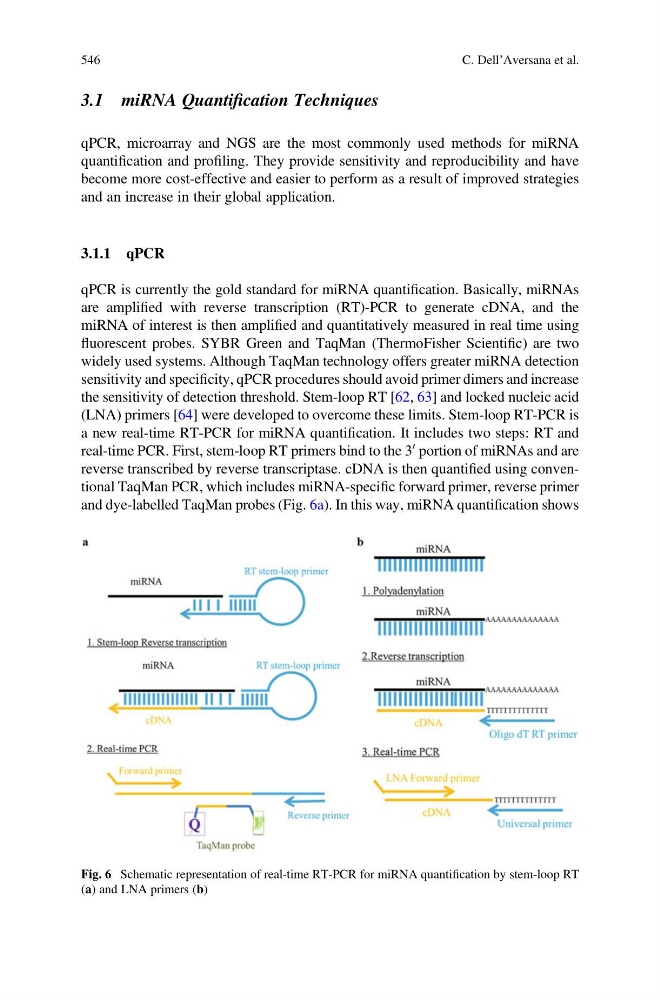
the sensitivity of detection threshold. Stem-loop RT [62, 63] and locked nucleic acid
(LNA) primers [64] were developed to overcome these limits. Stem-loop RT-PCR is
a new real-time RT-PCR for miRNA quantification. It includes two steps: RT and
real-time PCR. First, stem-loop RT primers bind to the 3
0 portion of miRNAs and are
reverse transcribed by reverse transcriptase. cDNA is then quantified using conventional TaqMan PCR, which includes miRNA-specific forward primer, reverse primer
and dye-labelled TaqMan probes (Fig. 6a). In this way, miRNA quantification shows
Fig. 6 Schematic representation of real-time RT-PCR for miRNA quantification by stem-loop RT
(a) and LNA primers (b)
546
C. Dell’Aversana et al.
qPCR, microarray and NGS are the most commonly used methods for miRNA
quantification and profiling. They provide sensitivity and reproducibility and have
become more cost-effective and easier to perform as a result of improved strategies
and an increase in their global application.
3.1.1 qPCR
qPCR is currently the gold standard for miRNA quantification. Basically, miRNAs
are amplified with reverse transcription (RT)-PCR to generate cDNA, and the
miRNA of interest is then amplified and quantitatively measured in real time using
fluorescent probes. SYBR Green and TaqMan (ThermoFisher Scientific) are two
widely used systems. Although TaqMan technology offers greater miRNA detection
sensitivity and specificity, qPCR procedures should avoid primer dimers and increase
the sensitivity of detection threshold. Stem-loop RT [62, 63] and locked nucleic acid
(LNA) primers [64] were developed to overcome these limits. Stem-loop RT-PCR is
a new real-time RT-PCR for miRNA quantification. It includes two steps: RT and
real-time PCR. First, stem-loop RT primers bind to the 3
0 portion of miRNAs and are
reverse transcribed by reverse transcriptase. cDNA is then quantified using conventional TaqMan PCR, which includes miRNA-specific forward primer, reverse primer
and dye-labelled TaqMan probes (Fig. 6a). In this way, miRNA quantification shows
Fig. 6 Schematic representation of real-time RT-PCR for miRNA quantification by stem-loop RT
(a) and LNA primers (b)
546
C. Dell’Aversana et al.