

experimental validation concerning target engagement and cellular effects has not
been reported.
A structure-based VS approach to identify reversible LSD1 inhibitors was
described by Sorna et al. [131]. This study involved docking into LSD1 using
several docking programs and scoring functions in a stepwise manner. For this
purpose, the ZINC database (about 13 million compounds) was first docked using
Glide in high-throughput virtual screening mode; the top-ranked 15% compounds
were further docked using Glide in Standard Precision mode, followed by docking of
the top-ranked 0.5 % using ICM. 121 hits were finally selected for in vitro screening,
which led to the identification of a series of six N
0 -(1-phenylethylidene)
benzohydrazide derivatives showing submicromolar activity against LSD1. Further
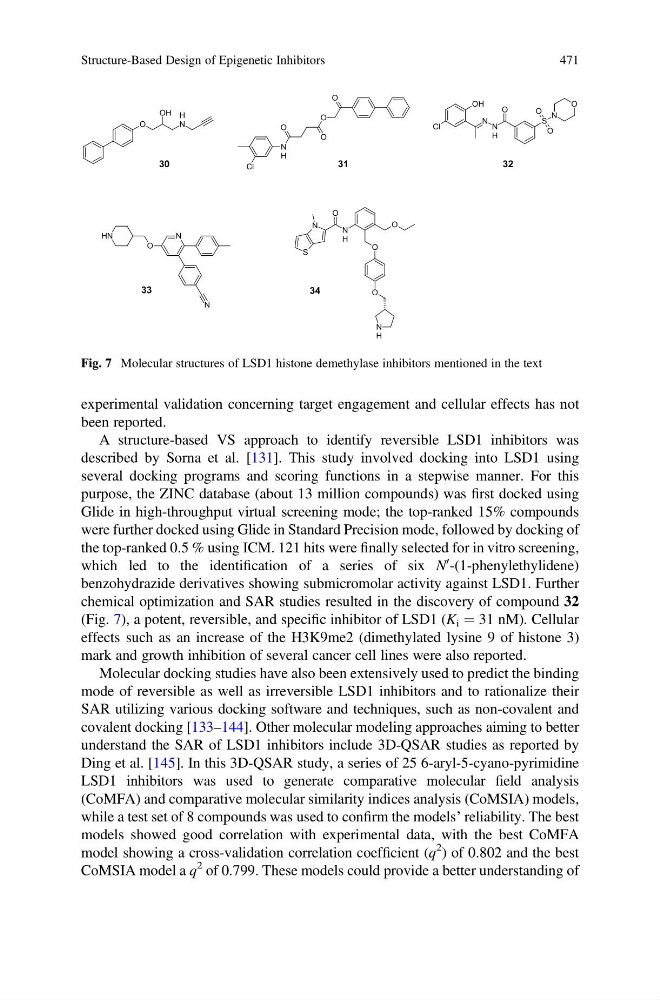
chemical optimization and SAR studies resulted in the discovery of compound 32
(Fig. 7), a potent, reversible, and specific inhibitor of LSD1 (K i ¼ 31 nM). Cellular
effects such as an increase of the H3K9me2 (dimethylated lysine 9 of histone 3)
mark and growth inhibition of several cancer cell lines were also reported.
Molecular docking studies have also been extensively used to predict the binding
mode of reversible as well as irreversible LSD1 inhibitors and to rationalize their
SAR utilizing various docking software and techniques, such as non-covalent and
covalent docking [133–144]. Other molecular modeling approaches aiming to better
understand the SAR of LSD1 inhibitors include 3D-QSAR studies as reported by
Ding et al. [145]. In this 3D-QSAR study, a series of 25 6-aryl-5-cyano-pyrimidine
LSD1 inhibitors was used to generate comparative molecular field analysis
(CoMFA) and comparative molecular similarity indices analysis (CoMSIA) models,
while a test set of 8 compounds was used to confirm the models’ reliability. The best
models showed good correlation with experimental data, with the best CoMFA
model showing a cross-validation correlation coefficient (q
2 ) of 0.802 and the best
CoMSIA model a q
2 of 0.799. These models could provide a better understanding of
30
O
OH
N
H
OH
Cl
N N
H
O
S
O
O N
O
N
H
O
O
O
O
Cl
S
N
O
N
H
O
O
N
H
O
31
32
33
N
O
N
H
N
34
Fig. 7 Molecular structures of LSD1 histone demethylase inhibitors mentioned in the text
Structure-Based Design of Epigenetic Inhibitors
471
been reported.
A structure-based VS approach to identify reversible LSD1 inhibitors was
described by Sorna et al. [131]. This study involved docking into LSD1 using
several docking programs and scoring functions in a stepwise manner. For this
purpose, the ZINC database (about 13 million compounds) was first docked using
Glide in high-throughput virtual screening mode; the top-ranked 15% compounds
were further docked using Glide in Standard Precision mode, followed by docking of
the top-ranked 0.5 % using ICM. 121 hits were finally selected for in vitro screening,
which led to the identification of a series of six N
0 -(1-phenylethylidene)
benzohydrazide derivatives showing submicromolar activity against LSD1. Further
chemical optimization and SAR studies resulted in the discovery of compound 32
(Fig. 7), a potent, reversible, and specific inhibitor of LSD1 (K i ¼ 31 nM). Cellular
effects such as an increase of the H3K9me2 (dimethylated lysine 9 of histone 3)
mark and growth inhibition of several cancer cell lines were also reported.
Molecular docking studies have also been extensively used to predict the binding
mode of reversible as well as irreversible LSD1 inhibitors and to rationalize their
SAR utilizing various docking software and techniques, such as non-covalent and
covalent docking [133–144]. Other molecular modeling approaches aiming to better
understand the SAR of LSD1 inhibitors include 3D-QSAR studies as reported by
Ding et al. [145]. In this 3D-QSAR study, a series of 25 6-aryl-5-cyano-pyrimidine
LSD1 inhibitors was used to generate comparative molecular field analysis
(CoMFA) and comparative molecular similarity indices analysis (CoMSIA) models,
while a test set of 8 compounds was used to confirm the models’ reliability. The best
models showed good correlation with experimental data, with the best CoMFA
model showing a cross-validation correlation coefficient (q
2 ) of 0.802 and the best
CoMSIA model a q
2 of 0.799. These models could provide a better understanding of
30
O
OH
N
H
OH
Cl
N N
H
O
S
O
O N
O
N
H
O
O
O
O
Cl
S
N
O
N
H
O
O
N
H
O
31
32
33
N
O
N
H
N
34
Fig. 7 Molecular structures of LSD1 histone demethylase inhibitors mentioned in the text
Structure-Based Design of Epigenetic Inhibitors
471