

In conclusion, HDAC2 inhibition should be avoided in asthma since it has the
potential to shift asthma’s eosinophilic character to the more neutrophilic one seen in
COPD, potentially by a similar mechanism of derepression of IL-8. Furthermore, the
use of HDAC6- and HDAC8-selective inhibitors highlights key modes of action of
the respective HDAC isoforms in asthma and shows that their inhibition leads to
promising effects on airway hyperresponsiveness, inflammation, and remodeling.
3 Protein and DNA Methylation in Asthma and COPD
The role of other PTMs in lung diseases is also being deciphered. Of these other
PTMs, most is known about dynamic methylation, governed by methyltransferases
and demethylases. Importantly, while reversible acetylation is only known to occur
on proteins, both proteins and DNA are found to be methylated. Similar to posttranslational modifications, DNA methylation is a post-replicative modification.
However, different enzyme families are at play that control either protein or DNA
methylation and demethylation. DNA methyltransferases (DNMTs) methylate the
C-5 carbon of cytosines that are next to a guanine, and the presence of
5-methylcytosine (m5C) in a promotor generally leads to a transcriptionally inactive
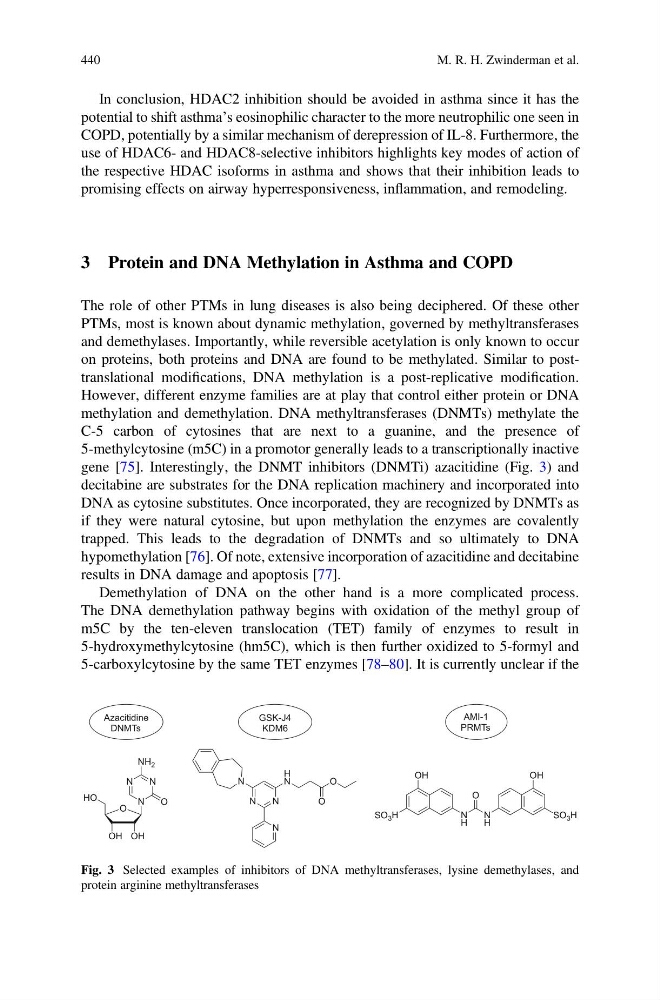
gene [75]. Interestingly, the DNMT inhibitors (DNMTi) azacitidine (Fig. 3) and
decitabine are substrates for the DNA replication machinery and incorporated into
DNA as cytosine substitutes. Once incorporated, they are recognized by DNMTs as
if they were natural cytosine, but upon methylation the enzymes are covalently
trapped. This leads to the degradation of DNMTs and so ultimately to DNA
hypomethylation [76]. Of note, extensive incorporation of azacitidine and decitabine
results in DNA damage and apoptosis [77].
Demethylation of DNA on the other hand is a more complicated process.
The DNA demethylation pathway begins with oxidation of the methyl group of
m5C by the ten-eleven translocation (TET) family of enzymes to result in
5-hydroxymethylcytosine (hm5C), which is then further oxidized to 5-formyl and
5-carboxylcytosine by the same TET enzymes [78–80]. It is currently unclear if the
N
N
H
N
N
O
O
N
O
HO
OH OH
N
N
N
NH 2
O
GSK-J4
KDM6
Azacitidine
DNMTs
N
H
O
N
H
OH
OH
SO 3 H
SO 3 H
AMI-1
PRMTs
Fig. 3 Selected examples of inhibitors of DNA methyltransferases, lysine demethylases, and
protein arginine methyltransferases
440
M. R. H. Zwinderman et al.
potential to shift asthma’s eosinophilic character to the more neutrophilic one seen in
COPD, potentially by a similar mechanism of derepression of IL-8. Furthermore, the
use of HDAC6- and HDAC8-selective inhibitors highlights key modes of action of
the respective HDAC isoforms in asthma and shows that their inhibition leads to
promising effects on airway hyperresponsiveness, inflammation, and remodeling.
3 Protein and DNA Methylation in Asthma and COPD
The role of other PTMs in lung diseases is also being deciphered. Of these other
PTMs, most is known about dynamic methylation, governed by methyltransferases
and demethylases. Importantly, while reversible acetylation is only known to occur
on proteins, both proteins and DNA are found to be methylated. Similar to posttranslational modifications, DNA methylation is a post-replicative modification.
However, different enzyme families are at play that control either protein or DNA
methylation and demethylation. DNA methyltransferases (DNMTs) methylate the
C-5 carbon of cytosines that are next to a guanine, and the presence of
5-methylcytosine (m5C) in a promotor generally leads to a transcriptionally inactive
gene [75]. Interestingly, the DNMT inhibitors (DNMTi) azacitidine (Fig. 3) and
decitabine are substrates for the DNA replication machinery and incorporated into
DNA as cytosine substitutes. Once incorporated, they are recognized by DNMTs as
if they were natural cytosine, but upon methylation the enzymes are covalently
trapped. This leads to the degradation of DNMTs and so ultimately to DNA
hypomethylation [76]. Of note, extensive incorporation of azacitidine and decitabine
results in DNA damage and apoptosis [77].
Demethylation of DNA on the other hand is a more complicated process.
The DNA demethylation pathway begins with oxidation of the methyl group of
m5C by the ten-eleven translocation (TET) family of enzymes to result in
5-hydroxymethylcytosine (hm5C), which is then further oxidized to 5-formyl and
5-carboxylcytosine by the same TET enzymes [78–80]. It is currently unclear if the
N
N
H
N
N
O
O
N
O
HO
OH OH
N
N
N
NH 2
O
GSK-J4
KDM6
Azacitidine
DNMTs
N
H
O
N
H
OH
OH
SO 3 H
SO 3 H
AMI-1
PRMTs
Fig. 3 Selected examples of inhibitors of DNA methyltransferases, lysine demethylases, and
protein arginine methyltransferases
440
M. R. H. Zwinderman et al.