

influx in the lungs, in turn caused by a decrease in mouse IL-8. The expression of the
pro-inflammatory cytokines IL-6 and IL-1ß was also decreased. Surprisingly, the
used HDACi restored overall HDAC activity and led to an overall decrease in
histone acetylation. This leads to intriguing questions about the exact mechanisms
by which HDACs and their inhibitors act and in which cell types they play a leading
role.
In the mouse COPD model, at least part of the effects can be explained mechanistically by the indirect action of entinostat on the acetylation status of NF-κB in
macrophages [51]. NF-κB contains seven lysine residues that can be acetylated in a
site-specific way. Acetylation of lysines 122 and 123 affects DNA binding, thereby
acting in an inhibitory manner [52]. In contrast, acetylated lysines 218 and 221 block
NF-κB’s association with its cytoplasmic partner IκB, thereby enhancing its nuclear
translocation and DNA-binding capability [53]. Acetylation at lysine 310 has been
shown to boost transcriptional activity without affecting IκB or DNA binding,
presumably by generating a binding site for coactivator proteins [54]. Most interestingly, acetylation of lysines 314 and 315 does not affect NF-κB’s transcriptional
activity but rather increases its promoter selectivity [55]. Overall, this means that
acetylation patterns shape NF-κB’s transcriptional activity and, importantly, gear it
toward certain parts of the chromatin. For all lysine residues, acetylation is under the
control of CBP/p300 acetyltransferases [56]. Deacetylation of NF-κB is mostly
controlled by HDAC3 (Fig. 1a), making HDAC3 a highly interesting target in
inflammation [26]. This is further backed up by the finding that HDAC3-deficient
macrophages are unable to activate almost half of LPS-induced inflammatory gene
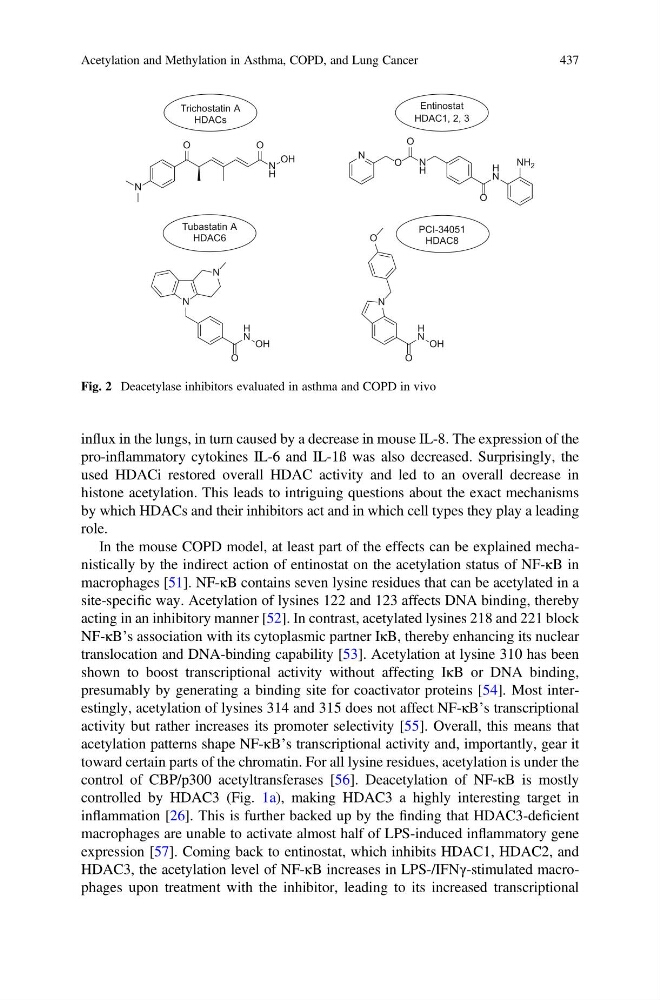
expression [57]. Coming back to entinostat, which inhibits HDAC1, HDAC2, and
HDAC3, the acetylation level of NF-κB increases in LPS-/IFNγ-stimulated macrophages upon treatment with the inhibitor, leading to its increased transcriptional
NH 2
H
N
O
N
H
O
O
N
Entinostat
HDAC1, 2, 3
N
O
O
N
H
OH
Trichostatin A
HDACs
N
N
H
N
O
OH
Tubastatin A
HDAC6
H
N
O
OH
N
O
PCI-34051
HDAC8
Fig. 2 Deacetylase inhibitors evaluated in asthma and COPD in vivo
Acetylation and Methylation in Asthma, COPD, and Lung Cancer
437
pro-inflammatory cytokines IL-6 and IL-1ß was also decreased. Surprisingly, the
used HDACi restored overall HDAC activity and led to an overall decrease in
histone acetylation. This leads to intriguing questions about the exact mechanisms
by which HDACs and their inhibitors act and in which cell types they play a leading
role.
In the mouse COPD model, at least part of the effects can be explained mechanistically by the indirect action of entinostat on the acetylation status of NF-κB in
macrophages [51]. NF-κB contains seven lysine residues that can be acetylated in a
site-specific way. Acetylation of lysines 122 and 123 affects DNA binding, thereby
acting in an inhibitory manner [52]. In contrast, acetylated lysines 218 and 221 block
NF-κB’s association with its cytoplasmic partner IκB, thereby enhancing its nuclear
translocation and DNA-binding capability [53]. Acetylation at lysine 310 has been
shown to boost transcriptional activity without affecting IκB or DNA binding,
presumably by generating a binding site for coactivator proteins [54]. Most interestingly, acetylation of lysines 314 and 315 does not affect NF-κB’s transcriptional
activity but rather increases its promoter selectivity [55]. Overall, this means that
acetylation patterns shape NF-κB’s transcriptional activity and, importantly, gear it
toward certain parts of the chromatin. For all lysine residues, acetylation is under the
control of CBP/p300 acetyltransferases [56]. Deacetylation of NF-κB is mostly
controlled by HDAC3 (Fig. 1a), making HDAC3 a highly interesting target in
inflammation [26]. This is further backed up by the finding that HDAC3-deficient
macrophages are unable to activate almost half of LPS-induced inflammatory gene
expression [57]. Coming back to entinostat, which inhibits HDAC1, HDAC2, and
HDAC3, the acetylation level of NF-κB increases in LPS-/IFNγ-stimulated macrophages upon treatment with the inhibitor, leading to its increased transcriptional
NH 2
H
N
O
N
H
O
O
N
Entinostat
HDAC1, 2, 3
N
O
O
N
H
OH
Trichostatin A
HDACs
N
N
H
N
O
OH
Tubastatin A
HDAC6
H
N
O
OH
N
O
PCI-34051
HDAC8
Fig. 2 Deacetylase inhibitors evaluated in asthma and COPD in vivo
Acetylation and Methylation in Asthma, COPD, and Lung Cancer
437