

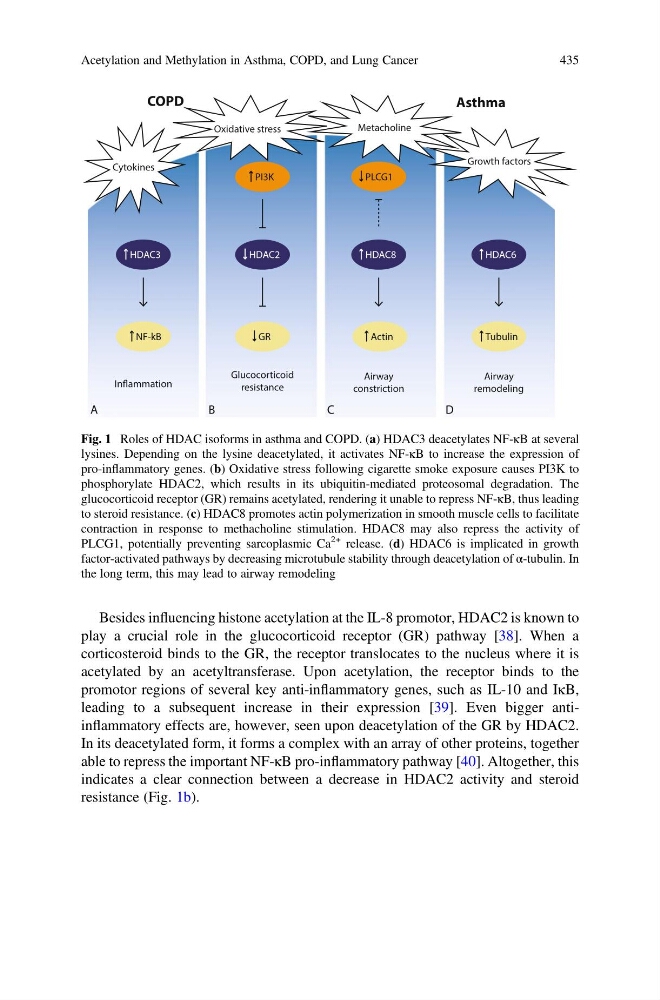
Besides influencing histone acetylation at the IL-8 promotor, HDAC2 is known to
play a crucial role in the glucocorticoid receptor (GR) pathway [38]. When a
corticosteroid binds to the GR, the receptor translocates to the nucleus where it is
acetylated by an acetyltransferase. Upon acetylation, the receptor binds to the
promotor regions of several key anti-inflammatory genes, such as IL-10 and IκB,
leading to a subsequent increase in their expression [39]. Even bigger antiinflammatory effects are, however, seen upon deacetylation of the GR by HDAC2.
In its deacetylated form, it forms a complex with an array of other proteins, together
able to repress the important NF-κB pro-inflammatory pathway [40]. Altogether, this
indicates a clear connection between a decrease in HDAC2 activity and steroid
resistance (Fig. 1b).
Glucocorticoid
resistance
Airway
remodeling
Airway
constriction
HDAC2
PI3K
GR
Cytokines
Inflammation
HDAC3
NF-kB
HDAC6
Tubulin
HDAC8
Actin
PLCG1
COPD
Asthma
Oxidative stress
Metacholine
Growth factors
A
B
C
D
Fig. 1 Roles of HDAC isoforms in asthma and COPD. (a) HDAC3 deacetylates NF-κB at several
lysines. Depending on the lysine deacetylated, it activates NF-κB to increase the expression of
pro-inflammatory genes. (b) Oxidative stress following cigarette smoke exposure causes PI3K to
phosphorylate HDAC2, which results in its ubiquitin-mediated proteosomal degradation. The
glucocorticoid receptor (GR) remains acetylated, rendering it unable to repress NF-κB, thus leading
to steroid resistance. (c) HDAC8 promotes actin polymerization in smooth muscle cells to facilitate
contraction in response to methacholine stimulation. HDAC8 may also repress the activity of
PLCG1, potentially preventing sarcoplasmic Ca
2+ release. (d) HDAC6 is implicated in growth
factor-activated pathways by decreasing microtubule stability through deacetylation of α-tubulin. In
the long term, this may lead to airway remodeling
Acetylation and Methylation in Asthma, COPD, and Lung Cancer
435
play a crucial role in the glucocorticoid receptor (GR) pathway [38]. When a
corticosteroid binds to the GR, the receptor translocates to the nucleus where it is
acetylated by an acetyltransferase. Upon acetylation, the receptor binds to the
promotor regions of several key anti-inflammatory genes, such as IL-10 and IκB,
leading to a subsequent increase in their expression [39]. Even bigger antiinflammatory effects are, however, seen upon deacetylation of the GR by HDAC2.
In its deacetylated form, it forms a complex with an array of other proteins, together
able to repress the important NF-κB pro-inflammatory pathway [40]. Altogether, this
indicates a clear connection between a decrease in HDAC2 activity and steroid
resistance (Fig. 1b).
Glucocorticoid
resistance
Airway
remodeling
Airway
constriction
HDAC2
PI3K
GR
Cytokines
Inflammation
HDAC3
NF-kB
HDAC6
Tubulin
HDAC8
Actin
PLCG1
COPD
Asthma
Oxidative stress
Metacholine
Growth factors
A
B
C
D
Fig. 1 Roles of HDAC isoforms in asthma and COPD. (a) HDAC3 deacetylates NF-κB at several
lysines. Depending on the lysine deacetylated, it activates NF-κB to increase the expression of
pro-inflammatory genes. (b) Oxidative stress following cigarette smoke exposure causes PI3K to
phosphorylate HDAC2, which results in its ubiquitin-mediated proteosomal degradation. The
glucocorticoid receptor (GR) remains acetylated, rendering it unable to repress NF-κB, thus leading
to steroid resistance. (c) HDAC8 promotes actin polymerization in smooth muscle cells to facilitate
contraction in response to methacholine stimulation. HDAC8 may also repress the activity of
PLCG1, potentially preventing sarcoplasmic Ca
2+ release. (d) HDAC6 is implicated in growth
factor-activated pathways by decreasing microtubule stability through deacetylation of α-tubulin. In
the long term, this may lead to airway remodeling
Acetylation and Methylation in Asthma, COPD, and Lung Cancer
435