

[43]. In terms of mutagenicity, it is known that hydroxamic acids undergo Lossen
rearrangement in the presence of metal ions, although no in vivo interrogation has
been reported to date (Fig. 3) [44].
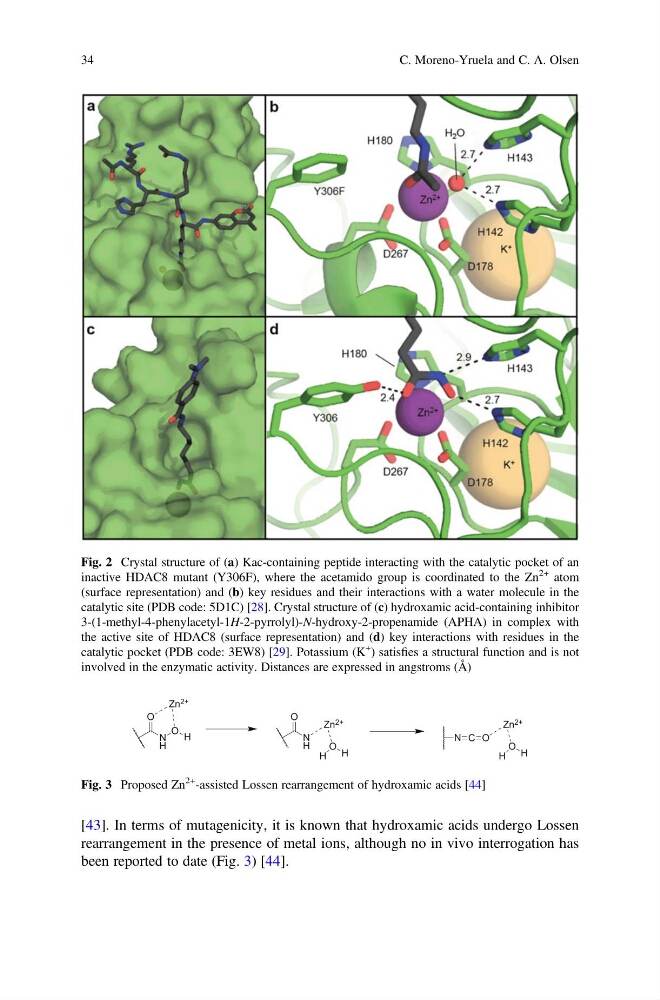
Fig. 2 Crystal structure of (a) Kac-containing peptide interacting with the catalytic pocket of an
inactive HDAC8 mutant (Y306F), where the acetamido group is coordinated to the Zn
2+ atom
(surface representation) and (b) key residues and their interactions with a water molecule in the
catalytic site (PDB code: 5D1C) [28]. Crystal structure of (c) hydroxamic acid-containing inhibitor
3-(1-methyl-4-phenylacetyl-1H-2-pyrrolyl)-N-hydroxy-2-propenamide (APHA) in complex with
the active site of HDAC8 (surface representation) and (d) key interactions with residues in the
catalytic pocket (PDB code: 3EW8) [29]. Potassium (K
+ ) satisfies a structural function and is not
involved in the enzymatic activity. Distances are expressed in angstroms (Å)
N
H
O
O
Zn 2+
H
N
H
O
Zn 2+
O H
H
O
Zn 2+
O H
H
C
N
Fig. 3 Proposed Zn
2+ -assisted Lossen rearrangement of hydroxamic acids [44]
34
C. Moreno-Yruela and C. A. Olsen
rearrangement in the presence of metal ions, although no in vivo interrogation has
been reported to date (Fig. 3) [44].
Fig. 2 Crystal structure of (a) Kac-containing peptide interacting with the catalytic pocket of an
inactive HDAC8 mutant (Y306F), where the acetamido group is coordinated to the Zn
2+ atom
(surface representation) and (b) key residues and their interactions with a water molecule in the
catalytic site (PDB code: 5D1C) [28]. Crystal structure of (c) hydroxamic acid-containing inhibitor
3-(1-methyl-4-phenylacetyl-1H-2-pyrrolyl)-N-hydroxy-2-propenamide (APHA) in complex with
the active site of HDAC8 (surface representation) and (d) key interactions with residues in the
catalytic pocket (PDB code: 3EW8) [29]. Potassium (K
+ ) satisfies a structural function and is not
involved in the enzymatic activity. Distances are expressed in angstroms (Å)
N
H
O
O
Zn 2+
H
N
H
O
Zn 2+
O H
H
O
Zn 2+
O H
H
C
N
Fig. 3 Proposed Zn
2+ -assisted Lossen rearrangement of hydroxamic acids [44]
34
C. Moreno-Yruela and C. A. Olsen