

89mer within the EZH2-interacting region of HOTAIR RNA to disrupt its interaction with PRC2. This PNA, named PNA3 in this study, inhibits the interaction
by 80% [53]. OC and breast cancer cell lines ectopically overexpressing HOTAIR
were then treated with PNA3 in combination with either cisplatin or etoposide.
PNA3 co-treatment reduced clonogenic survival and migrational capacity of
cisplatin-resistant cells, but PNA3 had no effect on either cell proliferation or
on HOTAIR levels when administered as a single agent [53], indicating that
HOTAIR inhibition could resensitise chemoresistant OC cells to these agents.
Co-treatment of OC cells with cisplatin and PNA3 also led to the downregulation
of ovarian cancer stem cell (CSC)-associated aldehyde dehydrogenase (ALDH1A1)
[59], suggesting that the combined treatment could confer chemosensitivity by
depleting chemoresistant CSC subpopulations of OC tumours [53].
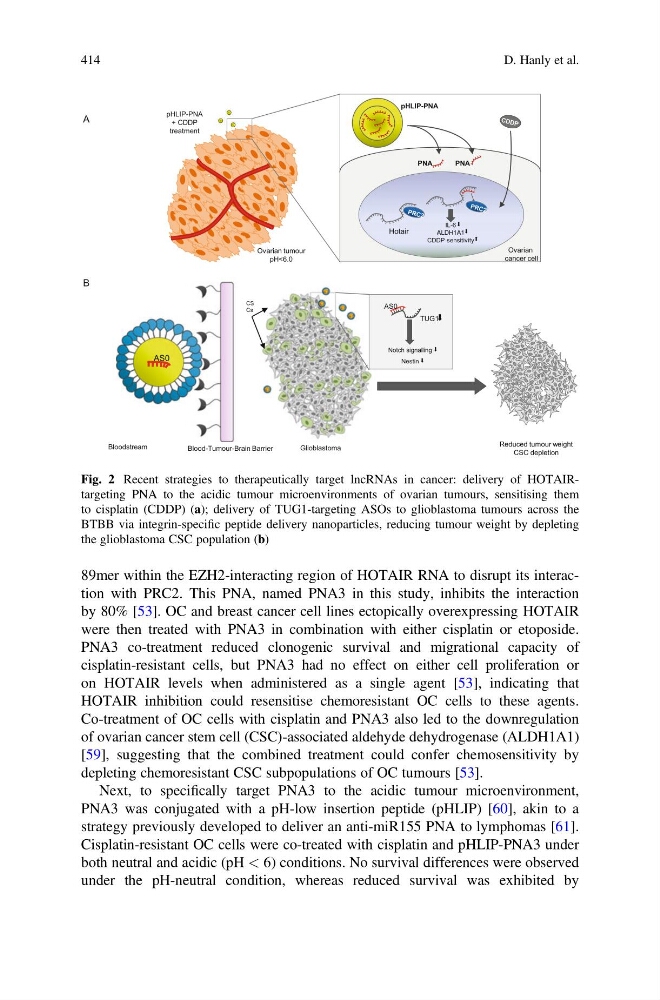
Next, to specifically target PNA3 to the acidic tumour microenvironment,
PNA3 was conjugated with a pH-low insertion peptide (pHLIP) [60], akin to a
strategy previously developed to deliver an anti-miR155 PNA to lymphomas [61].
Cisplatin-resistant OC cells were co-treated with cisplatin and pHLIP-PNA3 under
both neutral and acidic (pH < 6) conditions. No survival differences were observed
under the pH-neutral condition, whereas reduced survival was exhibited by
Hotair
IL-6
ALDH1A1
CDDP sensitivity
pHLIP-PNA
Ovarian tumour
pH<6.0
pHLIP-PNA
+ CDDP
treatment
PNA
PNA
Ovarian
cancer cell
Bloodstream
Blood-Tumour-Brain Barrier
Glioblastoma
Reduced tumour weight
CSC depletion
AS0
CS
Cs
AS0
TUG1
Notch signalling
Nestin
A
B
Fig. 2 Recent strategies to therapeutically target lncRNAs in cancer: delivery of HOTAIRtargeting PNA to the acidic tumour microenvironments of ovarian tumours, sensitising them
to cisplatin (CDDP) (a); delivery of TUG1-targeting ASOs to glioblastoma tumours across the
BTBB via integrin-specific peptide delivery nanoparticles, reducing tumour weight by depleting
the glioblastoma CSC population (b)
414
D. Hanly et al.
by 80% [53]. OC and breast cancer cell lines ectopically overexpressing HOTAIR
were then treated with PNA3 in combination with either cisplatin or etoposide.
PNA3 co-treatment reduced clonogenic survival and migrational capacity of
cisplatin-resistant cells, but PNA3 had no effect on either cell proliferation or
on HOTAIR levels when administered as a single agent [53], indicating that
HOTAIR inhibition could resensitise chemoresistant OC cells to these agents.
Co-treatment of OC cells with cisplatin and PNA3 also led to the downregulation
of ovarian cancer stem cell (CSC)-associated aldehyde dehydrogenase (ALDH1A1)
[59], suggesting that the combined treatment could confer chemosensitivity by
depleting chemoresistant CSC subpopulations of OC tumours [53].
Next, to specifically target PNA3 to the acidic tumour microenvironment,
PNA3 was conjugated with a pH-low insertion peptide (pHLIP) [60], akin to a
strategy previously developed to deliver an anti-miR155 PNA to lymphomas [61].
Cisplatin-resistant OC cells were co-treated with cisplatin and pHLIP-PNA3 under
both neutral and acidic (pH < 6) conditions. No survival differences were observed
under the pH-neutral condition, whereas reduced survival was exhibited by
Hotair
IL-6
ALDH1A1
CDDP sensitivity
pHLIP-PNA
Ovarian tumour
pH<6.0
pHLIP-PNA
+ CDDP
treatment
PNA
PNA
Ovarian
cancer cell
Bloodstream
Blood-Tumour-Brain Barrier
Glioblastoma
Reduced tumour weight
CSC depletion
AS0
CS
Cs
AS0
TUG1
Notch signalling
Nestin
A
B
Fig. 2 Recent strategies to therapeutically target lncRNAs in cancer: delivery of HOTAIRtargeting PNA to the acidic tumour microenvironments of ovarian tumours, sensitising them
to cisplatin (CDDP) (a); delivery of TUG1-targeting ASOs to glioblastoma tumours across the
BTBB via integrin-specific peptide delivery nanoparticles, reducing tumour weight by depleting
the glioblastoma CSC population (b)
414
D. Hanly et al.