

(K D values ¼ 5–8.6 μM), which demonstrated approximately a fivefold increase
in binding affinity to L3MBTL1 compared to UNC280, but without improved
selectivity between L3MBTL1 and L3MBTL3 in the AlphaScreen™ assay
(IC 50 ¼ 6–7.9 μM and 4.8 μM, respectively) [176, 177]. In addition, UNC669
did not bind to the L3MBTL1-D355A mutant suggesting it targets the intended
MBT2 domain-binding pocket. ITC and AlphaScreen™ binding results for UNC669
were further confirmed with a competitive fluorescence polarization (FP) inhibition
assay using a FAM-labeled H3K9Me1 peptide (IC 50 $ 10 μM).
Starting from the UNC669 scaffold, a series of second-generation molecules were
designed to gain information about SARs for the aromatic ring, the piperidine/
pyrrolidine moieties, and the carbonyl linker. The compounds were screened for
binding, potency, and selectivity against a panel of methyllysine domains [177].
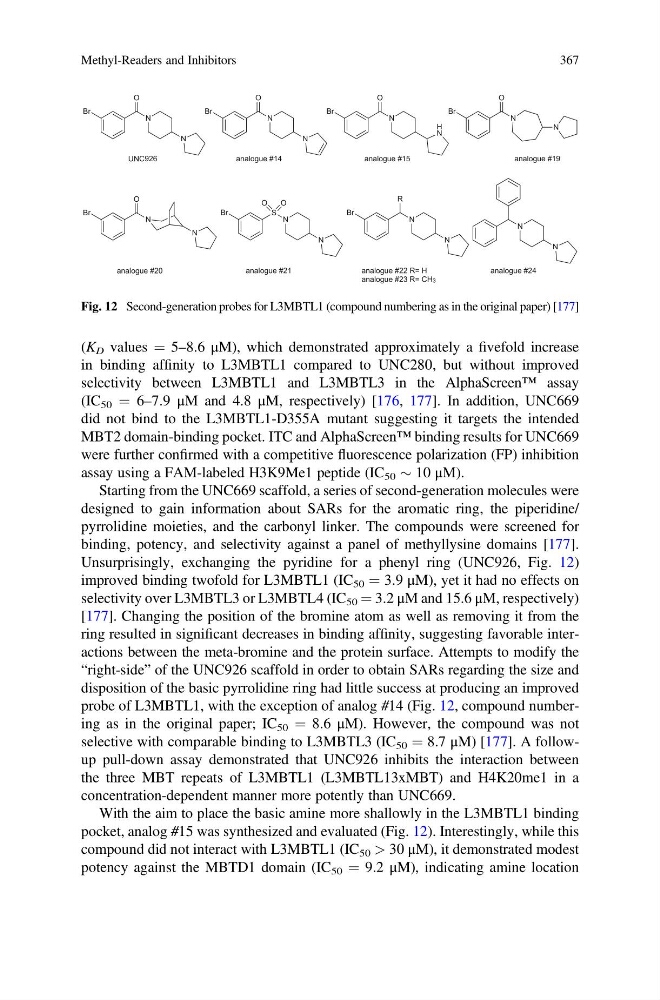
Unsurprisingly, exchanging the pyridine for a phenyl ring (UNC926, Fig. 12)
improved binding twofold for L3MBTL1 (IC 50 ¼ 3.9 μM), yet it had no effects on
selectivity over L3MBTL3 or L3MBTL4 (IC 50 ¼ 3.2 μM and 15.6 μM, respectively)
[177]. Changing the position of the bromine atom as well as removing it from the
ring resulted in significant decreases in binding affinity, suggesting favorable interactions between the meta-bromine and the protein surface. Attempts to modify the
“right-side” of the UNC926 scaffold in order to obtain SARs regarding the size and
disposition of the basic pyrrolidine ring had little success at producing an improved
probe of L3MBTL1, with the exception of analog #14 (Fig. 12, compound numbering as in the original paper; IC 50 ¼ 8.6 μM). However, the compound was not
selective with comparable binding to L3MBTL3 (IC 50 ¼ 8.7 μM) [177]. A followup pull-down assay demonstrated that UNC926 inhibits the interaction between
the three MBT repeats of L3MBTL1 (L3MBTL13xMBT) and H4K20me1 in a
concentration-dependent manner more potently than UNC669.
With the aim to place the basic amine more shallowly in the L3MBTL1 binding
pocket, analog #15 was synthesized and evaluated (Fig. 12). Interestingly, while this
compound did not interact with L3MBTL1 (IC 50 > 30 μM), it demonstrated modest
potency against the MBTD1 domain (IC 50 ¼ 9.2 μM), indicating amine location
N
O
N
Br
UNC926
N
O
N
Br
N
O
H
N
Br
N
O
N
Br
N
O
Br
N
S N
N
Br
O
O
N
R
N
Br
N
N
analogue #15
analogue #14
analogue #20
analogue #19
analogue #21
analogue #22 R= H
analogue #23 R= CH3
analogue #24
Fig. 12 Second-generation probes for L3MBTL1 (compound numbering as in the original paper) [177]
Methyl-Readers and Inhibitors
367
in binding affinity to L3MBTL1 compared to UNC280, but without improved
selectivity between L3MBTL1 and L3MBTL3 in the AlphaScreen™ assay
(IC 50 ¼ 6–7.9 μM and 4.8 μM, respectively) [176, 177]. In addition, UNC669
did not bind to the L3MBTL1-D355A mutant suggesting it targets the intended
MBT2 domain-binding pocket. ITC and AlphaScreen™ binding results for UNC669
were further confirmed with a competitive fluorescence polarization (FP) inhibition
assay using a FAM-labeled H3K9Me1 peptide (IC 50 $ 10 μM).
Starting from the UNC669 scaffold, a series of second-generation molecules were
designed to gain information about SARs for the aromatic ring, the piperidine/
pyrrolidine moieties, and the carbonyl linker. The compounds were screened for
binding, potency, and selectivity against a panel of methyllysine domains [177].
Unsurprisingly, exchanging the pyridine for a phenyl ring (UNC926, Fig. 12)
improved binding twofold for L3MBTL1 (IC 50 ¼ 3.9 μM), yet it had no effects on
selectivity over L3MBTL3 or L3MBTL4 (IC 50 ¼ 3.2 μM and 15.6 μM, respectively)
[177]. Changing the position of the bromine atom as well as removing it from the
ring resulted in significant decreases in binding affinity, suggesting favorable interactions between the meta-bromine and the protein surface. Attempts to modify the
“right-side” of the UNC926 scaffold in order to obtain SARs regarding the size and
disposition of the basic pyrrolidine ring had little success at producing an improved
probe of L3MBTL1, with the exception of analog #14 (Fig. 12, compound numbering as in the original paper; IC 50 ¼ 8.6 μM). However, the compound was not
selective with comparable binding to L3MBTL3 (IC 50 ¼ 8.7 μM) [177]. A followup pull-down assay demonstrated that UNC926 inhibits the interaction between
the three MBT repeats of L3MBTL1 (L3MBTL13xMBT) and H4K20me1 in a
concentration-dependent manner more potently than UNC669.
With the aim to place the basic amine more shallowly in the L3MBTL1 binding
pocket, analog #15 was synthesized and evaluated (Fig. 12). Interestingly, while this
compound did not interact with L3MBTL1 (IC 50 > 30 μM), it demonstrated modest
potency against the MBTD1 domain (IC 50 ¼ 9.2 μM), indicating amine location
N
O
N
Br
UNC926
N
O
N
Br
N
O
H
N
Br
N
O
N
Br
N
O
Br
N
S N
N
Br
O
O
N
R
N
Br
N
N
analogue #15
analogue #14
analogue #20
analogue #19
analogue #21
analogue #22 R= H
analogue #23 R= CH3
analogue #24
Fig. 12 Second-generation probes for L3MBTL1 (compound numbering as in the original paper) [177]
Methyl-Readers and Inhibitors
367