

deletion of PHD fingers in ING1, JARID1A, PHF23, NSD1–3, MLL, and PHF1 has
been identified in multiple forms of leukemia and solid tumors [41]. Germline
mutations in PHD finger domains of other proteins have been linked to autoimmune
or neurological disorders. To date, the majority of the PHD finger mutations that
result in disease prevent its natural function as a chromatin reader; therefore, while
small-molecule inhibitors of this domain can serve as essential probes to understand
their physiological functions, it is unclear whether inhibition of PHD finger function
will be a suitable therapeutic strategy.
3.2 Small Molecules Targeting PHD Fingers
3.2.1 Targeting JARID1A/KDM5A PHD3 Fingers
The first attempts toward the discovery of novel small-molecule ligands of PHD
finger domains revealed promising results. Using a newly developed HaloTag-based
assay, the 446 compounds included in the NIH Clinical Collection 1 library of phase
I–III clinical trial drugs were screened against the H3K4me3-recognizing third
PHD finger of Jumonji, AT-rich interactive domain 1A (JARID1A, also known as
KDM5A), which has been implicated as a potential driver in subsets of acute
myeloid leukemia (AML) [42] and is a recurrent genetic abnormality in pediatric
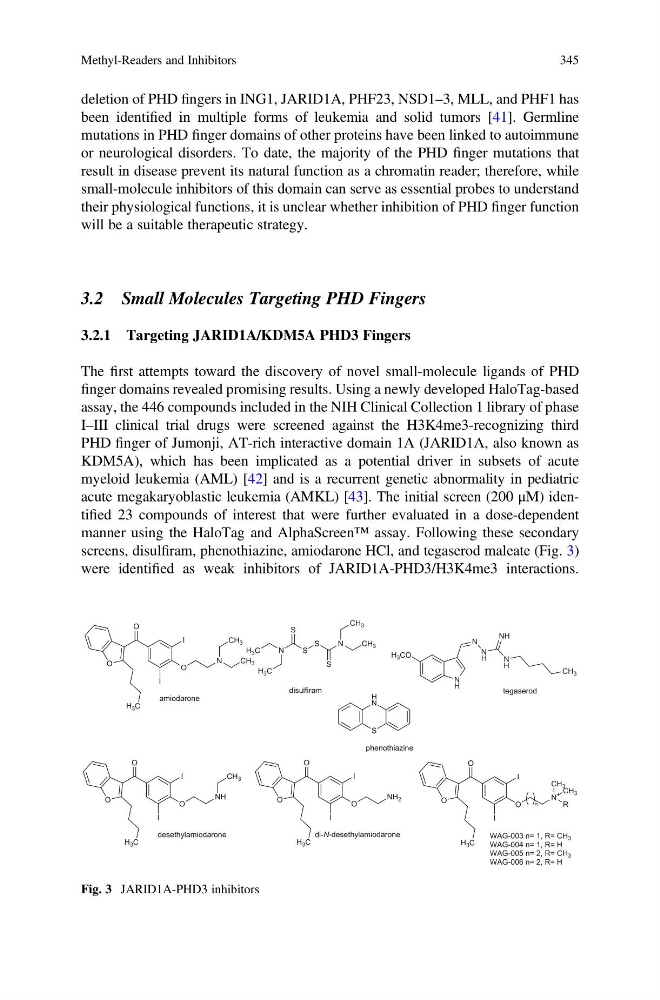
acute megakaryoblastic leukemia (AMKL) [43]. The initial screen (200 μM) identified 23 compounds of interest that were further evaluated in a dose-dependent
manner using the HaloTag and AlphaScreen™ assay. Following these secondary
screens, disulfiram, phenothiazine, amiodarone HCl, and tegaserod maleate (Fig. 3)
were identified as weak inhibitors of JARID1A-PHD3/H3K4me3 interactions.
I
I
O
O
O
H 3 C
N
CH 3
CH 3
amiodarone
I
I
O
O
O
H 3 C
NH
CH 3
I
I
O
O
O
H 3 C
NH 2
S
S
N
S
N
S
CH 3
CH 3
H 3 C
H 3 C
disulfiram
desethylamiodarone
di-N-desethylamiodarone
S
H
N
N
H
H 3 CO
N
N
H
N
H
NH
CH 3
phenothiazine
tegaserod
I
I
O
O
O
H 3 C
N
+
n
R
CH 3
CH 3
WAG-003 n= 1, R= CH 3
WAG-004 n= 1, R= H
WAG-005 n= 2, R= CH 3
WAG-006 n= 2, R= H
Fig. 3 JARID1A-PHD3 inhibitors
Methyl-Readers and Inhibitors
345
been identified in multiple forms of leukemia and solid tumors [41]. Germline
mutations in PHD finger domains of other proteins have been linked to autoimmune
or neurological disorders. To date, the majority of the PHD finger mutations that
result in disease prevent its natural function as a chromatin reader; therefore, while
small-molecule inhibitors of this domain can serve as essential probes to understand
their physiological functions, it is unclear whether inhibition of PHD finger function
will be a suitable therapeutic strategy.
3.2 Small Molecules Targeting PHD Fingers
3.2.1 Targeting JARID1A/KDM5A PHD3 Fingers
The first attempts toward the discovery of novel small-molecule ligands of PHD
finger domains revealed promising results. Using a newly developed HaloTag-based
assay, the 446 compounds included in the NIH Clinical Collection 1 library of phase
I–III clinical trial drugs were screened against the H3K4me3-recognizing third
PHD finger of Jumonji, AT-rich interactive domain 1A (JARID1A, also known as
KDM5A), which has been implicated as a potential driver in subsets of acute
myeloid leukemia (AML) [42] and is a recurrent genetic abnormality in pediatric
acute megakaryoblastic leukemia (AMKL) [43]. The initial screen (200 μM) identified 23 compounds of interest that were further evaluated in a dose-dependent
manner using the HaloTag and AlphaScreen™ assay. Following these secondary
screens, disulfiram, phenothiazine, amiodarone HCl, and tegaserod maleate (Fig. 3)
were identified as weak inhibitors of JARID1A-PHD3/H3K4me3 interactions.
I
I
O
O
O
H 3 C
N
CH 3
CH 3
amiodarone
I
I
O
O
O
H 3 C
NH
CH 3
I
I
O
O
O
H 3 C
NH 2
S
S
N
S
N
S
CH 3
CH 3
H 3 C
H 3 C
disulfiram
desethylamiodarone
di-N-desethylamiodarone
S
H
N
N
H
H 3 CO
N
N
H
N
H
NH
CH 3
phenothiazine
tegaserod
I
I
O
O
O
H 3 C
N
+
n
R
CH 3
CH 3
WAG-003 n= 1, R= CH 3
WAG-004 n= 1, R= H
WAG-005 n= 2, R= CH 3
WAG-006 n= 2, R= H
Fig. 3 JARID1A-PHD3 inhibitors
Methyl-Readers and Inhibitors
345