

to gene transcription [4]. The crosstalk between methylated Lys and Arg and the
resulting control over the dynamic addition and elimination of these PTMs is
critical in governing chromatin structure and in the regulation of gene transcription
[10]. Dysregulation of Lys and Arg methylation has been linked to breast, prostate,
colon, bladder, and lung cancers [11], as well as leukemia, cardiovascular diseases,
HIV, multiple sclerosis, and spinal muscular atrophy [11–13]. However, a comprehensive map of these PTMs and their function has not been established. Therefore,
a deep understanding of the significance of Lys and Arg methylation and their
recognition by reader proteins is of paramount importance to the development of
inhibitors, probes, and therapeutics for diseases.
2 Methyl-Reader Domains and Families
After the discovery, made almost 30 years ago, that SRC homology 2 (SH2) domains
bind to short protein motifs that are tyrosine phosphorylated [14], it became evident
that different modular domains bind distinct types of PTMs [15]. Indeed, even
if little is still known about the effect of lysine and arginine methylation on
chromatin structure itself, a number of readers of these PTMs have been identified
since 2001, when a chromodomain (CD) of HP1 was found to recognize histone
H3K9me3 [16–18].
NH 2
N +
H
H
H
lysine methylation
arginine methylation
HN
O
N +
CH 3
H
H
HN
O
N +
CH 3
H
CH 3
HN
O
N +
CH 3
CH 3
CH 3
HN
O
Kme1
Kme2
Kme3
lysine (K)
H
N
HN
O
arginine (R)
NH 2
+
H
N
HN
O
HN
NH 2
+
CH 3
H
N
HN
O
HN
H +
N
CH 3
H
N
HN
O
N
NH 2
+
CH 3
CH 3
H 3 C
Rme1
Rme2s
Rme2a
KMTs
(lysine methyltransferases)
KDMs
(lysine demethylases)
PRMTs
(protein arginine methyltransferases)
RDMs (JMJD6) ?
(protein arginine demethylases)
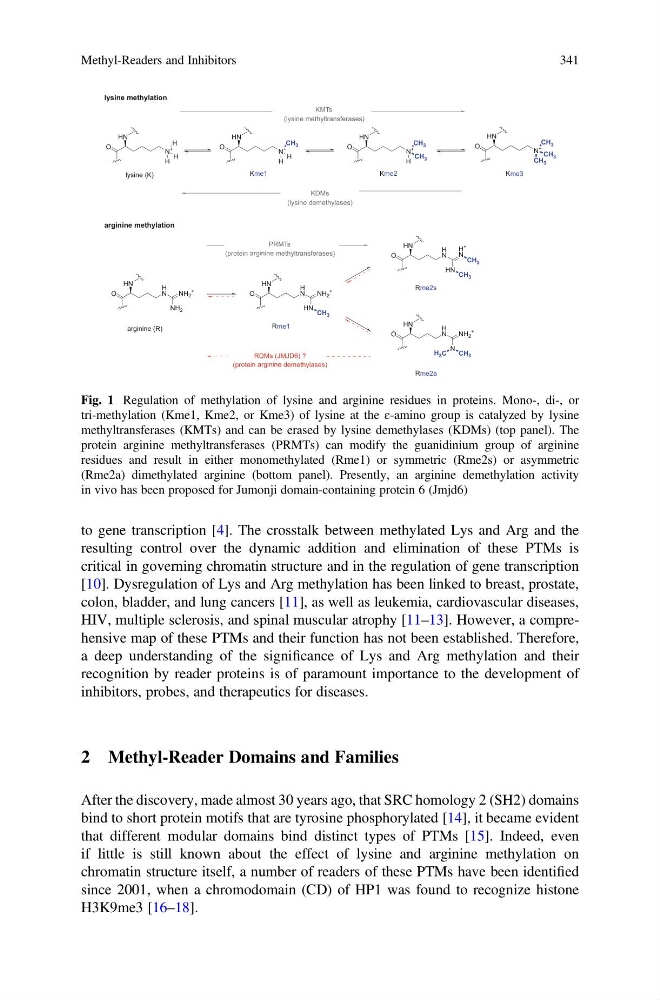
Fig. 1 Regulation of methylation of lysine and arginine residues in proteins. Mono-, di-, or
tri-methylation (Kme1, Kme2, or Kme3) of lysine at the ε-amino group is catalyzed by lysine
methyltransferases (KMTs) and can be erased by lysine demethylases (KDMs) (top panel). The
protein arginine methyltransferases (PRMTs) can modify the guanidinium group of arginine
residues and result in either monomethylated (Rme1) or symmetric (Rme2s) or asymmetric
(Rme2a) dimethylated arginine (bottom panel). Presently, an arginine demethylation activity
in vivo has been proposed for Jumonji domain-containing protein 6 (Jmjd6)
Methyl-Readers and Inhibitors
341
resulting control over the dynamic addition and elimination of these PTMs is
critical in governing chromatin structure and in the regulation of gene transcription
[10]. Dysregulation of Lys and Arg methylation has been linked to breast, prostate,
colon, bladder, and lung cancers [11], as well as leukemia, cardiovascular diseases,
HIV, multiple sclerosis, and spinal muscular atrophy [11–13]. However, a comprehensive map of these PTMs and their function has not been established. Therefore,
a deep understanding of the significance of Lys and Arg methylation and their
recognition by reader proteins is of paramount importance to the development of
inhibitors, probes, and therapeutics for diseases.
2 Methyl-Reader Domains and Families
After the discovery, made almost 30 years ago, that SRC homology 2 (SH2) domains
bind to short protein motifs that are tyrosine phosphorylated [14], it became evident
that different modular domains bind distinct types of PTMs [15]. Indeed, even
if little is still known about the effect of lysine and arginine methylation on
chromatin structure itself, a number of readers of these PTMs have been identified
since 2001, when a chromodomain (CD) of HP1 was found to recognize histone
H3K9me3 [16–18].
NH 2
N +
H
H
H
lysine methylation
arginine methylation
HN
O
N +
CH 3
H
H
HN
O
N +
CH 3
H
CH 3
HN
O
N +
CH 3
CH 3
CH 3
HN
O
Kme1
Kme2
Kme3
lysine (K)
H
N
HN
O
arginine (R)
NH 2
+
H
N
HN
O
HN
NH 2
+
CH 3
H
N
HN
O
HN
H +
N
CH 3
H
N
HN
O
N
NH 2
+
CH 3
CH 3
H 3 C
Rme1
Rme2s
Rme2a
KMTs
(lysine methyltransferases)
KDMs
(lysine demethylases)
PRMTs
(protein arginine methyltransferases)
RDMs (JMJD6) ?
(protein arginine demethylases)
Fig. 1 Regulation of methylation of lysine and arginine residues in proteins. Mono-, di-, or
tri-methylation (Kme1, Kme2, or Kme3) of lysine at the ε-amino group is catalyzed by lysine
methyltransferases (KMTs) and can be erased by lysine demethylases (KDMs) (top panel). The
protein arginine methyltransferases (PRMTs) can modify the guanidinium group of arginine
residues and result in either monomethylated (Rme1) or symmetric (Rme2s) or asymmetric
(Rme2a) dimethylated arginine (bottom panel). Presently, an arginine demethylation activity
in vivo has been proposed for Jumonji domain-containing protein 6 (Jmjd6)
Methyl-Readers and Inhibitors
341