

An alternative computational approach is to use known small-molecule scaffolds
as starting points. An advantage to this is the ability to use known structural biology
to rationally design specific interactions to improve affinity and selectivity. This
is often challenging due to high structure homology between the 61 human
bromodomains. Shadrick et al. used molecular docking of previously reported
bromodomain binding epitopes based on a tetrahydroquinoline scaffold [74]. This
core is synthetically tractable and was used to develop a selective inhibitor for BET
BD2s. They rationally designed analogs to take advantage of the difference in the
position of the structural waters in the ZA channel in BRD2 BD1 vs. BD2 and their
contacts with tetrahydroquinoline analogs. Using this technique, they developed a
modestly selective BET BD2 inhibitor with 7.8-fold selectivity for BD2 of BRD2 as
determined by ITC, though the selectivity was less in both SPR and TR-FRET
assays. This study demonstrates the continued difficulty of engineering domain or
isoform selectivity between bromodomains, despite the wealth of structural biology
studies focused on bromodomains.
Continued increases in access to computational power and advances in theory
have furthered the use of molecular dynamics in designing selectivity. A study by
Aldeghi et al. described a retrospective prediction of the pan-bromodomain inhibitor
bromosporine and the BET BD2-selective compound RVX-208. Affinities for a
subset of bromodomains using absolute binding free energy calculations, based on
molecular dynamics, were calculated. They achieved a good correlation between
experimentally measured and predicted affinities; these predictions may lead to
designed selectivity in the future [77]. Recent advances in virtual screening use
proteochemometric models with small-molecule fingerprints and binding-site
descriptors to develop more selective molecules between the bromodomain families
[78]. Virtual screening poses do not always recapitulate in co-crystal structures;
Allen et al. discovered that molecular dynamics were required to determine accurate
poses for their novel class of BRD4 inhibitors [79].
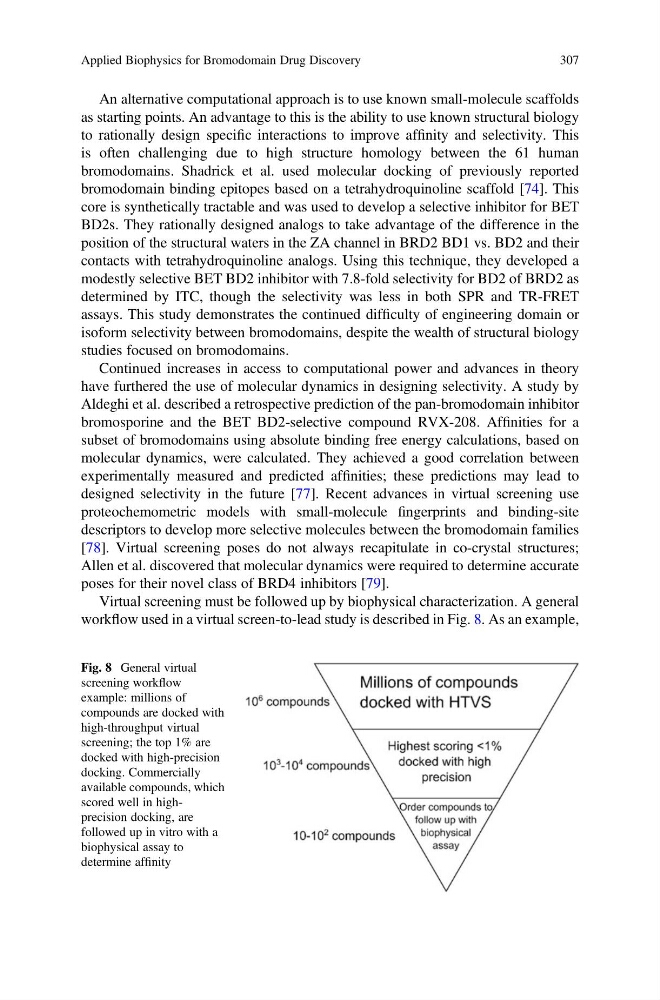
Virtual screening must be followed up by biophysical characterization. A general
workflow used in a virtual screen-to-lead study is described in Fig. 8. As an example,
Fig. 8 General virtual
screening workflow
example: millions of
compounds are docked with
high-throughput virtual
screening; the top 1% are
docked with high-precision
docking. Commercially
available compounds, which
scored well in highprecision docking, are
followed up in vitro with a
biophysical assay to
determine affinity
Applied Biophysics for Bromodomain Drug Discovery
307
as starting points. An advantage to this is the ability to use known structural biology
to rationally design specific interactions to improve affinity and selectivity. This
is often challenging due to high structure homology between the 61 human
bromodomains. Shadrick et al. used molecular docking of previously reported
bromodomain binding epitopes based on a tetrahydroquinoline scaffold [74]. This
core is synthetically tractable and was used to develop a selective inhibitor for BET
BD2s. They rationally designed analogs to take advantage of the difference in the
position of the structural waters in the ZA channel in BRD2 BD1 vs. BD2 and their
contacts with tetrahydroquinoline analogs. Using this technique, they developed a
modestly selective BET BD2 inhibitor with 7.8-fold selectivity for BD2 of BRD2 as
determined by ITC, though the selectivity was less in both SPR and TR-FRET
assays. This study demonstrates the continued difficulty of engineering domain or
isoform selectivity between bromodomains, despite the wealth of structural biology
studies focused on bromodomains.
Continued increases in access to computational power and advances in theory
have furthered the use of molecular dynamics in designing selectivity. A study by
Aldeghi et al. described a retrospective prediction of the pan-bromodomain inhibitor
bromosporine and the BET BD2-selective compound RVX-208. Affinities for a
subset of bromodomains using absolute binding free energy calculations, based on
molecular dynamics, were calculated. They achieved a good correlation between
experimentally measured and predicted affinities; these predictions may lead to
designed selectivity in the future [77]. Recent advances in virtual screening use
proteochemometric models with small-molecule fingerprints and binding-site
descriptors to develop more selective molecules between the bromodomain families
[78]. Virtual screening poses do not always recapitulate in co-crystal structures;
Allen et al. discovered that molecular dynamics were required to determine accurate
poses for their novel class of BRD4 inhibitors [79].
Virtual screening must be followed up by biophysical characterization. A general
workflow used in a virtual screen-to-lead study is described in Fig. 8. As an example,
Fig. 8 General virtual
screening workflow
example: millions of
compounds are docked with
high-throughput virtual
screening; the top 1% are
docked with high-precision
docking. Commercially
available compounds, which
scored well in highprecision docking, are
followed up in vitro with a
biophysical assay to
determine affinity
Applied Biophysics for Bromodomain Drug Discovery
307