

micromolar concentrations. A second compound, a tetrahydroquinoline, MS2126,
was also shown to display lower levels of activity. The tetrahydroquinoline motif has
since been shown to be an effective scaffold against additional bromodomains.
By 2011, Zhou and co-workers would develop improved inhibitors based on
cell-permeable peptide macrocycles derived from p53 [51] and a small molecule
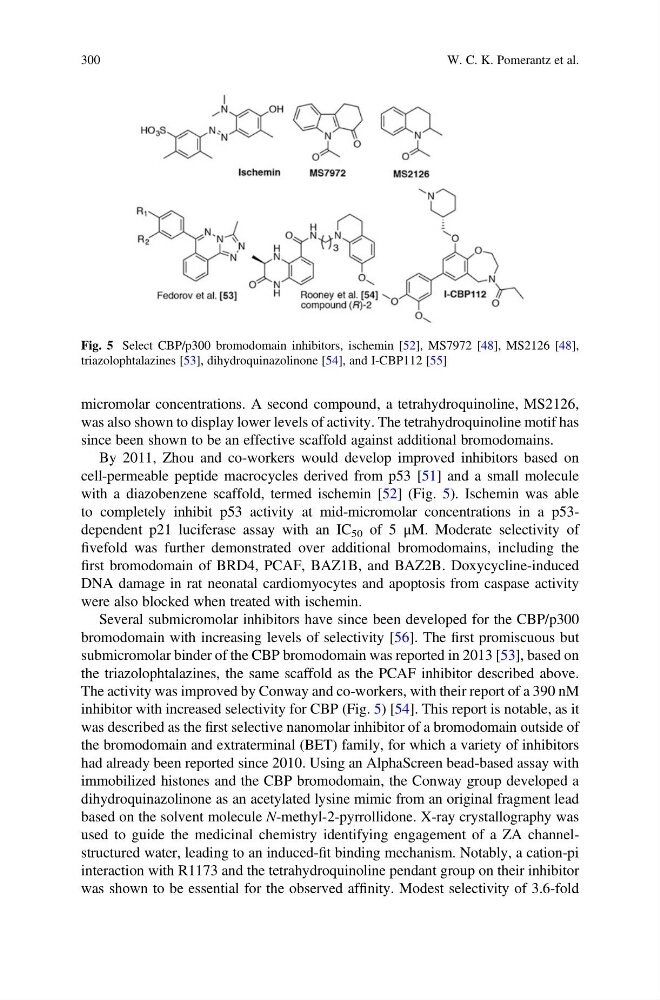
with a diazobenzene scaffold, termed ischemin [52] (Fig. 5). Ischemin was able
to completely inhibit p53 activity at mid-micromolar concentrations in a p53dependent p21 luciferase assay with an IC 50 of 5 μM. Moderate selectivity of
fivefold was further demonstrated over additional bromodomains, including the
first bromodomain of BRD4, PCAF, BAZ1B, and BAZ2B. Doxycycline-induced
DNA damage in rat neonatal cardiomyocytes and apoptosis from caspase activity
were also blocked when treated with ischemin.
Several submicromolar inhibitors have since been developed for the CBP/p300
bromodomain with increasing levels of selectivity [56]. The first promiscuous but
submicromolar binder of the CBP bromodomain was reported in 2013 [53], based on
the triazolophtalazines, the same scaffold as the PCAF inhibitor described above.
The activity was improved by Conway and co-workers, with their report of a 390 nM
inhibitor with increased selectivity for CBP (Fig. 5) [54]. This report is notable, as it
was described as the first selective nanomolar inhibitor of a bromodomain outside of
the bromodomain and extraterminal (BET) family, for which a variety of inhibitors
had already been reported since 2010. Using an AlphaScreen bead-based assay with
immobilized histones and the CBP bromodomain, the Conway group developed a
dihydroquinazolinone as an acetylated lysine mimic from an original fragment lead
based on the solvent molecule N-methyl-2-pyrrollidone. X-ray crystallography was
used to guide the medicinal chemistry identifying engagement of a ZA channelstructured water, leading to an induced-fit binding mechanism. Notably, a cation-pi
interaction with R1173 and the tetrahydroquinoline pendant group on their inhibitor
was shown to be essential for the observed affinity. Modest selectivity of 3.6-fold
Fig. 5 Select CBP/p300 bromodomain inhibitors, ischemin [52], MS7972 [48], MS2126 [48],
triazolophtalazines [53], dihydroquinazolinone [54], and I-CBP112 [55]
300
W. C. K. Pomerantz et al.
was also shown to display lower levels of activity. The tetrahydroquinoline motif has
since been shown to be an effective scaffold against additional bromodomains.
By 2011, Zhou and co-workers would develop improved inhibitors based on
cell-permeable peptide macrocycles derived from p53 [51] and a small molecule
with a diazobenzene scaffold, termed ischemin [52] (Fig. 5). Ischemin was able
to completely inhibit p53 activity at mid-micromolar concentrations in a p53dependent p21 luciferase assay with an IC 50 of 5 μM. Moderate selectivity of
fivefold was further demonstrated over additional bromodomains, including the
first bromodomain of BRD4, PCAF, BAZ1B, and BAZ2B. Doxycycline-induced
DNA damage in rat neonatal cardiomyocytes and apoptosis from caspase activity
were also blocked when treated with ischemin.
Several submicromolar inhibitors have since been developed for the CBP/p300
bromodomain with increasing levels of selectivity [56]. The first promiscuous but
submicromolar binder of the CBP bromodomain was reported in 2013 [53], based on
the triazolophtalazines, the same scaffold as the PCAF inhibitor described above.
The activity was improved by Conway and co-workers, with their report of a 390 nM
inhibitor with increased selectivity for CBP (Fig. 5) [54]. This report is notable, as it
was described as the first selective nanomolar inhibitor of a bromodomain outside of
the bromodomain and extraterminal (BET) family, for which a variety of inhibitors
had already been reported since 2010. Using an AlphaScreen bead-based assay with
immobilized histones and the CBP bromodomain, the Conway group developed a
dihydroquinazolinone as an acetylated lysine mimic from an original fragment lead
based on the solvent molecule N-methyl-2-pyrrollidone. X-ray crystallography was
used to guide the medicinal chemistry identifying engagement of a ZA channelstructured water, leading to an induced-fit binding mechanism. Notably, a cation-pi
interaction with R1173 and the tetrahydroquinoline pendant group on their inhibitor
was shown to be essential for the observed affinity. Modest selectivity of 3.6-fold
Fig. 5 Select CBP/p300 bromodomain inhibitors, ischemin [52], MS7972 [48], MS2126 [48],
triazolophtalazines [53], dihydroquinazolinone [54], and I-CBP112 [55]
300
W. C. K. Pomerantz et al.