

biological context. The readers are referred to [154] for an overview of sequencing
techniques available for mapping oxidised 5mC on the genome and [155, 156] for
reviews on some approaches to studying the enzyme activities of TETs. In this section,
we highlight key methodologies used for kinetic analysis of TETs in vitro and recent
TET assays developed for inhibitor discovery.
5.1 Kinetic Analysis of Human TETs
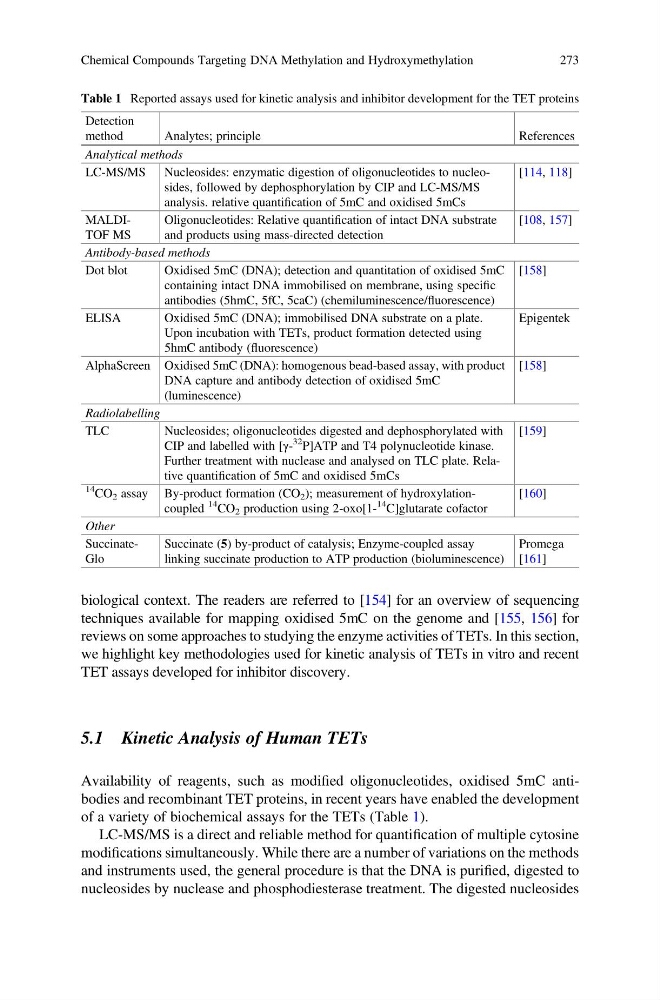
Availability of reagents, such as modified oligonucleotides, oxidised 5mC antibodies and recombinant TET proteins, in recent years have enabled the development
of a variety of biochemical assays for the TETs (Table 1).
LC-MS/MS is a direct and reliable method for quantification of multiple cytosine
modifications simultaneously. While there are a number of variations on the methods
and instruments used, the general procedure is that the DNA is purified, digested to
nucleosides by nuclease and phosphodiesterase treatment. The digested nucleosides
Table 1 Reported assays used for kinetic analysis and inhibitor development for the TET proteins
Detection
method
Analytes; principle
References
Analytical methods
LC-MS/MS Nucleosides: enzymatic digestion of oligonucleotides to nucleosides, followed by dephosphorylation by CIP and LC-MS/MS
analysis. relative quantification of 5mC and oxidised 5mCs
[114, 118]
MALDITOF MS
Oligonucleotides: Relative quantification of intact DNA substrate
and products using mass-directed detection
[108, 157]
Antibody-based methods
Dot blot
Oxidised 5mC (DNA); detection and quantitation of oxidised 5mC
containing intact DNA immobilised on membrane, using specific
antibodies (5hmC, 5fC, 5caC) (chemiluminescence/fluorescence)
[158]
ELISA
Oxidised 5mC (DNA); immobilised DNA substrate on a plate.
Upon incubation with TETs, product formation detected using
5hmC antibody (fluorescence)
Epigentek
AlphaScreen Oxidised 5mC (DNA): homogenous bead-based assay, with product
DNA capture and antibody detection of oxidised 5mC
(luminescence)
[158]
Radiolabelling
TLC
Nucleosides; oligonucleotides digested and dephosphorylated with
CIP and labelled with [γ32
P]ATP and T4 polynucleotide kinase.
Further treatment with nuclease and analysed on TLC plate. Relative quantification of 5mC and oxidised 5mCs
[159]
14
CO 2 assay By-product formation (CO 2 ); measurement of hydroxylationcoupled
14
CO 2 production using 2-oxo[114
C]glutarate cofactor
[160]
Other
SuccinateGlo
Succinate (5) by-product of catalysis; Enzyme-coupled assay
linking succinate production to ATP production (bioluminescence)
Promega
[161]
Chemical Compounds Targeting DNA Methylation and Hydroxymethylation
273
techniques available for mapping oxidised 5mC on the genome and [155, 156] for
reviews on some approaches to studying the enzyme activities of TETs. In this section,
we highlight key methodologies used for kinetic analysis of TETs in vitro and recent
TET assays developed for inhibitor discovery.
5.1 Kinetic Analysis of Human TETs
Availability of reagents, such as modified oligonucleotides, oxidised 5mC antibodies and recombinant TET proteins, in recent years have enabled the development
of a variety of biochemical assays for the TETs (Table 1).
LC-MS/MS is a direct and reliable method for quantification of multiple cytosine
modifications simultaneously. While there are a number of variations on the methods
and instruments used, the general procedure is that the DNA is purified, digested to
nucleosides by nuclease and phosphodiesterase treatment. The digested nucleosides
Table 1 Reported assays used for kinetic analysis and inhibitor development for the TET proteins
Detection
method
Analytes; principle
References
Analytical methods
LC-MS/MS Nucleosides: enzymatic digestion of oligonucleotides to nucleosides, followed by dephosphorylation by CIP and LC-MS/MS
analysis. relative quantification of 5mC and oxidised 5mCs
[114, 118]
MALDITOF MS
Oligonucleotides: Relative quantification of intact DNA substrate
and products using mass-directed detection
[108, 157]
Antibody-based methods
Dot blot
Oxidised 5mC (DNA); detection and quantitation of oxidised 5mC
containing intact DNA immobilised on membrane, using specific
antibodies (5hmC, 5fC, 5caC) (chemiluminescence/fluorescence)
[158]
ELISA
Oxidised 5mC (DNA); immobilised DNA substrate on a plate.
Upon incubation with TETs, product formation detected using
5hmC antibody (fluorescence)
Epigentek
AlphaScreen Oxidised 5mC (DNA): homogenous bead-based assay, with product
DNA capture and antibody detection of oxidised 5mC
(luminescence)
[158]
Radiolabelling
TLC
Nucleosides; oligonucleotides digested and dephosphorylated with
CIP and labelled with [γ32
P]ATP and T4 polynucleotide kinase.
Further treatment with nuclease and analysed on TLC plate. Relative quantification of 5mC and oxidised 5mCs
[159]
14
CO 2 assay By-product formation (CO 2 ); measurement of hydroxylationcoupled
14
CO 2 production using 2-oxo[114
C]glutarate cofactor
[160]
Other
SuccinateGlo
Succinate (5) by-product of catalysis; Enzyme-coupled assay
linking succinate production to ATP production (bioluminescence)
Promega
[161]
Chemical Compounds Targeting DNA Methylation and Hydroxymethylation
273