

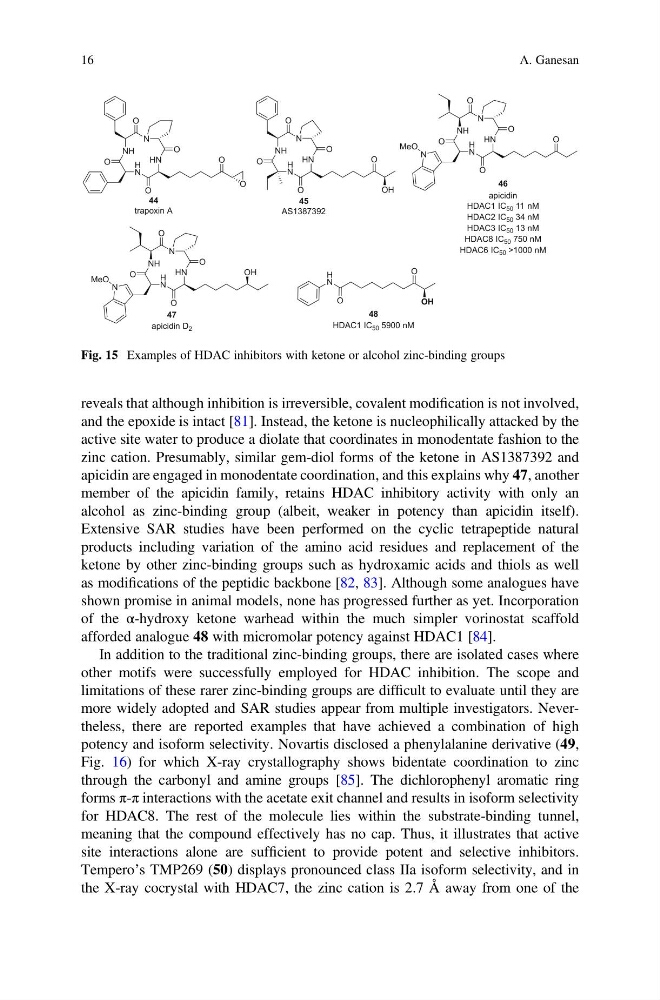
reveals that although inhibition is irreversible, covalent modification is not involved,
and the epoxide is intact [81]. Instead, the ketone is nucleophilically attacked by the
active site water to produce a diolate that coordinates in monodentate fashion to the
zinc cation. Presumably, similar gem-diol forms of the ketone in AS1387392 and
apicidin are engaged in monodentate coordination, and this explains why 47, another
member of the apicidin family, retains HDAC inhibitory activity with only an
alcohol as zinc-binding group (albeit, weaker in potency than apicidin itself).
Extensive SAR studies have been performed on the cyclic tetrapeptide natural
products including variation of the amino acid residues and replacement of the
ketone by other zinc-binding groups such as hydroxamic acids and thiols as well
as modifications of the peptidic backbone [82, 83]. Although some analogues have
shown promise in animal models, none has progressed further as yet. Incorporation
of the α-hydroxy ketone warhead within the much simpler vorinostat scaffold
afforded analogue 48 with micromolar potency against HDAC1 [84].
In addition to the traditional zinc-binding groups, there are isolated cases where
other motifs were successfully employed for HDAC inhibition. The scope and
limitations of these rarer zinc-binding groups are difficult to evaluate until they are
more widely adopted and SAR studies appear from multiple investigators. Nevertheless, there are reported examples that have achieved a combination of high
potency and isoform selectivity. Novartis disclosed a phenylalanine derivative (49,
Fig. 16) for which X-ray crystallography shows bidentate coordination to zinc
through the carbonyl and amine groups [85]. The dichlorophenyl aromatic ring
forms π-π interactions with the acetate exit channel and results in isoform selectivity
for HDAC8. The rest of the molecule lies within the substrate-binding tunnel,
meaning that the compound effectively has no cap. Thus, it illustrates that active
site interactions alone are sufficient to provide potent and selective inhibitors.
Tempero’s TMP269 (50) displays pronounced class IIa isoform selectivity, and in
the X-ray cocrystal with HDAC7, the zinc cation is 2.7 Å away from one of the
N
NH
H
N
HN
O
O
O
O
O
O
44
trapoxin A
N
NH
H
N
HN
O
O
O
O
N
MeO
O
N
NH
H
N
HN
O
O
O
O
O
OH
45
AS1387392
46
apicidin
HDAC1 IC 50 11 nM
HDAC2 IC 50 34 nM
HDAC3 IC 50 13 nM
HDAC8 IC 50 750 nM
HDAC6 IC 50 >1000 nM
N
NH
H
N
HN
O
O
O
O
N
MeO
OH
47
apicidin D 2
H
N
O
O
OH
48
HDAC1 IC 50 5900 nM
Fig. 15 Examples of HDAC inhibitors with ketone or alcohol zinc-binding groups
16
A. Ganesan
and the epoxide is intact [81]. Instead, the ketone is nucleophilically attacked by the
active site water to produce a diolate that coordinates in monodentate fashion to the
zinc cation. Presumably, similar gem-diol forms of the ketone in AS1387392 and
apicidin are engaged in monodentate coordination, and this explains why 47, another
member of the apicidin family, retains HDAC inhibitory activity with only an
alcohol as zinc-binding group (albeit, weaker in potency than apicidin itself).
Extensive SAR studies have been performed on the cyclic tetrapeptide natural
products including variation of the amino acid residues and replacement of the
ketone by other zinc-binding groups such as hydroxamic acids and thiols as well
as modifications of the peptidic backbone [82, 83]. Although some analogues have
shown promise in animal models, none has progressed further as yet. Incorporation
of the α-hydroxy ketone warhead within the much simpler vorinostat scaffold
afforded analogue 48 with micromolar potency against HDAC1 [84].
In addition to the traditional zinc-binding groups, there are isolated cases where
other motifs were successfully employed for HDAC inhibition. The scope and
limitations of these rarer zinc-binding groups are difficult to evaluate until they are
more widely adopted and SAR studies appear from multiple investigators. Nevertheless, there are reported examples that have achieved a combination of high
potency and isoform selectivity. Novartis disclosed a phenylalanine derivative (49,
Fig. 16) for which X-ray crystallography shows bidentate coordination to zinc
through the carbonyl and amine groups [85]. The dichlorophenyl aromatic ring
forms π-π interactions with the acetate exit channel and results in isoform selectivity
for HDAC8. The rest of the molecule lies within the substrate-binding tunnel,
meaning that the compound effectively has no cap. Thus, it illustrates that active
site interactions alone are sufficient to provide potent and selective inhibitors.
Tempero’s TMP269 (50) displays pronounced class IIa isoform selectivity, and in
the X-ray cocrystal with HDAC7, the zinc cation is 2.7 Å away from one of the
N
NH
H
N
HN
O
O
O
O
O
O
44
trapoxin A
N
NH
H
N
HN
O
O
O
O
N
MeO
O
N
NH
H
N
HN
O
O
O
O
O
OH
45
AS1387392
46
apicidin
HDAC1 IC 50 11 nM
HDAC2 IC 50 34 nM
HDAC3 IC 50 13 nM
HDAC8 IC 50 750 nM
HDAC6 IC 50 >1000 nM
N
NH
H
N
HN
O
O
O
O
N
MeO
OH
47
apicidin D 2
H
N
O
O
OH
48
HDAC1 IC 50 5900 nM
Fig. 15 Examples of HDAC inhibitors with ketone or alcohol zinc-binding groups
16
A. Ganesan