

was excised [70]. These compounds no longer obey the classical three-point HDAC
pharmacophore, and while 34 was inactive at the tested concentrations, 33 inhibits
HDACs at a micromolar level. Although this represents a substantial drop in activity
relative to the approved drug romidepsin, the analogue avoids the pharmacokinetic
liabilities associated with zinc-binding groups and might be amenable to further
optimization to produce potent compounds. An alternative approach to increasing
potency with synthetic thiols is the introduction of a second functional group to
enable bidentate coordination. The α-mercaptoketone vorinostat analogue 35, for
example, was more active in HDAC inhibition compared to vorinostat [71].
In addition to hydroxamic acids and thiols, the other zinc-binding group that has
led to an approved HDAC inhibitor is the benzamide or ortho-anilinoamide. X-ray
studies indicate coordination of the amine to the zinc cation, as well as weak binding
to the carbonyl oxygen. Thus, the benzamides, like the hydroxamic acids, are
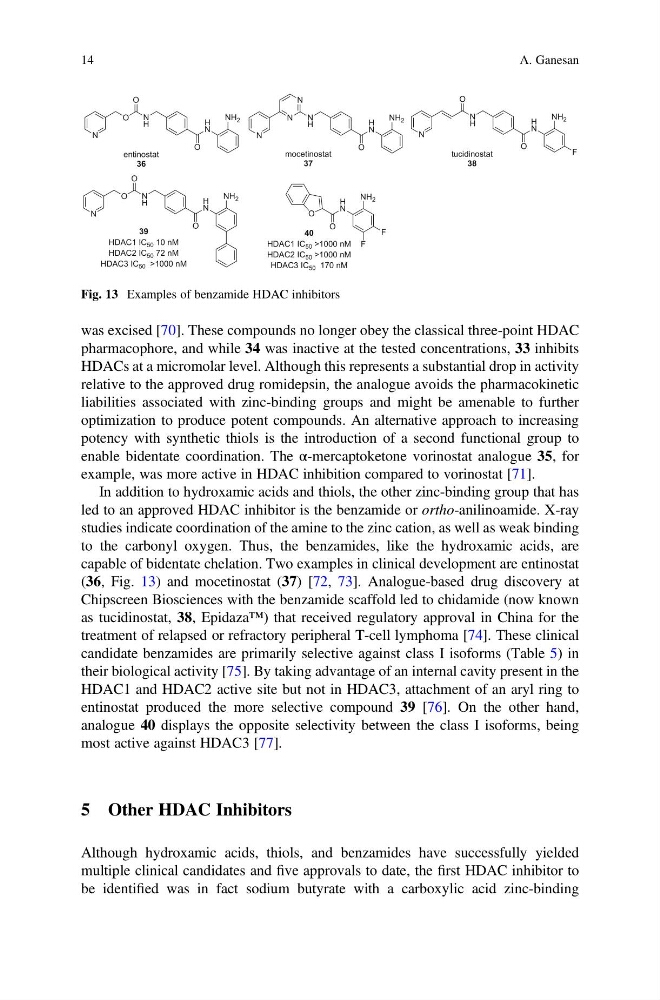
capable of bidentate chelation. Two examples in clinical development are entinostat
(36, Fig. 13) and mocetinostat (37) [72, 73]. Analogue-based drug discovery at
Chipscreen Biosciences with the benzamide scaffold led to chidamide (now known
as tucidinostat, 38, Epidaza™) that received regulatory approval in China for the
treatment of relapsed or refractory peripheral T-cell lymphoma [74]. These clinical
candidate benzamides are primarily selective against class I isoforms (Table 5) in
their biological activity [75]. By taking advantage of an internal cavity present in the
HDAC1 and HDAC2 active site but not in HDAC3, attachment of an aryl ring to
entinostat produced the more selective compound 39 [76]. On the other hand,
analogue 40 displays the opposite selectivity between the class I isoforms, being
most active against HDAC3 [77].
5 Other HDAC Inhibitors
Although hydroxamic acids, thiols, and benzamides have successfully yielded
multiple clinical candidates and five approvals to date, the first HDAC inhibitor to
be identified was in fact sodium butyrate with a carboxylic acid zinc-binding
NH 2
H
N
O
N
H
O
O
N
entinostat
36
NH 2
H
N
O
N
H
N
N
N
mocetinostat
37
NH 2
H
N
O
N
H
O
N
F
tucidinostat
38
NH 2
H
N
O
N
H
O
O
N
39
HDAC1 IC 50 10 nM
HDAC2 IC 50 72 nM
HDAC3 IC 50 >1000 nM
NH 2
H
N
O
O
F
F
40
HDAC1 IC 50 >1000 nM
HDAC2 IC 50 >1000 nM
HDAC3 IC 50 170 nM
Fig. 13 Examples of benzamide HDAC inhibitors
14
A. Ganesan
pharmacophore, and while 34 was inactive at the tested concentrations, 33 inhibits
HDACs at a micromolar level. Although this represents a substantial drop in activity
relative to the approved drug romidepsin, the analogue avoids the pharmacokinetic
liabilities associated with zinc-binding groups and might be amenable to further
optimization to produce potent compounds. An alternative approach to increasing
potency with synthetic thiols is the introduction of a second functional group to
enable bidentate coordination. The α-mercaptoketone vorinostat analogue 35, for
example, was more active in HDAC inhibition compared to vorinostat [71].
In addition to hydroxamic acids and thiols, the other zinc-binding group that has
led to an approved HDAC inhibitor is the benzamide or ortho-anilinoamide. X-ray
studies indicate coordination of the amine to the zinc cation, as well as weak binding
to the carbonyl oxygen. Thus, the benzamides, like the hydroxamic acids, are
capable of bidentate chelation. Two examples in clinical development are entinostat
(36, Fig. 13) and mocetinostat (37) [72, 73]. Analogue-based drug discovery at
Chipscreen Biosciences with the benzamide scaffold led to chidamide (now known
as tucidinostat, 38, Epidaza™) that received regulatory approval in China for the
treatment of relapsed or refractory peripheral T-cell lymphoma [74]. These clinical
candidate benzamides are primarily selective against class I isoforms (Table 5) in
their biological activity [75]. By taking advantage of an internal cavity present in the
HDAC1 and HDAC2 active site but not in HDAC3, attachment of an aryl ring to
entinostat produced the more selective compound 39 [76]. On the other hand,
analogue 40 displays the opposite selectivity between the class I isoforms, being
most active against HDAC3 [77].
5 Other HDAC Inhibitors
Although hydroxamic acids, thiols, and benzamides have successfully yielded
multiple clinical candidates and five approvals to date, the first HDAC inhibitor to
be identified was in fact sodium butyrate with a carboxylic acid zinc-binding
NH 2
H
N
O
N
H
O
O
N
entinostat
36
NH 2
H
N
O
N
H
N
N
N
mocetinostat
37
NH 2
H
N
O
N
H
O
N
F
tucidinostat
38
NH 2
H
N
O
N
H
O
O
N
39
HDAC1 IC 50 10 nM
HDAC2 IC 50 72 nM
HDAC3 IC 50 >1000 nM
NH 2
H
N
O
O
F
F
40
HDAC1 IC 50 >1000 nM
HDAC2 IC 50 >1000 nM
HDAC3 IC 50 170 nM
Fig. 13 Examples of benzamide HDAC inhibitors
14
A. Ganesan