

4 Thiol and Benzamide HDAC Inhibitors
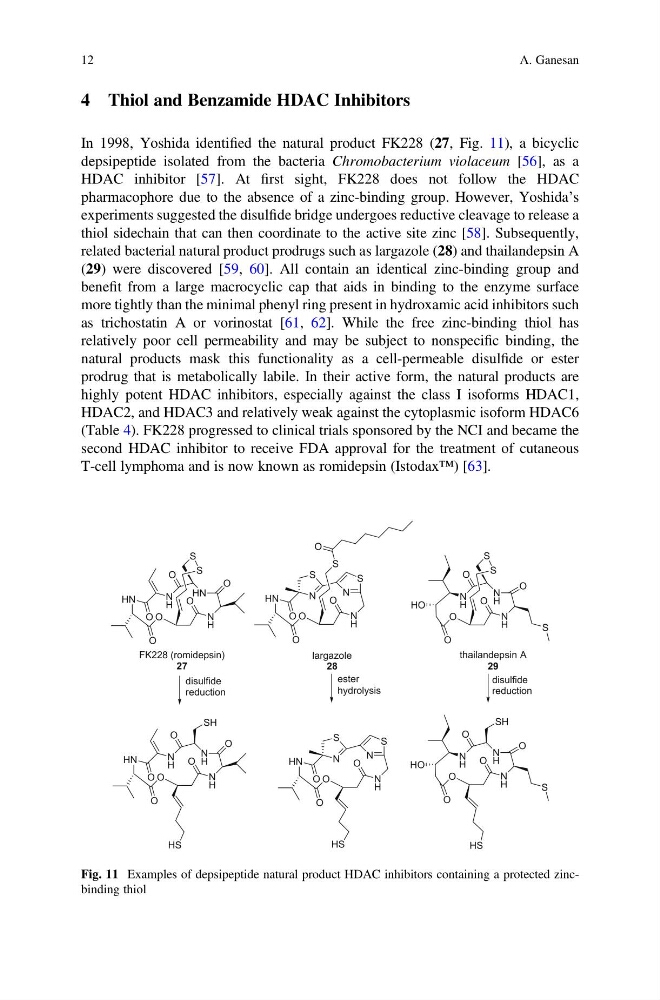
In 1998, Yoshida identified the natural product FK228 (27, Fig. 11), a bicyclic
depsipeptide isolated from the bacteria Chromobacterium violaceum [56], as a
HDAC inhibitor [57]. At first sight, FK228 does not follow the HDAC
pharmacophore due to the absence of a zinc-binding group. However, Yoshida’s
experiments suggested the disulfide bridge undergoes reductive cleavage to release a
thiol sidechain that can then coordinate to the active site zinc [58]. Subsequently,
related bacterial natural product prodrugs such as largazole (28) and thailandepsin A
(29) were discovered [59, 60]. All contain an identical zinc-binding group and
benefit from a large macrocyclic cap that aids in binding to the enzyme surface
more tightly than the minimal phenyl ring present in hydroxamic acid inhibitors such
as trichostatin A or vorinostat [61, 62]. While the free zinc-binding thiol has
relatively poor cell permeability and may be subject to nonspecific binding, the
natural products mask this functionality as a cell-permeable disulfide or ester
prodrug that is metabolically labile. In their active form, the natural products are
highly potent HDAC inhibitors, especially against the class I isoforms HDAC1,
HDAC2, and HDAC3 and relatively weak against the cytoplasmic isoform HDAC6
(Table 4). FK228 progressed to clinical trials sponsored by the NCI and became the
second HDAC inhibitor to receive FDA approval for the treatment of cutaneous
T-cell lymphoma and is now known as romidepsin (Istodax™) [63].
O
O
O
N
H
O
HN
N
H
O
HN
O
S
S
disulfide
reduction
O
O
O
N
H
O
N
H
N
H
O
HN
O
HS
FK228 (romidepsin)
27
O
O
O
N
H
N
N
O
HN
S
S
S
O
largazole
28
O
O
O
N
H
N
H
N
H
O
S
S
HO
O
S
thailandepsin A
29
ester
hydrolysis
disulfide
reduction
O
O
O
N
H
N
N
O
HN
S
S
HS
O
O
O
N
H
N
H
N
H
O
HO
O
S
HS
SH
SH
Fig. 11 Examples of depsipeptide natural product HDAC inhibitors containing a protected zincbinding thiol
12
A. Ganesan
In 1998, Yoshida identified the natural product FK228 (27, Fig. 11), a bicyclic
depsipeptide isolated from the bacteria Chromobacterium violaceum [56], as a
HDAC inhibitor [57]. At first sight, FK228 does not follow the HDAC
pharmacophore due to the absence of a zinc-binding group. However, Yoshida’s
experiments suggested the disulfide bridge undergoes reductive cleavage to release a
thiol sidechain that can then coordinate to the active site zinc [58]. Subsequently,
related bacterial natural product prodrugs such as largazole (28) and thailandepsin A
(29) were discovered [59, 60]. All contain an identical zinc-binding group and
benefit from a large macrocyclic cap that aids in binding to the enzyme surface
more tightly than the minimal phenyl ring present in hydroxamic acid inhibitors such
as trichostatin A or vorinostat [61, 62]. While the free zinc-binding thiol has
relatively poor cell permeability and may be subject to nonspecific binding, the
natural products mask this functionality as a cell-permeable disulfide or ester
prodrug that is metabolically labile. In their active form, the natural products are
highly potent HDAC inhibitors, especially against the class I isoforms HDAC1,
HDAC2, and HDAC3 and relatively weak against the cytoplasmic isoform HDAC6
(Table 4). FK228 progressed to clinical trials sponsored by the NCI and became the
second HDAC inhibitor to receive FDA approval for the treatment of cutaneous
T-cell lymphoma and is now known as romidepsin (Istodax™) [63].
O
O
O
N
H
O
HN
N
H
O
HN
O
S
S
disulfide
reduction
O
O
O
N
H
O
N
H
N
H
O
HN
O
HS
FK228 (romidepsin)
27
O
O
O
N
H
N
N
O
HN
S
S
S
O
largazole
28
O
O
O
N
H
N
H
N
H
O
S
S
HO
O
S
thailandepsin A
29
ester
hydrolysis
disulfide
reduction
O
O
O
N
H
N
N
O
HN
S
S
HS
O
O
O
N
H
N
H
N
H
O
HO
O
S
HS
SH
SH
Fig. 11 Examples of depsipeptide natural product HDAC inhibitors containing a protected zincbinding thiol
12
A. Ganesan