

The chemotherapy of cancer, including targeted therapy using anticancer drugs,
usually provides a certain level of beneficial therapeutic effect while simultaneously
causing serious adverse effects on account of the cytotoxicity of the employed drugs
toward normal cells. In order to reduce the adverse effects of anticancer drugs,
several drug delivery systems (DDSs) for anticancer drugs have been developed.
One example is antibody-drug conjugates (ADCs) that show both potent and
selective cytotoxicity toward cancer cells that express a specific antigen. Some of
these ADCs, such as brentuximab vedotin and trastuzumab emtansine, are currently
used in clinical practice. However, because of their macromolecular structure, ADCs
have several limitations, including poor tissue penetration, immunogenicity, low
bioavailability, and high cost. To overcome the problems of macromolecule-based
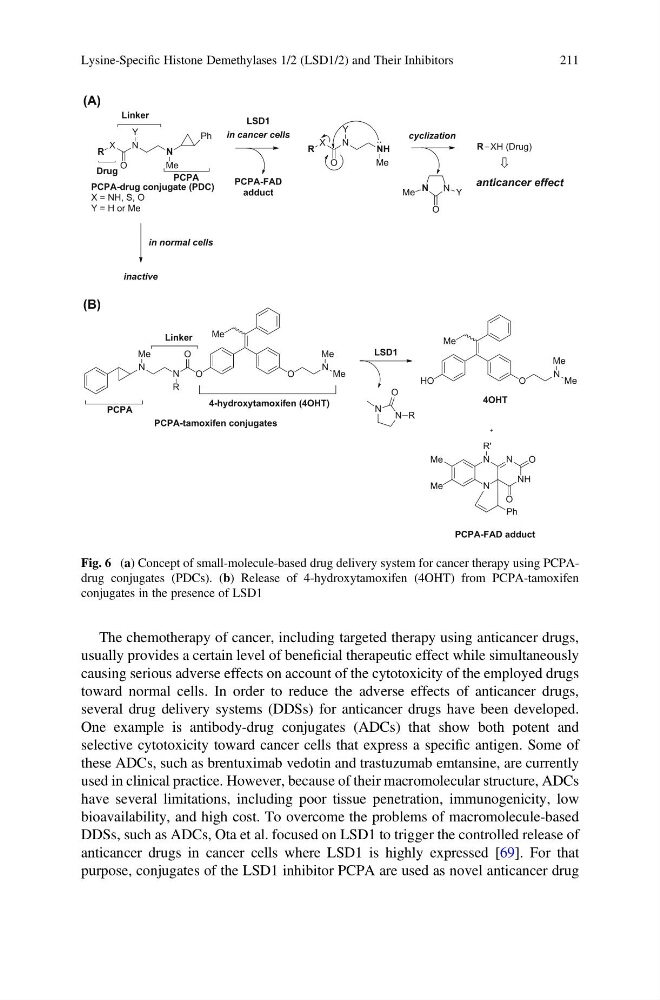
DDSs, such as ADCs, Ota et al. focused on LSD1 to trigger the controlled release of
anticancer drugs in cancer cells where LSD1 is highly expressed [69]. For that
purpose, conjugates of the LSD1 inhibitor PCPA are used as novel anticancer drug
N
Ph
N
Me
O
X
R
NH
N
Me
O
X
R
LSD1
N
N
Me
O
PCPA
Linker
PCPA-drug conjugate (PDC)
X = NH, S, O
Y = H or Me
anticancer effect
in cancer cells
R XH (Drug)
cyclization
Y
Y
Y
inactive
in normal cells
Drug
PCPA-FAD
adduct
(A)
O
O
Me
N Me
Me
N
O
N
Me
R
PCPA-tamoxifen conjugates
PCPA
4-hydroxytamoxifen (4OHT)
Linker
HO
O
Me
N Me
Me
LSD1
PCPA-FAD adduct
N N
O
R
4OHT
N
N
NH
N
R'
Me
Me
O
O
Ph
(B)
Fig. 6 (a) Concept of small-molecule-based drug delivery system for cancer therapy using PCPAdrug conjugates (PDCs). (b) Release of 4-hydroxytamoxifen (4OHT) from PCPA-tamoxifen
conjugates in the presence of LSD1
Lysine-Specific Histone Demethylases 1/2 (LSD1/2) and Their Inhibitors
211
usually provides a certain level of beneficial therapeutic effect while simultaneously
causing serious adverse effects on account of the cytotoxicity of the employed drugs
toward normal cells. In order to reduce the adverse effects of anticancer drugs,
several drug delivery systems (DDSs) for anticancer drugs have been developed.
One example is antibody-drug conjugates (ADCs) that show both potent and
selective cytotoxicity toward cancer cells that express a specific antigen. Some of
these ADCs, such as brentuximab vedotin and trastuzumab emtansine, are currently
used in clinical practice. However, because of their macromolecular structure, ADCs
have several limitations, including poor tissue penetration, immunogenicity, low
bioavailability, and high cost. To overcome the problems of macromolecule-based
DDSs, such as ADCs, Ota et al. focused on LSD1 to trigger the controlled release of
anticancer drugs in cancer cells where LSD1 is highly expressed [69]. For that
purpose, conjugates of the LSD1 inhibitor PCPA are used as novel anticancer drug
N
Ph
N
Me
O
X
R
NH
N
Me
O
X
R
LSD1
N
N
Me
O
PCPA
Linker
PCPA-drug conjugate (PDC)
X = NH, S, O
Y = H or Me
anticancer effect
in cancer cells
R XH (Drug)
cyclization
Y
Y
Y
inactive
in normal cells
Drug
PCPA-FAD
adduct
(A)
O
O
Me
N Me
Me
N
O
N
Me
R
PCPA-tamoxifen conjugates
PCPA
4-hydroxytamoxifen (4OHT)
Linker
HO
O
Me
N Me
Me
LSD1
PCPA-FAD adduct
N N
O
R
4OHT
N
N
NH
N
R'
Me
Me
O
O
Ph
(B)
Fig. 6 (a) Concept of small-molecule-based drug delivery system for cancer therapy using PCPAdrug conjugates (PDCs). (b) Release of 4-hydroxytamoxifen (4OHT) from PCPA-tamoxifen
conjugates in the presence of LSD1
Lysine-Specific Histone Demethylases 1/2 (LSD1/2) and Their Inhibitors
211