

Histone lysine methylation is reversibly controlled by two kinds of enzymes,
lysine methyltransferases (KMTs) and lysine demethylases (KDMs) [5]. KMTs add
a methyl group to histone lysine residues, whereas KDMs remove the methyl group
from methylated histone lysine residues, discriminating the methylated positions and
states.
Lysine-specific histone demethylases 1/2 (LSD1/2) (KDM1A/B) are KDMs and
are associated with several diseases, such as cancer and neurological disorders.
Therefore, small-molecule inhibitors of LSD are of interest as potential therapeutic
agents. In this chapter, the biology and pharmacology of LSD and hitherto reported
LSD inhibitors are presented, and their potential as therapeutic agents is discussed.
2 Biology of Lysine-Specific Histone Demethylases 1/2
(LSD1/2)
Histone methylation had been regarded as an irreversible modification because of the
high thermodynamic stability of the N–C bond. Indeed, whereas a number of KMTs
had been identified by 2003 [1], no KDMs had been identified. However, in 2004,
LSD1 was the first histone demethylase to be identified [6].
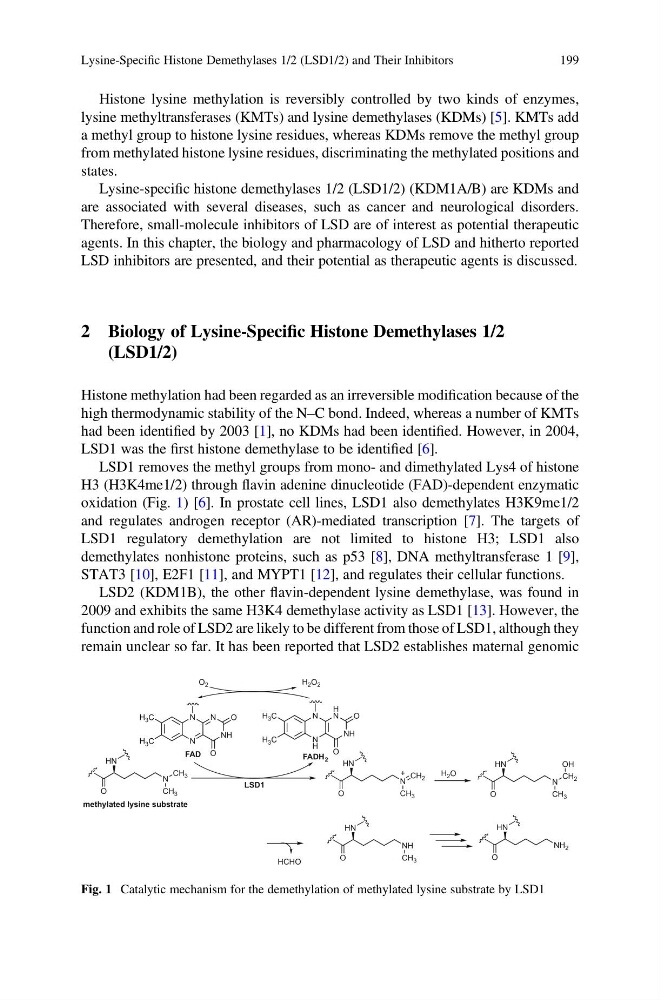
LSD1 removes the methyl groups from mono- and dimethylated Lys4 of histone
H3 (H3K4me1/2) through flavin adenine dinucleotide (FAD)-dependent enzymatic
oxidation (Fig. 1) [6]. In prostate cell lines, LSD1 also demethylates H3K9me1/2
and regulates androgen receptor (AR)-mediated transcription [7]. The targets of
LSD1 regulatory demethylation are not limited to histone H3; LSD1 also
demethylates nonhistone proteins, such as p53 [8], DNA methyltransferase 1 [9],
STAT3 [10], E2F1 [11], and MYPT1 [12], and regulates their cellular functions.
LSD2 (KDM1B), the other flavin-dependent lysine demethylase, was found in
2009 and exhibits the same H3K4 demethylase activity as LSD1 [13]. However, the
function and role of LSD2 are likely to be different from those of LSD1, although they
remain unclear so far. It has been reported that LSD2 establishes maternal genomic
N
CH 3
CH 3
FAD
FADH 2
N
N
H 3 C
H 3 C
NH
N
O
O
N
H
N
H 3 C
H 3 C
NH
H
N
O
O
O 2
H 2 O 2
HN
O
LSD1
N
CH 3
CH 2
HN
O
H 2 O
N
CH 3
CH 2
HN
O
NH
CH 3
HN
O
NH 2
HN
O
OH
+
methylated lysine substrate
HCHO
Fig. 1 Catalytic mechanism for the demethylation of methylated lysine substrate by LSD1
Lysine-Specific Histone Demethylases 1/2 (LSD1/2) and Their Inhibitors
199
lysine methyltransferases (KMTs) and lysine demethylases (KDMs) [5]. KMTs add
a methyl group to histone lysine residues, whereas KDMs remove the methyl group
from methylated histone lysine residues, discriminating the methylated positions and
states.
Lysine-specific histone demethylases 1/2 (LSD1/2) (KDM1A/B) are KDMs and
are associated with several diseases, such as cancer and neurological disorders.
Therefore, small-molecule inhibitors of LSD are of interest as potential therapeutic
agents. In this chapter, the biology and pharmacology of LSD and hitherto reported
LSD inhibitors are presented, and their potential as therapeutic agents is discussed.
2 Biology of Lysine-Specific Histone Demethylases 1/2
(LSD1/2)
Histone methylation had been regarded as an irreversible modification because of the
high thermodynamic stability of the N–C bond. Indeed, whereas a number of KMTs
had been identified by 2003 [1], no KDMs had been identified. However, in 2004,
LSD1 was the first histone demethylase to be identified [6].
LSD1 removes the methyl groups from mono- and dimethylated Lys4 of histone
H3 (H3K4me1/2) through flavin adenine dinucleotide (FAD)-dependent enzymatic
oxidation (Fig. 1) [6]. In prostate cell lines, LSD1 also demethylates H3K9me1/2
and regulates androgen receptor (AR)-mediated transcription [7]. The targets of
LSD1 regulatory demethylation are not limited to histone H3; LSD1 also
demethylates nonhistone proteins, such as p53 [8], DNA methyltransferase 1 [9],
STAT3 [10], E2F1 [11], and MYPT1 [12], and regulates their cellular functions.
LSD2 (KDM1B), the other flavin-dependent lysine demethylase, was found in
2009 and exhibits the same H3K4 demethylase activity as LSD1 [13]. However, the
function and role of LSD2 are likely to be different from those of LSD1, although they
remain unclear so far. It has been reported that LSD2 establishes maternal genomic
N
CH 3
CH 3
FAD
FADH 2
N
N
H 3 C
H 3 C
NH
N
O
O
N
H
N
H 3 C
H 3 C
NH
H
N
O
O
O 2
H 2 O 2
HN
O
LSD1
N
CH 3
CH 2
HN
O
H 2 O
N
CH 3
CH 2
HN
O
NH
CH 3
HN
O
NH 2
HN
O
OH
+
methylated lysine substrate
HCHO
Fig. 1 Catalytic mechanism for the demethylation of methylated lysine substrate by LSD1
Lysine-Specific Histone Demethylases 1/2 (LSD1/2) and Their Inhibitors
199