

Despite these limitations, the overview of the PRMT inhibitors here presented
revealed that potent and highly selective compounds have already been developed
against PRMT3 (SGC707 (40) [113]), CARM1/PRMT4 (TP-064 (52) [137]) and
PRMT5 (GSK3326595 (63) [199], GSK591 (66) [167] and LLY-283 (68) [166]). In
addition, the dual PRMT4/PRMT6 (51) [135] and PRMT5/PRMT7 (74) [191]
inhibitors that have been developed, as well as the more general type I PRMT
inhibitor (6) [50], serve to strengthen the toolbox of small molecules needed for
detailed investigations of PRMTs. Furthermore, the technology recently developed
for the co-crystallization of PRMTs with their respective substrates using transition
state mimics [141] is expected to yield key new structural insights of value in the
discovery of new PRMT inhibitors.
To date, PRMT5 is the first PRMT for which an inhibitor has been taken into
phase I clinical trials, illustrating the rapid progress being made in this field. The
increasing number of reports describing the involvements of PRMTs in cellular
processes and the development of new PRMT inhibitors can be expected to result in
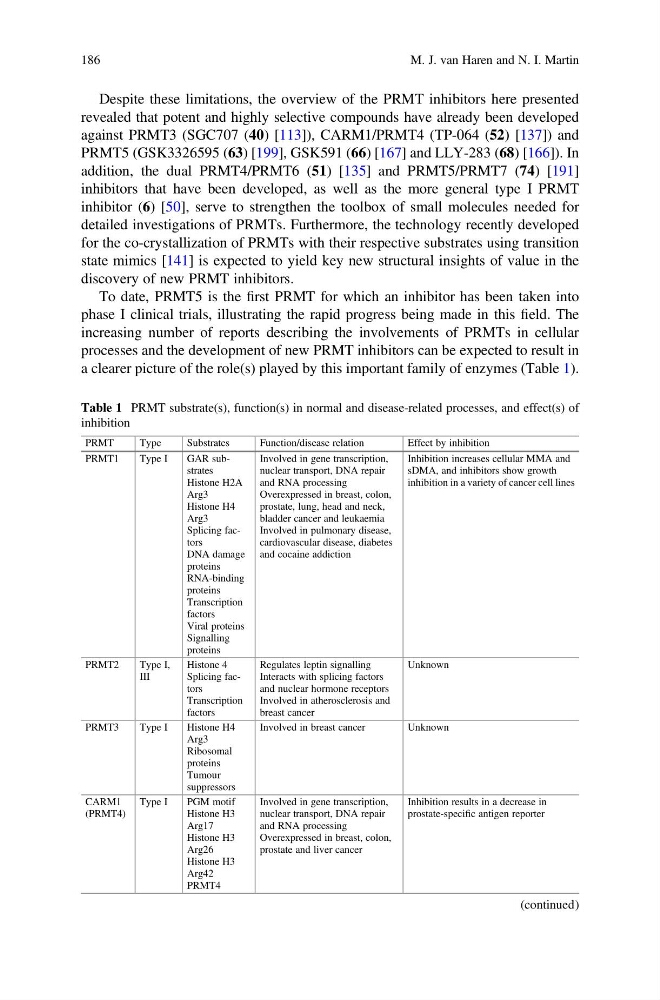
a clearer picture of the role(s) played by this important family of enzymes (Table 1).
Table 1 PRMT substrate(s), function(s) in normal and disease-related processes, and effect(s) of
inhibition
PRMT
Type
Substrates
Function/disease relation
Effect by inhibition
PRMT1
Type I
GAR substrates
Histone H2A
Arg3
Histone H4
Arg3
Splicing factors
DNA damage
proteins
RNA-binding
proteins
Transcription
factors
Viral proteins
Signalling
proteins
Involved in gene transcription,
nuclear transport, DNA repair
and RNA processing
Overexpressed in breast, colon,
prostate, lung, head and neck,
bladder cancer and leukaemia
Involved in pulmonary disease,
cardiovascular disease, diabetes
and cocaine addiction
Inhibition increases cellular MMA and
sDMA, and inhibitors show growth
inhibition in a variety of cancer cell lines
PRMT2
Type I,
III
Histone 4
Splicing factors
Transcription
factors
Regulates leptin signalling
Interacts with splicing factors
and nuclear hormone receptors
Involved in atherosclerosis and
breast cancer
Unknown
PRMT3
Type I
Histone H4
Arg3
Ribosomal
proteins
Tumour
suppressors
Involved in breast cancer
Unknown
CARM1
(PRMT4)
Type I
PGM motif
Histone H3
Arg17
Histone H3
Arg26
Histone H3
Arg42
PRMT4
Involved in gene transcription,
nuclear transport, DNA repair
and RNA processing
Overexpressed in breast, colon,
prostate and liver cancer
Inhibition results in a decrease in
prostate-specific antigen reporter
(continued)
186
M. J. van Haren and N. I. Martin
revealed that potent and highly selective compounds have already been developed
against PRMT3 (SGC707 (40) [113]), CARM1/PRMT4 (TP-064 (52) [137]) and
PRMT5 (GSK3326595 (63) [199], GSK591 (66) [167] and LLY-283 (68) [166]). In
addition, the dual PRMT4/PRMT6 (51) [135] and PRMT5/PRMT7 (74) [191]
inhibitors that have been developed, as well as the more general type I PRMT
inhibitor (6) [50], serve to strengthen the toolbox of small molecules needed for
detailed investigations of PRMTs. Furthermore, the technology recently developed
for the co-crystallization of PRMTs with their respective substrates using transition
state mimics [141] is expected to yield key new structural insights of value in the
discovery of new PRMT inhibitors.
To date, PRMT5 is the first PRMT for which an inhibitor has been taken into
phase I clinical trials, illustrating the rapid progress being made in this field. The
increasing number of reports describing the involvements of PRMTs in cellular
processes and the development of new PRMT inhibitors can be expected to result in
a clearer picture of the role(s) played by this important family of enzymes (Table 1).
Table 1 PRMT substrate(s), function(s) in normal and disease-related processes, and effect(s) of
inhibition
PRMT
Type
Substrates
Function/disease relation
Effect by inhibition
PRMT1
Type I
GAR substrates
Histone H2A
Arg3
Histone H4
Arg3
Splicing factors
DNA damage
proteins
RNA-binding
proteins
Transcription
factors
Viral proteins
Signalling
proteins
Involved in gene transcription,
nuclear transport, DNA repair
and RNA processing
Overexpressed in breast, colon,
prostate, lung, head and neck,
bladder cancer and leukaemia
Involved in pulmonary disease,
cardiovascular disease, diabetes
and cocaine addiction
Inhibition increases cellular MMA and
sDMA, and inhibitors show growth
inhibition in a variety of cancer cell lines
PRMT2
Type I,
III
Histone 4
Splicing factors
Transcription
factors
Regulates leptin signalling
Interacts with splicing factors
and nuclear hormone receptors
Involved in atherosclerosis and
breast cancer
Unknown
PRMT3
Type I
Histone H4
Arg3
Ribosomal
proteins
Tumour
suppressors
Involved in breast cancer
Unknown
CARM1
(PRMT4)
Type I
PGM motif
Histone H3
Arg17
Histone H3
Arg26
Histone H3
Arg42
PRMT4
Involved in gene transcription,
nuclear transport, DNA repair
and RNA processing
Overexpressed in breast, colon,
prostate and liver cancer
Inhibition results in a decrease in
prostate-specific antigen reporter
(continued)
186
M. J. van Haren and N. I. Martin