

the inhibition of type I over type II/III PRMTs. While such type I-specific PRMT
inhibitor can be of value when looking into the role of aDMA in complex systems,
their therapeutic potential remains to be demonstrated. Nevertheless, in order to
investigate the specific roles of the individual PRMTs in detail, a comprehensive
toolbox of inhibitory compounds is essential.
3 PRMT1
3.1 Background
PRMT1 was the first identified member of the protein arginine methyltransferase
family and the most abundant [9, 51, 52]. Alternative splicing results in the possibility of at least seven variants (v1–v7) with differences in the length of the
N-terminal tail [53]. These variants can differ in localization and substrate specificity. PRMT1 produces asymmetrically dimethylated arginine (aDMA) and is responsible for more than 85% of all arginine methylations [52]. As expected, knockout of
PRMT1 in cells results in a significant decrease in aDMA and a corresponding
increase in MMA and sDMA [54].
In its target substrates, PRMT1 preferentially methylates the RGG motif, although
this is not a strict prerequisite [6, 8, 55]. Known PRMT1 substrates are diverse and
include histone H4R3, Sam68 (sarcoma associated in mitosis of 68 kDa), MRE11
(meiotic recombination 11), 53BP1 (p53-binding protein 1) and hnRNP A1 (heterogeneous nuclear ribonucleoprotein A1), among many others which are involved in
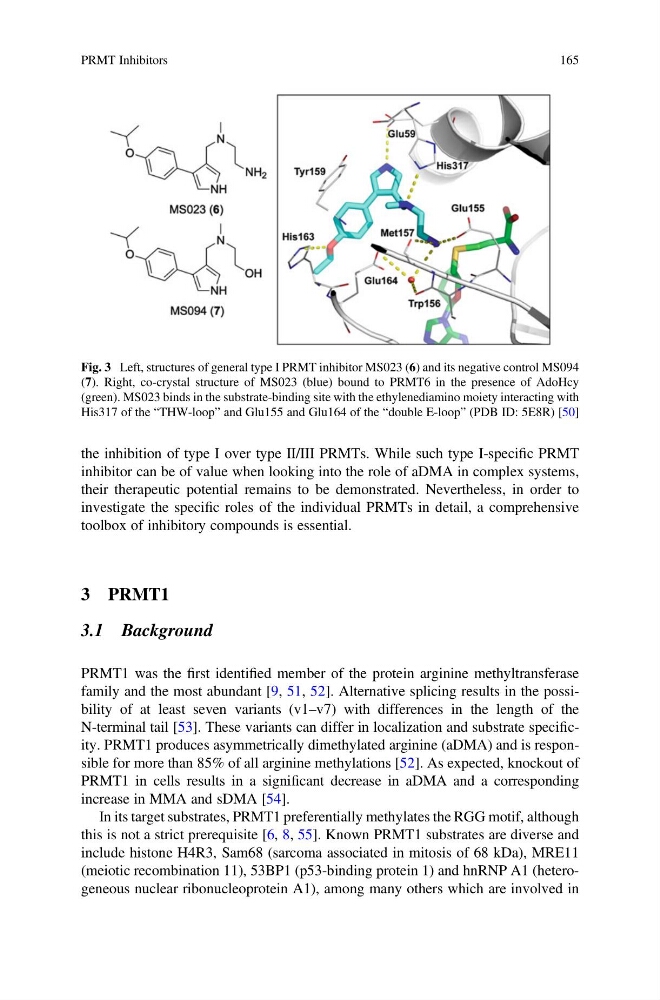
Fig. 3 Left, structures of general type I PRMT inhibitor MS023 (6) and its negative control MS094
(7). Right, co-crystal structure of MS023 (blue) bound to PRMT6 in the presence of AdoHcy
(green). MS023 binds in the substrate-binding site with the ethylenediamino moiety interacting with
His317 of the “THW-loop” and Glu155 and Glu164 of the “double E-loop” (PDB ID: 5E8R) [50]
PRMT Inhibitors
165
inhibitor can be of value when looking into the role of aDMA in complex systems,
their therapeutic potential remains to be demonstrated. Nevertheless, in order to
investigate the specific roles of the individual PRMTs in detail, a comprehensive
toolbox of inhibitory compounds is essential.
3 PRMT1
3.1 Background
PRMT1 was the first identified member of the protein arginine methyltransferase
family and the most abundant [9, 51, 52]. Alternative splicing results in the possibility of at least seven variants (v1–v7) with differences in the length of the
N-terminal tail [53]. These variants can differ in localization and substrate specificity. PRMT1 produces asymmetrically dimethylated arginine (aDMA) and is responsible for more than 85% of all arginine methylations [52]. As expected, knockout of
PRMT1 in cells results in a significant decrease in aDMA and a corresponding
increase in MMA and sDMA [54].
In its target substrates, PRMT1 preferentially methylates the RGG motif, although
this is not a strict prerequisite [6, 8, 55]. Known PRMT1 substrates are diverse and
include histone H4R3, Sam68 (sarcoma associated in mitosis of 68 kDa), MRE11
(meiotic recombination 11), 53BP1 (p53-binding protein 1) and hnRNP A1 (heterogeneous nuclear ribonucleoprotein A1), among many others which are involved in
Fig. 3 Left, structures of general type I PRMT inhibitor MS023 (6) and its negative control MS094
(7). Right, co-crystal structure of MS023 (blue) bound to PRMT6 in the presence of AdoHcy
(green). MS023 binds in the substrate-binding site with the ethylenediamino moiety interacting with
His317 of the “THW-loop” and Glu155 and Glu164 of the “double E-loop” (PDB ID: 5E8R) [50]
PRMT Inhibitors
165