

an inhibitory potency against PCAF (IC 50 ¼ 9.7 μM) even lower than those observed
with Gcn5 (IC 50 ¼ 8.4 μM), p300 (IC 50 ¼ 5.3 μM) and CBP (IC 50 ¼ 2.5 μM)
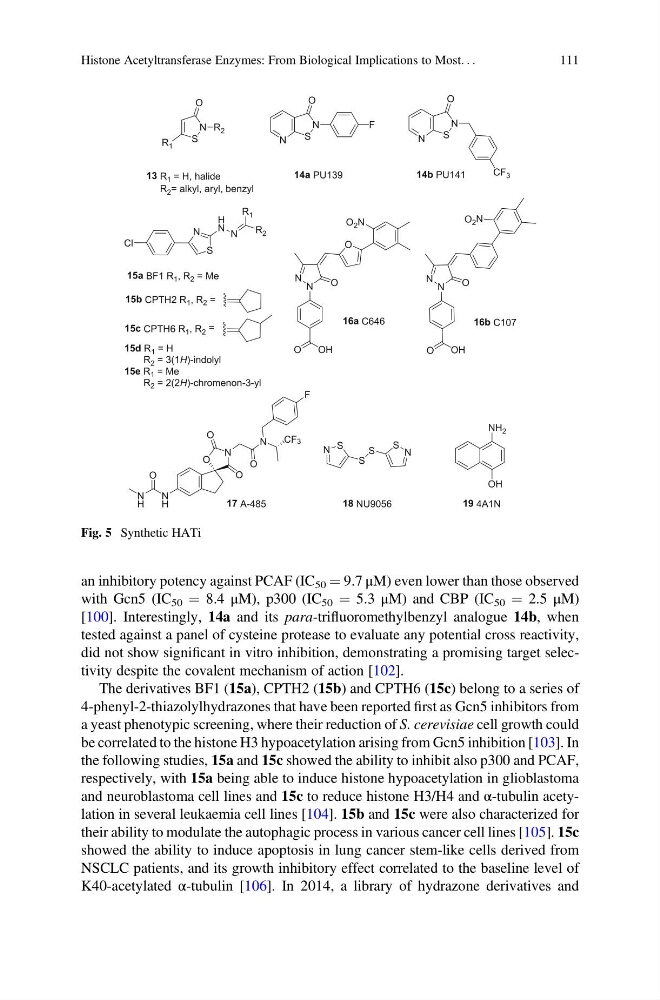
[100]. Interestingly, 14a and its para-trifluoromethylbenzyl analogue 14b, when
tested against a panel of cysteine protease to evaluate any potential cross reactivity,
did not show significant in vitro inhibition, demonstrating a promising target selectivity despite the covalent mechanism of action [102].
The derivatives BF1 (15a), CPTH2 (15b) and CPTH6 (15c) belong to a series of
4-phenyl-2-thiazolylhydrazones that have been reported first as Gcn5 inhibitors from
a yeast phenotypic screening, where their reduction of S. cerevisiae cell growth could
be correlated to the histone H3 hypoacetylation arising from Gcn5 inhibition [103]. In
the following studies, 15a and 15c showed the ability to inhibit also p300 and PCAF,
respectively, with 15a being able to induce histone hypoacetylation in glioblastoma
and neuroblastoma cell lines and 15c to reduce histone H3/H4 and α-tubulin acetylation in several leukaemia cell lines [104]. 15b and 15c were also characterized for
their ability to modulate the autophagic process in various cancer cell lines [105]. 15c
showed the ability to induce apoptosis in lung cancer stem-like cells derived from
NSCLC patients, and its growth inhibitory effect correlated to the baseline level of
K40-acetylated α-tubulin [106]. In 2014, a library of hydrazone derivatives and
S
N
O
R 2
R 1
13 R 1 = H, halide
R 2 = alkyl, aryl, benzyl
S
N
O
N
F
14a PU139
S
N
O
N
14b PU141
CF 3
15a BF1 R 1 , R 2 = Me
N
H
N
N
S
Cl
R 2
R 1
15d R 1 = H
R 2 = 3(1H)-indolyl
15e R 1 = Me
R 2 = 2(2H)-chromenon-3-yl
O
O 2 N
O
N N
O
OH
16a C646
O
N N
OH
O
16b C107
O 2 N
15b CPTH2 R 1 , R 2 =
15c CPTH6 R 1 , R 2 =
N S
S
S
N
S
18 NU9056
OH
NH 2
19 4A1N
N
H
N
O
N
H
O
N
O
O
O
CF3
F
17 A-485
Fig. 5 Synthetic HATi
Histone Acetyltransferase Enzymes: From Biological Implications to Most. . .
111
with Gcn5 (IC 50 ¼ 8.4 μM), p300 (IC 50 ¼ 5.3 μM) and CBP (IC 50 ¼ 2.5 μM)
[100]. Interestingly, 14a and its para-trifluoromethylbenzyl analogue 14b, when
tested against a panel of cysteine protease to evaluate any potential cross reactivity,
did not show significant in vitro inhibition, demonstrating a promising target selectivity despite the covalent mechanism of action [102].
The derivatives BF1 (15a), CPTH2 (15b) and CPTH6 (15c) belong to a series of
4-phenyl-2-thiazolylhydrazones that have been reported first as Gcn5 inhibitors from
a yeast phenotypic screening, where their reduction of S. cerevisiae cell growth could
be correlated to the histone H3 hypoacetylation arising from Gcn5 inhibition [103]. In
the following studies, 15a and 15c showed the ability to inhibit also p300 and PCAF,
respectively, with 15a being able to induce histone hypoacetylation in glioblastoma
and neuroblastoma cell lines and 15c to reduce histone H3/H4 and α-tubulin acetylation in several leukaemia cell lines [104]. 15b and 15c were also characterized for
their ability to modulate the autophagic process in various cancer cell lines [105]. 15c
showed the ability to induce apoptosis in lung cancer stem-like cells derived from
NSCLC patients, and its growth inhibitory effect correlated to the baseline level of
K40-acetylated α-tubulin [106]. In 2014, a library of hydrazone derivatives and
S
N
O
R 2
R 1
13 R 1 = H, halide
R 2 = alkyl, aryl, benzyl
S
N
O
N
F
14a PU139
S
N
O
N
14b PU141
CF 3
15a BF1 R 1 , R 2 = Me
N
H
N
N
S
Cl
R 2
R 1
15d R 1 = H
R 2 = 3(1H)-indolyl
15e R 1 = Me
R 2 = 2(2H)-chromenon-3-yl
O
O 2 N
O
N N
O
OH
16a C646
O
N N
OH
O
16b C107
O 2 N
15b CPTH2 R 1 , R 2 =
15c CPTH6 R 1 , R 2 =
N S
S
S
N
S
18 NU9056
OH
NH 2
19 4A1N
N
H
N
O
N
H
O
N
O
O
O
CF3
F
17 A-485
Fig. 5 Synthetic HATi
Histone Acetyltransferase Enzymes: From Biological Implications to Most. . .
111