

51
• managing power grid peak demands, including with battery technologies;
• power grid peak demands driven by urban air conditioning;
• energy independence, dependence, and geopolitics, especially in oil and natural
gas, but increasingly with wind and solar siting;
• vehicle fuel efficiency increases and vehicle electrification;
• energy for mass transportation;
• air pollution and health from fossil fuel burning, including power plants, and
vehicles;
• air pollution and health from biomass and charcoal burning for cooking fires and
residential heating;
• the problems with establishing safe and agreeable disposal of wastes from
nuclear energy;
• the Faustian bargain of “normal accidents” with nuclear energy;
• aging energy infrastructure;
• falling energy prices and disincentives for developing new cleaner technologies; and
• economic and technological approaches for increasing energy efficiency.
2.5 Water Systems
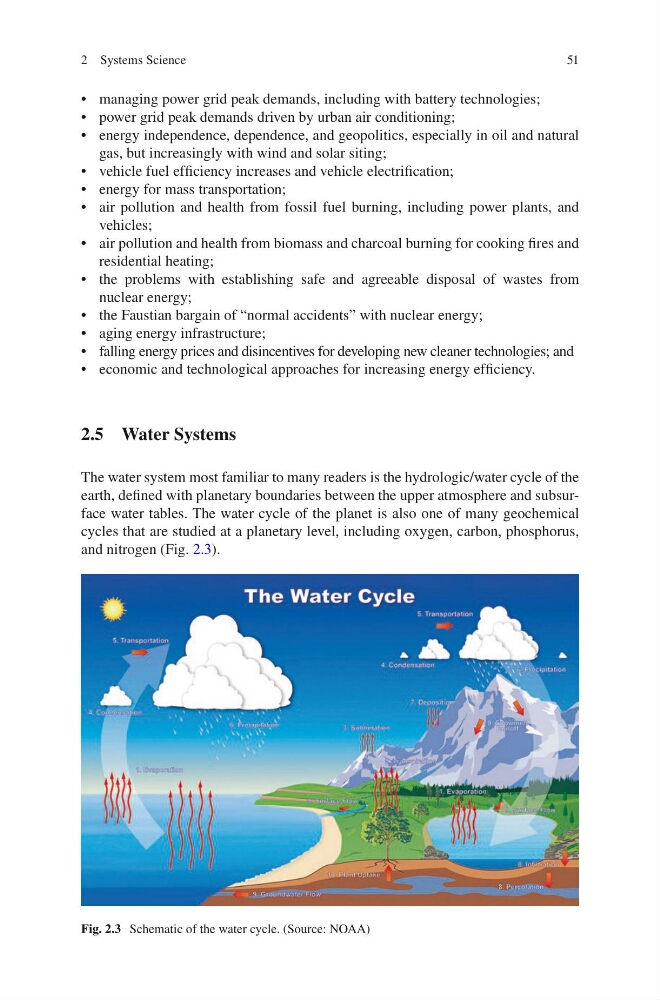
The water system most familiar to many readers is the hydrologic/water cycle of the
earth, defined with planetary boundaries between the upper atmosphere and subsurface water tables. The water cycle of the planet is also one of many geochemical
cycles that are studied at a planetary level, including oxygen, carbon, phosphorus,
and nitrogen (Fig. 2.3).
Fig. 2.3 Schematic of the water cycle. (Source: NOAA)
2 Systems Science
• managing power grid peak demands, including with battery technologies;
• power grid peak demands driven by urban air conditioning;
• energy independence, dependence, and geopolitics, especially in oil and natural
gas, but increasingly with wind and solar siting;
• vehicle fuel efficiency increases and vehicle electrification;
• energy for mass transportation;
• air pollution and health from fossil fuel burning, including power plants, and
vehicles;
• air pollution and health from biomass and charcoal burning for cooking fires and
residential heating;
• the problems with establishing safe and agreeable disposal of wastes from
nuclear energy;
• the Faustian bargain of “normal accidents” with nuclear energy;
• aging energy infrastructure;
• falling energy prices and disincentives for developing new cleaner technologies; and
• economic and technological approaches for increasing energy efficiency.
2.5 Water Systems
The water system most familiar to many readers is the hydrologic/water cycle of the
earth, defined with planetary boundaries between the upper atmosphere and subsurface water tables. The water cycle of the planet is also one of many geochemical
cycles that are studied at a planetary level, including oxygen, carbon, phosphorus,
and nitrogen (Fig. 2.3).
Fig. 2.3 Schematic of the water cycle. (Source: NOAA)
2 Systems Science