

49
Notable examples of tools to explore large-scale energy systems that will be
addressed in Chap. 15 (Modeling) include the following:
• MARKAL (derived from “Market Allocation”) developed by the International
Energy Agency is a model widely applied at many scales to project the evolution
of energy systems over 40–50 years under certain assumptions. This is a bottomup model that allows the assessment of different techno-economic assumptions
about the future.
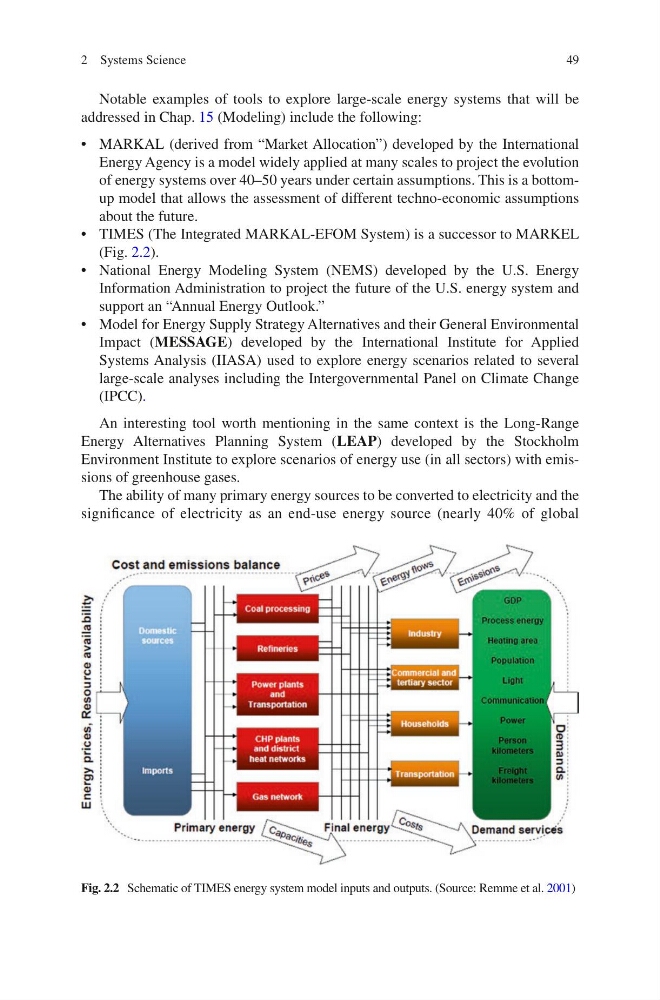
• TIMES (The Integrated MARKAL-EFOM System) is a successor to MARKEL
(Fig. 2.2).
• National Energy Modeling System (NEMS) developed by the U.S. Energy
Information Administration to project the future of the U.S. energy system and
support an “Annual Energy Outlook.”
• Model for Energy Supply Strategy Alternatives and their General Environmental
Impact (MESSAGE) developed by the International Institute for Applied
Systems Analysis (IIASA) used to explore energy scenarios related to several
large- scale analyses including the Intergovernmental Panel on Climate Change
(IPCC).
An interesting tool worth mentioning in the same context is the Long-Range
Energy Alternatives Planning System (LEAP) developed by the Stockholm
Environment Institute to explore scenarios of energy use (in all sectors) with emissions of greenhouse gases.
The ability of many primary energy sources to be converted to electricity and the
significance of electricity as an end-use energy source (nearly 40% of global
Fig. 2.2 Schematic of TIMES energy system model inputs and outputs. (Source: Remme et al. 2001)
2 Systems Science
Notable examples of tools to explore large-scale energy systems that will be
addressed in Chap. 15 (Modeling) include the following:
• MARKAL (derived from “Market Allocation”) developed by the International
Energy Agency is a model widely applied at many scales to project the evolution
of energy systems over 40–50 years under certain assumptions. This is a bottomup model that allows the assessment of different techno-economic assumptions
about the future.
• TIMES (The Integrated MARKAL-EFOM System) is a successor to MARKEL
(Fig. 2.2).
• National Energy Modeling System (NEMS) developed by the U.S. Energy
Information Administration to project the future of the U.S. energy system and
support an “Annual Energy Outlook.”
• Model for Energy Supply Strategy Alternatives and their General Environmental
Impact (MESSAGE) developed by the International Institute for Applied
Systems Analysis (IIASA) used to explore energy scenarios related to several
large- scale analyses including the Intergovernmental Panel on Climate Change
(IPCC).
An interesting tool worth mentioning in the same context is the Long-Range
Energy Alternatives Planning System (LEAP) developed by the Stockholm
Environment Institute to explore scenarios of energy use (in all sectors) with emissions of greenhouse gases.
The ability of many primary energy sources to be converted to electricity and the
significance of electricity as an end-use energy source (nearly 40% of global
Fig. 2.2 Schematic of TIMES energy system model inputs and outputs. (Source: Remme et al. 2001)
2 Systems Science