

43
types, brands, and qualities, each with its nutritional attributes, some of which are
commoditized and some not, while water and energy feature a smallish and relatively well-defined set of types and properties and (especially in the global north)
are heavily commoditized.
There are multiple conversion processes from agricultural commodities to food
commodities that require careful attention. These can be simple like the conversion
of wheat into flour, or the use of one product like corn as a feedstock for a secondary
product like beef, or the combination of products into a process to produce an output
like a frozen dinner.
These complexities lead to a diversity of structural relationships between different parts of food systems, with some structural arrangements more dominated by
anthropogenic factors like agricultural practices, economics, industrial labor relations, and diet choices than others, which orient more toward biological, chemical,
and environmental factors. These different structural relations lead to various internal interactions between the parts of the food system and a wide range of approaches
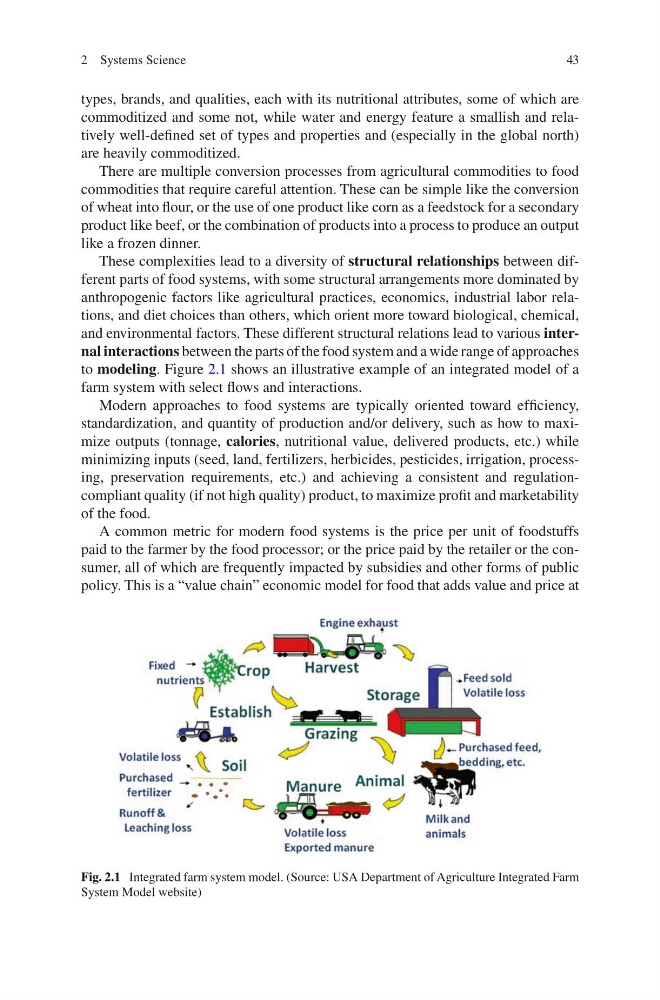
to modeling. Figure 2.1 shows an illustrative example of an integrated model of a
farm system with select flows and interactions.
Modern approaches to food systems are typically oriented toward efficiency,
standardization, and quantity of production and/or delivery, such as how to maximize outputs (tonnage, calories, nutritional value, delivered products, etc.) while
minimizing inputs (seed, land, fertilizers, herbicides, pesticides, irrigation, processing, preservation requirements, etc.) and achieving a consistent and regulationcompliant quality (if not high quality) product, to maximize profit and marketability
of the food.
A common metric for modern food systems is the price per unit of foodstuffs
paid to the farmer by the food processor; or the price paid by the retailer or the consumer, all of which are frequently impacted by subsidies and other forms of public
policy. This is a “value chain” economic model for food that adds value and price at
Fig. 2.1 Integrated farm system model. (Source: USA Department of Agriculture Integrated Farm
System Model website)
2 Systems Science
types, brands, and qualities, each with its nutritional attributes, some of which are
commoditized and some not, while water and energy feature a smallish and relatively well-defined set of types and properties and (especially in the global north)
are heavily commoditized.
There are multiple conversion processes from agricultural commodities to food
commodities that require careful attention. These can be simple like the conversion
of wheat into flour, or the use of one product like corn as a feedstock for a secondary
product like beef, or the combination of products into a process to produce an output
like a frozen dinner.
These complexities lead to a diversity of structural relationships between different parts of food systems, with some structural arrangements more dominated by
anthropogenic factors like agricultural practices, economics, industrial labor relations, and diet choices than others, which orient more toward biological, chemical,
and environmental factors. These different structural relations lead to various internal interactions between the parts of the food system and a wide range of approaches
to modeling. Figure 2.1 shows an illustrative example of an integrated model of a
farm system with select flows and interactions.
Modern approaches to food systems are typically oriented toward efficiency,
standardization, and quantity of production and/or delivery, such as how to maximize outputs (tonnage, calories, nutritional value, delivered products, etc.) while
minimizing inputs (seed, land, fertilizers, herbicides, pesticides, irrigation, processing, preservation requirements, etc.) and achieving a consistent and regulationcompliant quality (if not high quality) product, to maximize profit and marketability
of the food.
A common metric for modern food systems is the price per unit of foodstuffs
paid to the farmer by the food processor; or the price paid by the retailer or the consumer, all of which are frequently impacted by subsidies and other forms of public
policy. This is a “value chain” economic model for food that adds value and price at
Fig. 2.1 Integrated farm system model. (Source: USA Department of Agriculture Integrated Farm
System Model website)
2 Systems Science