

546
It is clear that there are tremendous differences in the political, economic, and
social contexts within which the food–energy–water nexus manifests in regions
where water resources are abundant. In water-abundant areas, it may be more difficult to convince people that they should organize and develop collaborative governance of their water resources and watersheds. Such challenges call for building
consensus on what should be changed at both the production and consumption end
of food, energy, and water systems in order to ensure their sustainability. Furthermore,
these challenges require a shift in thinking about the governance of these systems,
away from the incessant pursuit of increased production, and toward more efficient
production and use of food, energy, and water resources.
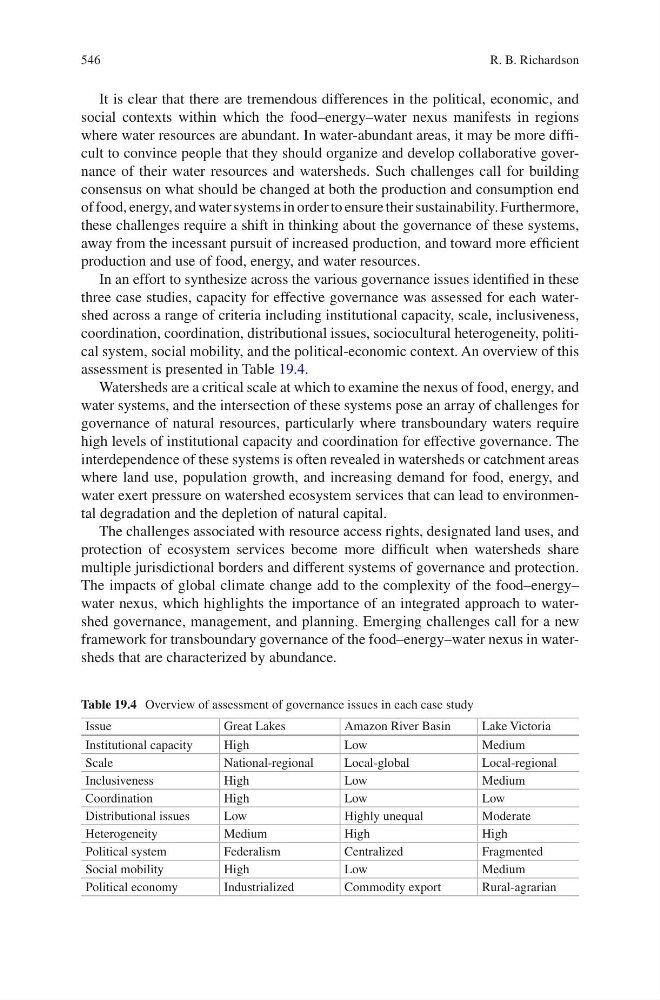
In an effort to synthesize across the various governance issues identified in these
three case studies, capacity for effective governance was assessed for each watershed across a range of criteria including institutional capacity, scale, inclusiveness,
coordination, coordination, distributional issues, sociocultural heterogeneity, political system, social mobility, and the political-economic context. An overview of this
assessment is presented in Table 19.4.
Watersheds are a critical scale at which to examine the nexus of food, energy, and
water systems, and the intersection of these systems pose an array of challenges for
governance of natural resources, particularly where transboundary waters require
high levels of institutional capacity and coordination for effective governance. The
interdependence of these systems is often revealed in watersheds or catchment areas
where land use, population growth, and increasing demand for food, energy, and
water exert pressure on watershed ecosystem services that can lead to environmental degradation and the depletion of natural capital.
The challenges associated with resource access rights, designated land uses, and
protection of ecosystem services become more difficult when watersheds share
multiple jurisdictional borders and different systems of governance and protection.
The impacts of global climate change add to the complexity of the food–energy–
water nexus, which highlights the importance of an integrated approach to watershed governance, management, and planning. Emerging challenges call for a new
framework for transboundary governance of the food–energy–water nexus in watersheds that are characterized by abundance.
Table 19.4 Overview of assessment of governance issues in each case study
Issue
Great Lakes
Amazon River Basin
Lake Victoria
Institutional capacity
High
Low
Medium
Scale
National-regional
Local-global
Local-regional
Inclusiveness
High
Low
Medium
Coordination
High
Low
Low
Distributional issues
Low
Highly unequal
Moderate
Heterogeneity
Medium
High
High
Political system
Federalism
Centralized
Fragmented
Social mobility
High
Low
Medium
Political economy
Industrialized
Commodity export
Rural-agrarian
R. B. Richardson
It is clear that there are tremendous differences in the political, economic, and
social contexts within which the food–energy–water nexus manifests in regions
where water resources are abundant. In water-abundant areas, it may be more difficult to convince people that they should organize and develop collaborative governance of their water resources and watersheds. Such challenges call for building
consensus on what should be changed at both the production and consumption end
of food, energy, and water systems in order to ensure their sustainability. Furthermore,
these challenges require a shift in thinking about the governance of these systems,
away from the incessant pursuit of increased production, and toward more efficient
production and use of food, energy, and water resources.
In an effort to synthesize across the various governance issues identified in these
three case studies, capacity for effective governance was assessed for each watershed across a range of criteria including institutional capacity, scale, inclusiveness,
coordination, coordination, distributional issues, sociocultural heterogeneity, political system, social mobility, and the political-economic context. An overview of this
assessment is presented in Table 19.4.
Watersheds are a critical scale at which to examine the nexus of food, energy, and
water systems, and the intersection of these systems pose an array of challenges for
governance of natural resources, particularly where transboundary waters require
high levels of institutional capacity and coordination for effective governance. The
interdependence of these systems is often revealed in watersheds or catchment areas
where land use, population growth, and increasing demand for food, energy, and
water exert pressure on watershed ecosystem services that can lead to environmental degradation and the depletion of natural capital.
The challenges associated with resource access rights, designated land uses, and
protection of ecosystem services become more difficult when watersheds share
multiple jurisdictional borders and different systems of governance and protection.
The impacts of global climate change add to the complexity of the food–energy–
water nexus, which highlights the importance of an integrated approach to watershed governance, management, and planning. Emerging challenges call for a new
framework for transboundary governance of the food–energy–water nexus in watersheds that are characterized by abundance.
Table 19.4 Overview of assessment of governance issues in each case study
Issue
Great Lakes
Amazon River Basin
Lake Victoria
Institutional capacity
High
Low
Medium
Scale
National-regional
Local-global
Local-regional
Inclusiveness
High
Low
Medium
Coordination
High
Low
Low
Distributional issues
Low
Highly unequal
Moderate
Heterogeneity
Medium
High
High
Political system
Federalism
Centralized
Fragmented
Social mobility
High
Low
Medium
Political economy
Industrialized
Commodity export
Rural-agrarian
R. B. Richardson