

533
The Amazon drainage basin covers an area of about 7.5 million km
2
(approximately 2.9 million mi
2
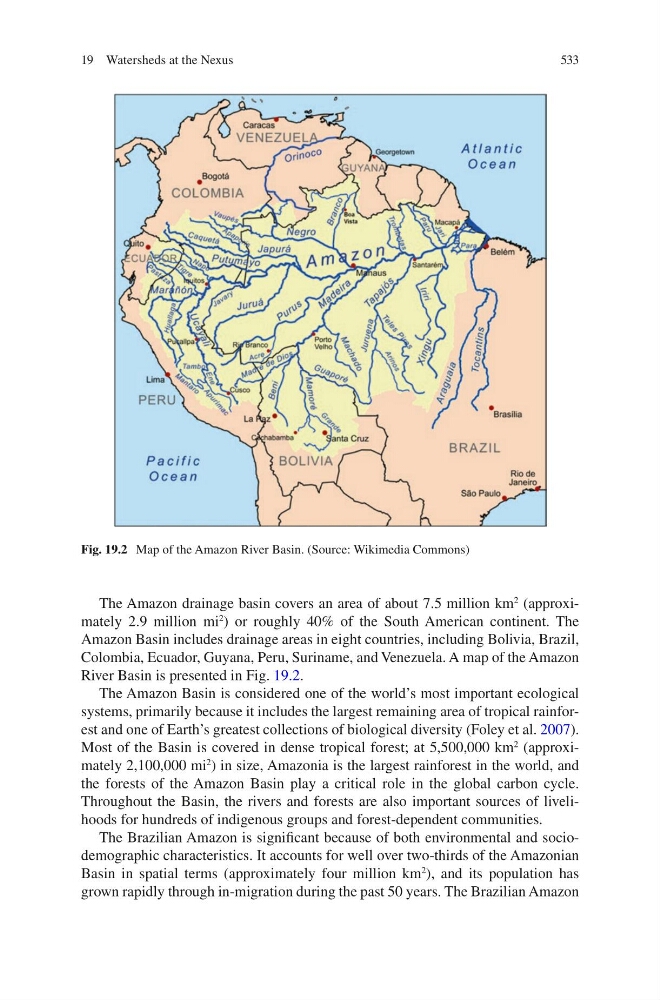
) or roughly 40% of the South American continent. The
Amazon Basin includes drainage areas in eight countries, including Bolivia, Brazil,
Colombia, Ecuador, Guyana, Peru, Suriname, and Venezuela. A map of the Amazon
River Basin is presented in Fig. 19.2.
The Amazon Basin is considered one of the world’s most important ecological
systems, primarily because it includes the largest remaining area of tropical rainforest and one of Earth’s greatest collections of biological diversity (Foley et al. 2007).
Most of the Basin is covered in dense tropical forest; at 5,500,000 km
2
(approximately 2,100,000 mi
2
) in size, Amazonia is the largest rainforest in the world, and
the forests of the Amazon Basin play a critical role in the global carbon cycle.
Throughout the Basin, the rivers and forests are also important sources of livelihoods for hundreds of indigenous groups and forest-dependent communities.
The Brazilian Amazon is significant because of both environmental and sociodemographic characteristics. It accounts for well over two-thirds of the Amazonian
Basin in spatial terms (approximately four million km
2
), and its population has
grown rapidly through in-migration during the past 50 years. The Brazilian Amazon
Fig. 19.2 Map of the Amazon River Basin. (Source: Wikimedia Commons)
19 Watersheds at the Nexus
The Amazon drainage basin covers an area of about 7.5 million km
2
(approximately 2.9 million mi
2
) or roughly 40% of the South American continent. The
Amazon Basin includes drainage areas in eight countries, including Bolivia, Brazil,
Colombia, Ecuador, Guyana, Peru, Suriname, and Venezuela. A map of the Amazon
River Basin is presented in Fig. 19.2.
The Amazon Basin is considered one of the world’s most important ecological
systems, primarily because it includes the largest remaining area of tropical rainforest and one of Earth’s greatest collections of biological diversity (Foley et al. 2007).
Most of the Basin is covered in dense tropical forest; at 5,500,000 km
2
(approximately 2,100,000 mi
2
) in size, Amazonia is the largest rainforest in the world, and
the forests of the Amazon Basin play a critical role in the global carbon cycle.
Throughout the Basin, the rivers and forests are also important sources of livelihoods for hundreds of indigenous groups and forest-dependent communities.
The Brazilian Amazon is significant because of both environmental and sociodemographic characteristics. It accounts for well over two-thirds of the Amazonian
Basin in spatial terms (approximately four million km
2
), and its population has
grown rapidly through in-migration during the past 50 years. The Brazilian Amazon
Fig. 19.2 Map of the Amazon River Basin. (Source: Wikimedia Commons)
19 Watersheds at the Nexus