

504
come together to create substantive change with relatively low up-front investment.
For instance, U.S. EPA’s Net Zero Strategy has gradually built a culture of improving the environment, saving money, and helping communities become more sustainable and resilient via conserving water, reducing energy use, and eliminating solid
waste at individual military and non-military communities.
18.3.4 Principles for Understanding Urban FEW Supply
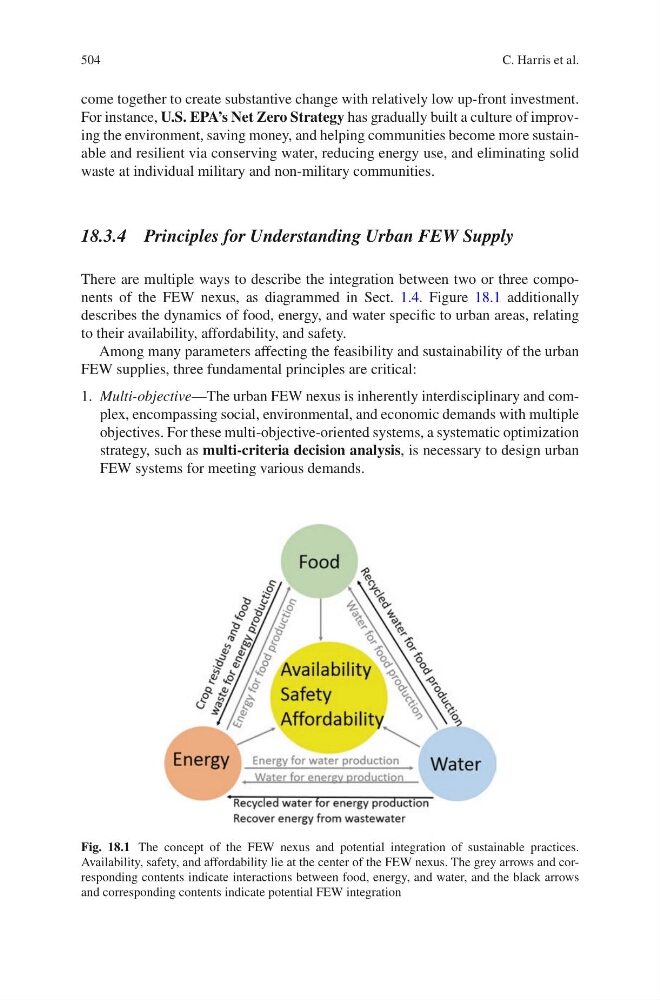
There are multiple ways to describe the integration between two or three components of the FEW nexus, as diagrammed in Sect. 1.4. Figure 18.1 additionally
describes the dynamics of food, energy, and water specific to urban areas, relating
to their availability, affordability, and safety.
Among many parameters affecting the feasibility and sustainability of the urban
FEW supplies, three fundamental principles are critical:
1. Multi-objective—The urban FEW nexus is inherently interdisciplinary and complex, encompassing social, environmental, and economic demands with multiple
objectives. For these multi-objective-oriented systems, a systematic optimization
strategy, such as multi-criteria decision analysis, is necessary to design urban
FEW systems for meeting various demands.
Fig. 18.1 The concept of the FEW nexus and potential integration of sustainable practices.
Availability, safety, and affordability lie at the center of the FEW nexus. The grey arrows and corresponding contents indicate interactions between food, energy, and water, and the black arrows
and corresponding contents indicate potential FEW integration
C. Harris et al.
come together to create substantive change with relatively low up-front investment.
For instance, U.S. EPA’s Net Zero Strategy has gradually built a culture of improving the environment, saving money, and helping communities become more sustainable and resilient via conserving water, reducing energy use, and eliminating solid
waste at individual military and non-military communities.
18.3.4 Principles for Understanding Urban FEW Supply
There are multiple ways to describe the integration between two or three components of the FEW nexus, as diagrammed in Sect. 1.4. Figure 18.1 additionally
describes the dynamics of food, energy, and water specific to urban areas, relating
to their availability, affordability, and safety.
Among many parameters affecting the feasibility and sustainability of the urban
FEW supplies, three fundamental principles are critical:
1. Multi-objective—The urban FEW nexus is inherently interdisciplinary and complex, encompassing social, environmental, and economic demands with multiple
objectives. For these multi-objective-oriented systems, a systematic optimization
strategy, such as multi-criteria decision analysis, is necessary to design urban
FEW systems for meeting various demands.
Fig. 18.1 The concept of the FEW nexus and potential integration of sustainable practices.
Availability, safety, and affordability lie at the center of the FEW nexus. The grey arrows and corresponding contents indicate interactions between food, energy, and water, and the black arrows
and corresponding contents indicate potential FEW integration
C. Harris et al.