

384
and gap filling of many process observations to estimate “mass balance” at larger
scales; typically, bottom-up methods are expensive, require cross- organizational
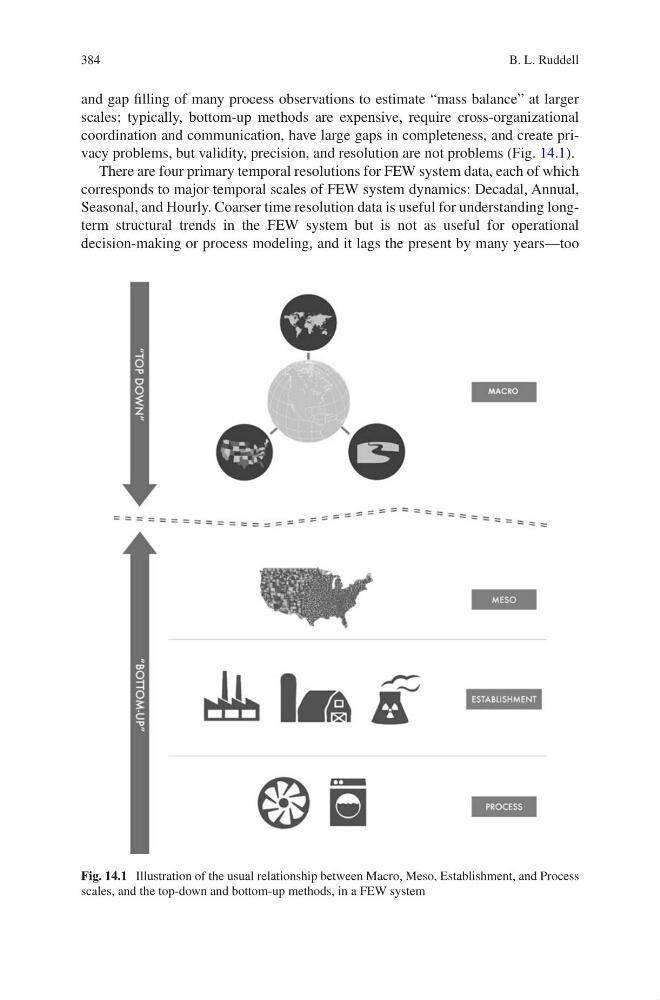
coordination and communication, have large gaps in completeness, and create privacy problems, but validity, precision, and resolution are not problems (Fig. 14.1).
There are four primary temporal resolutions for FEW system data, each of which
corresponds to major temporal scales of FEW system dynamics: Decadal, Annual,
Seasonal, and Hourly. Coarser time resolution data is useful for understanding longterm structural trends in the FEW system but is not as useful for operational
decision- making or process modeling, and it lags the present by many years—too
Fig. 14.1 Illustration of the usual relationship between Macro, Meso, Establishment, and Process
scales, and the top-down and bottom-up methods, in a FEW system
B. L. Ruddell
and gap filling of many process observations to estimate “mass balance” at larger
scales; typically, bottom-up methods are expensive, require cross- organizational
coordination and communication, have large gaps in completeness, and create privacy problems, but validity, precision, and resolution are not problems (Fig. 14.1).
There are four primary temporal resolutions for FEW system data, each of which
corresponds to major temporal scales of FEW system dynamics: Decadal, Annual,
Seasonal, and Hourly. Coarser time resolution data is useful for understanding longterm structural trends in the FEW system but is not as useful for operational
decision- making or process modeling, and it lags the present by many years—too
Fig. 14.1 Illustration of the usual relationship between Macro, Meso, Establishment, and Process
scales, and the top-down and bottom-up methods, in a FEW system
B. L. Ruddell