

327
12.2 Connecting Practical Questions with Scientific
Capabilities
12.2.1 Pasteur’s Quadrant and Use-Inspired Science
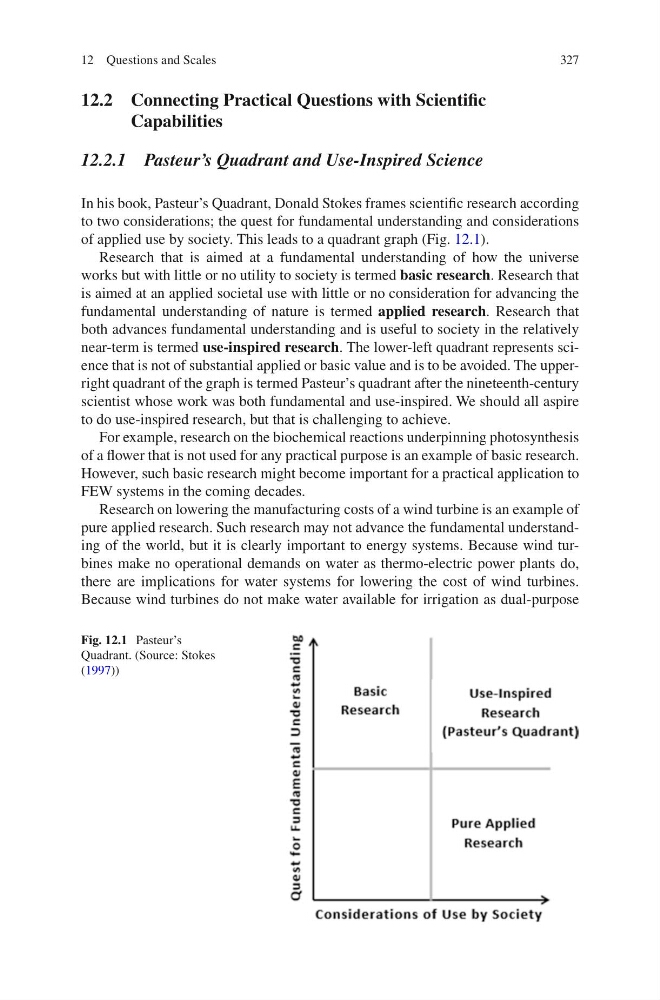
In his book, Pasteur’s Quadrant, Donald Stokes frames scientific research according
to two considerations; the quest for fundamental understanding and considerations
of applied use by society. This leads to a quadrant graph (Fig. 12.1).
Research that is aimed at a fundamental understanding of how the universe
works but with little or no utility to society is termed basic research. Research that
is aimed at an applied societal use with little or no consideration for advancing the
fundamental understanding of nature is termed applied research. Research that
both advances fundamental understanding and is useful to society in the relatively
near- term is termed use-inspired research. The lower-left quadrant represents science that is not of substantial applied or basic value and is to be avoided. The upperright quadrant of the graph is termed Pasteur’s quadrant after the nineteenth-century
scientist whose work was both fundamental and use-inspired. We should all aspire
to do use-inspired research, but that is challenging to achieve.
For example, research on the biochemical reactions underpinning photosynthesis
of a flower that is not used for any practical purpose is an example of basic research.
However, such basic research might become important for a practical application to
FEW systems in the coming decades.
Research on lowering the manufacturing costs of a wind turbine is an example of
pure applied research. Such research may not advance the fundamental understanding of the world, but it is clearly important to energy systems. Because wind turbines make no operational demands on water as thermo-electric power plants do,
there are implications for water systems for lowering the cost of wind turbines.
Because wind turbines do not make water available for irrigation as dual-purpose
Fig. 12.1 Pasteur’s
Quadrant. (Source: Stokes
(1997))
12 Questions and Scales
12.2 Connecting Practical Questions with Scientific
Capabilities
12.2.1 Pasteur’s Quadrant and Use-Inspired Science
In his book, Pasteur’s Quadrant, Donald Stokes frames scientific research according
to two considerations; the quest for fundamental understanding and considerations
of applied use by society. This leads to a quadrant graph (Fig. 12.1).
Research that is aimed at a fundamental understanding of how the universe
works but with little or no utility to society is termed basic research. Research that
is aimed at an applied societal use with little or no consideration for advancing the
fundamental understanding of nature is termed applied research. Research that
both advances fundamental understanding and is useful to society in the relatively
near- term is termed use-inspired research. The lower-left quadrant represents science that is not of substantial applied or basic value and is to be avoided. The upperright quadrant of the graph is termed Pasteur’s quadrant after the nineteenth-century
scientist whose work was both fundamental and use-inspired. We should all aspire
to do use-inspired research, but that is challenging to achieve.
For example, research on the biochemical reactions underpinning photosynthesis
of a flower that is not used for any practical purpose is an example of basic research.
However, such basic research might become important for a practical application to
FEW systems in the coming decades.
Research on lowering the manufacturing costs of a wind turbine is an example of
pure applied research. Such research may not advance the fundamental understanding of the world, but it is clearly important to energy systems. Because wind turbines make no operational demands on water as thermo-electric power plants do,
there are implications for water systems for lowering the cost of wind turbines.
Because wind turbines do not make water available for irrigation as dual-purpose
Fig. 12.1 Pasteur’s
Quadrant. (Source: Stokes
(1997))
12 Questions and Scales