

313
the underlying science of climate change … profound uncertainties arise in the socioeconomic factors [related to mitigation]. Those uncertainties include the development and
deployment of technologies, prices for major primary energy sources, average rates of economic growth and the distribution of benefits and costs within societies, emission patterns,
and a wide array of institutional factors such as whether and how countries cooperate effectively at the international level.
Effective mitigation policies rest of perception of risk and social benefits; recognition of uncertainty; an understanding of costs and benefits; the economic, social,
and cultural conditions of the community targeted; and an ability to integrate all
critical issues, including food, energy, and water systems. Such policies are more
likely to achieve their aims without unintended or unforeseen side effects.
Central to mitigation efforts on a global scale are the issues of sustainable development (SD) explored in Chap. 3.
First, the climate threat constrains possible development paths, and sufficiently disruptive
climate change could preclude any prospect for a sustainable future (medium evidence,
high agreement). Thus, a stable climate is one component of SD.
Second, there are synergies and trade-offs between climate responses and broader SD
goals, because some climate responses generate co-benefits for human and economic development, while others can have adverse side effects and generate risks (robust evidence, high
agreement).
11.5.1 Energy
In 2010, the burning of fossil fuels accounted for 69% of global anthropogenic
emissions of carbon dioxide (IPCC 2014b). Nearly half of these emissions (approximately 35% of total anthropogenic GHG emissions) are related to the extraction,
movement, conversion, storage of energy to end-users. This includes the electric
power sector, where the use of coal is the largest source of GHG emissions. The
transportation sector, dominated by the use of petroleum-based fuels, accounted
for approximately 23% of total anthropogenic GHG emissions.
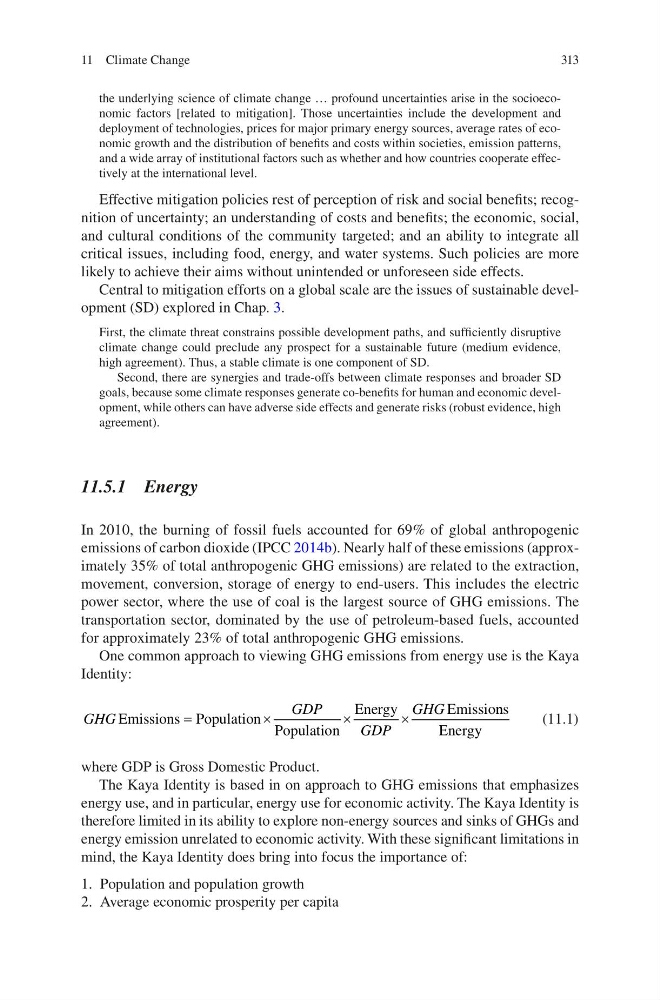
One common approach to viewing GHG emissions from energy use is the Kaya
Identity:
GHG
GDP
GDP
GHG
Emissions Population Population
Energy
Emissio
u
u
u
n ns
Energy
(11.1)
where GDP is Gross Domestic Product.
The Kaya Identity is based in on approach to GHG emissions that emphasizes
energy use, and in particular, energy use for economic activity. The Kaya Identity is
therefore limited in its ability to explore non-energy sources and sinks of GHGs and
energy emission unrelated to economic activity. With these significant limitations in
mind, the Kaya Identity does bring into focus the importance of:
1. Population and population growth
2. Average economic prosperity per capita
11 Climate Change
the underlying science of climate change … profound uncertainties arise in the socioeconomic factors [related to mitigation]. Those uncertainties include the development and
deployment of technologies, prices for major primary energy sources, average rates of economic growth and the distribution of benefits and costs within societies, emission patterns,
and a wide array of institutional factors such as whether and how countries cooperate effectively at the international level.
Effective mitigation policies rest of perception of risk and social benefits; recognition of uncertainty; an understanding of costs and benefits; the economic, social,
and cultural conditions of the community targeted; and an ability to integrate all
critical issues, including food, energy, and water systems. Such policies are more
likely to achieve their aims without unintended or unforeseen side effects.
Central to mitigation efforts on a global scale are the issues of sustainable development (SD) explored in Chap. 3.
First, the climate threat constrains possible development paths, and sufficiently disruptive
climate change could preclude any prospect for a sustainable future (medium evidence,
high agreement). Thus, a stable climate is one component of SD.
Second, there are synergies and trade-offs between climate responses and broader SD
goals, because some climate responses generate co-benefits for human and economic development, while others can have adverse side effects and generate risks (robust evidence, high
agreement).
11.5.1 Energy
In 2010, the burning of fossil fuels accounted for 69% of global anthropogenic
emissions of carbon dioxide (IPCC 2014b). Nearly half of these emissions (approximately 35% of total anthropogenic GHG emissions) are related to the extraction,
movement, conversion, storage of energy to end-users. This includes the electric
power sector, where the use of coal is the largest source of GHG emissions. The
transportation sector, dominated by the use of petroleum-based fuels, accounted
for approximately 23% of total anthropogenic GHG emissions.
One common approach to viewing GHG emissions from energy use is the Kaya
Identity:
GHG
GDP
GDP
GHG
Emissions Population Population
Energy
Emissio
u
u
u
n ns
Energy
(11.1)
where GDP is Gross Domestic Product.
The Kaya Identity is based in on approach to GHG emissions that emphasizes
energy use, and in particular, energy use for economic activity. The Kaya Identity is
therefore limited in its ability to explore non-energy sources and sinks of GHGs and
energy emission unrelated to economic activity. With these significant limitations in
mind, the Kaya Identity does bring into focus the importance of:
1. Population and population growth
2. Average economic prosperity per capita
11 Climate Change