

280
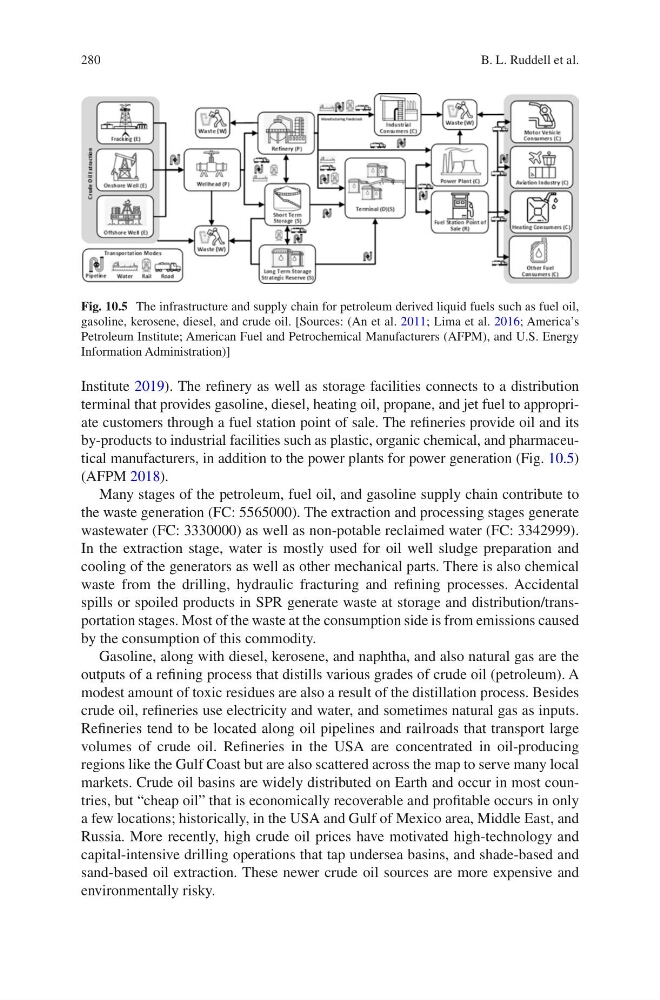
Institute 2019). The refinery as well as storage facilities connects to a distribution
terminal that provides gasoline, diesel, heating oil, propane, and jet fuel to appropriate customers through a fuel station point of sale. The refineries provide oil and its
by-products to industrial facilities such as plastic, organic chemical, and pharmaceutical manufacturers, in addition to the power plants for power generation (Fig. 10.5)
(AFPM 2018).
Many stages of the petroleum, fuel oil, and gasoline supply chain contribute to
the waste generation (FC: 5565000). The extraction and processing stages generate
wastewater (FC: 3330000) as well as non-potable reclaimed water (FC: 3342999).
In the extraction stage, water is mostly used for oil well sludge preparation and
cooling of the generators as well as other mechanical parts. There is also chemical
waste from the drilling, hydraulic fracturing and refining processes. Accidental
spills or spoiled products in SPR generate waste at storage and distribution/transportation stages. Most of the waste at the consumption side is from emissions caused
by the consumption of this commodity.
Gasoline, along with diesel, kerosene, and naphtha, and also natural gas are the
outputs of a refining process that distills various grades of crude oil (petroleum). A
modest amount of toxic residues are also a result of the distillation process. Besides
crude oil, refineries use electricity and water, and sometimes natural gas as inputs.
Refineries tend to be located along oil pipelines and railroads that transport large
volumes of crude oil. Refineries in the USA are concentrated in oil-producing
regions like the Gulf Coast but are also scattered across the map to serve many local
markets. Crude oil basins are widely distributed on Earth and occur in most countries, but “cheap oil” that is economically recoverable and profitable occurs in only
a few locations; historically, in the USA and Gulf of Mexico area, Middle East, and
Russia. More recently, high crude oil prices have motivated high-technology and
capital-intensive drilling operations that tap undersea basins, and shade-based and
sand-based oil extraction. These newer crude oil sources are more expensive and
environmentally risky.
Fig. 10.5 The infrastructure and supply chain for petroleum derived liquid fuels such as fuel oil,
gasoline, kerosene, diesel, and crude oil. [Sources: (An et al. 2011; Lima et al. 2016; America’s
Petroleum Institute; American Fuel and Petrochemical Manufacturers (AFPM), and U.S. Energy
Information Administration)]
B. L. Ruddell et al.
Institute 2019). The refinery as well as storage facilities connects to a distribution
terminal that provides gasoline, diesel, heating oil, propane, and jet fuel to appropriate customers through a fuel station point of sale. The refineries provide oil and its
by-products to industrial facilities such as plastic, organic chemical, and pharmaceutical manufacturers, in addition to the power plants for power generation (Fig. 10.5)
(AFPM 2018).
Many stages of the petroleum, fuel oil, and gasoline supply chain contribute to
the waste generation (FC: 5565000). The extraction and processing stages generate
wastewater (FC: 3330000) as well as non-potable reclaimed water (FC: 3342999).
In the extraction stage, water is mostly used for oil well sludge preparation and
cooling of the generators as well as other mechanical parts. There is also chemical
waste from the drilling, hydraulic fracturing and refining processes. Accidental
spills or spoiled products in SPR generate waste at storage and distribution/transportation stages. Most of the waste at the consumption side is from emissions caused
by the consumption of this commodity.
Gasoline, along with diesel, kerosene, and naphtha, and also natural gas are the
outputs of a refining process that distills various grades of crude oil (petroleum). A
modest amount of toxic residues are also a result of the distillation process. Besides
crude oil, refineries use electricity and water, and sometimes natural gas as inputs.
Refineries tend to be located along oil pipelines and railroads that transport large
volumes of crude oil. Refineries in the USA are concentrated in oil-producing
regions like the Gulf Coast but are also scattered across the map to serve many local
markets. Crude oil basins are widely distributed on Earth and occur in most countries, but “cheap oil” that is economically recoverable and profitable occurs in only
a few locations; historically, in the USA and Gulf of Mexico area, Middle East, and
Russia. More recently, high crude oil prices have motivated high-technology and
capital-intensive drilling operations that tap undersea basins, and shade-based and
sand-based oil extraction. These newer crude oil sources are more expensive and
environmentally risky.
Fig. 10.5 The infrastructure and supply chain for petroleum derived liquid fuels such as fuel oil,
gasoline, kerosene, diesel, and crude oil. [Sources: (An et al. 2011; Lima et al. 2016; America’s
Petroleum Institute; American Fuel and Petrochemical Manufacturers (AFPM), and U.S. Energy
Information Administration)]
B. L. Ruddell et al.