

227
catalyst in HABs events appears to be nutrient loading (e.g., nitrogen and phosphorus) of water bodies from over-application of nitrogenous fertilizer (mainly manure)
to fields, which then washes into lakes and streams during precipitation events.
Other factors include increasing temperatures and still water. In areas where climate
change is resulting in warmer temperatures and intensification of weather events,
conditions favoring cyanobacteria blooms and the cyanotoxins they produce will
likely increase, resulting in the need to carefully assess how to reduce nutrient loading from non-point sources in the watershed (Paerl et al. 2016). Cyanotoxins produced by extreme HABs events can be difficult for drinking water treatment plants
to remove, and exposure via skin contact, inhalation, or drinking can even result in
renal failure and death, making them of significant political interest.
The Finger Lakes region of Western New York, home to roughly 21% of the
state’s agricultural land, is a prime example of this type of food–water nexus impact.
There, farm runoff contributes to water quality degradation in the lakes, which,
together with the region’s pastoral scenery and vibrant wine and culinary scene,
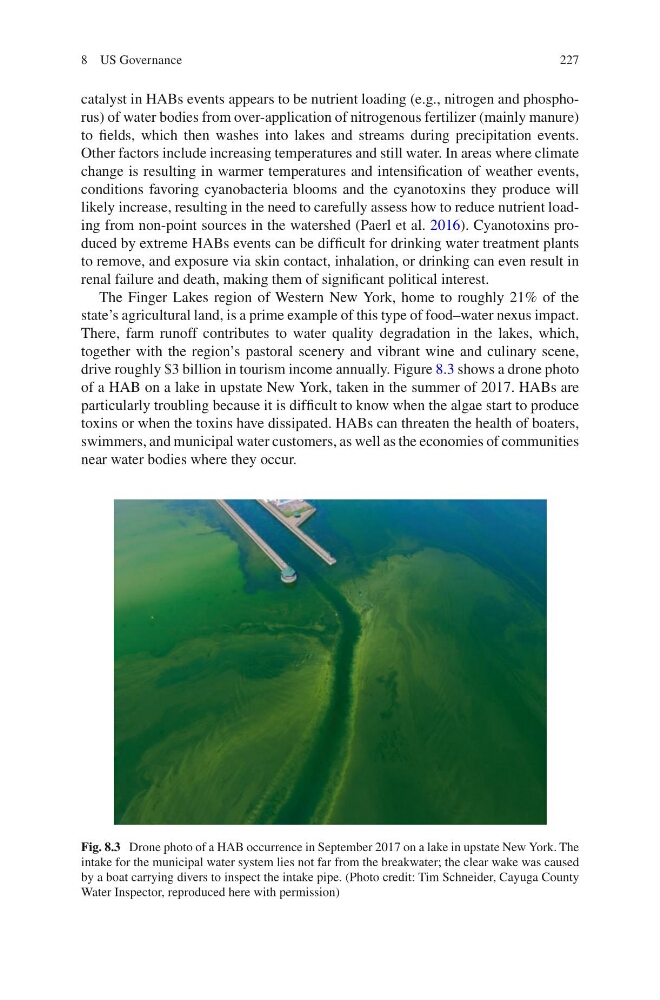
drive roughly $3 billion in tourism income annually. Figure 8.3 shows a drone photo
of a HAB on a lake in upstate New York, taken in the summer of 2017. HABs are
particularly troubling because it is difficult to know when the algae start to produce
toxins or when the toxins have dissipated. HABs can threaten the health of boaters,
swimmers, and municipal water customers, as well as the economies of communities
near water bodies where they occur.
Fig. 8.3 Drone photo of a HAB occurrence in September 2017 on a lake in upstate New York. The
intake for the municipal water system lies not far from the breakwater; the clear wake was caused
by a boat carrying divers to inspect the intake pipe. (Photo credit: Tim Schneider, Cayuga County
Water Inspector, reproduced here with permission)
8 US Governance
catalyst in HABs events appears to be nutrient loading (e.g., nitrogen and phosphorus) of water bodies from over-application of nitrogenous fertilizer (mainly manure)
to fields, which then washes into lakes and streams during precipitation events.
Other factors include increasing temperatures and still water. In areas where climate
change is resulting in warmer temperatures and intensification of weather events,
conditions favoring cyanobacteria blooms and the cyanotoxins they produce will
likely increase, resulting in the need to carefully assess how to reduce nutrient loading from non-point sources in the watershed (Paerl et al. 2016). Cyanotoxins produced by extreme HABs events can be difficult for drinking water treatment plants
to remove, and exposure via skin contact, inhalation, or drinking can even result in
renal failure and death, making them of significant political interest.
The Finger Lakes region of Western New York, home to roughly 21% of the
state’s agricultural land, is a prime example of this type of food–water nexus impact.
There, farm runoff contributes to water quality degradation in the lakes, which,
together with the region’s pastoral scenery and vibrant wine and culinary scene,
drive roughly $3 billion in tourism income annually. Figure 8.3 shows a drone photo
of a HAB on a lake in upstate New York, taken in the summer of 2017. HABs are
particularly troubling because it is difficult to know when the algae start to produce
toxins or when the toxins have dissipated. HABs can threaten the health of boaters,
swimmers, and municipal water customers, as well as the economies of communities
near water bodies where they occur.
Fig. 8.3 Drone photo of a HAB occurrence in September 2017 on a lake in upstate New York. The
intake for the municipal water system lies not far from the breakwater; the clear wake was caused
by a boat carrying divers to inspect the intake pipe. (Photo credit: Tim Schneider, Cayuga County
Water Inspector, reproduced here with permission)
8 US Governance