

221
costs of water treatment to meet treaty obligations will likely only rise in the
coming years.
The second critical confluence of water and energy resource use occurs in the
conversion of primary energy sources such as coal, natural gas, and uranium into
electricity. Conventional thermal power plants burn fossil fuels to create hightemperature, high-pressure steam that then spins turbines, which in turn spin
generators to produce electricity. Nuclear plants derive their heat source from the
fissioning of uranium nuclei, but otherwise, their process is essentially the same as
conventional thermal-electric plants. In both cases, water is used in two ways. First,
some circulates in the steam loop, where it is alternately heated to steam and
condensed back to water in a non-consumptive process; the water in the steam loop
is almost entirely reused. Second, water is drawn into the plant on a continual basis
for cooling, to provide the cold sink necessary for re-condensing the steam after it
has flowed across the turbine-generator assembly and done its work. After absorbing
the steam’s excess heat, the cooling water—now significantly warmed—is
discharged to the environment, usually into the same body of water from which it
was first withdrawn. It is precisely this type of thermal discharge that falls under
the purview of Section 316 of the CWA, as discussed above.
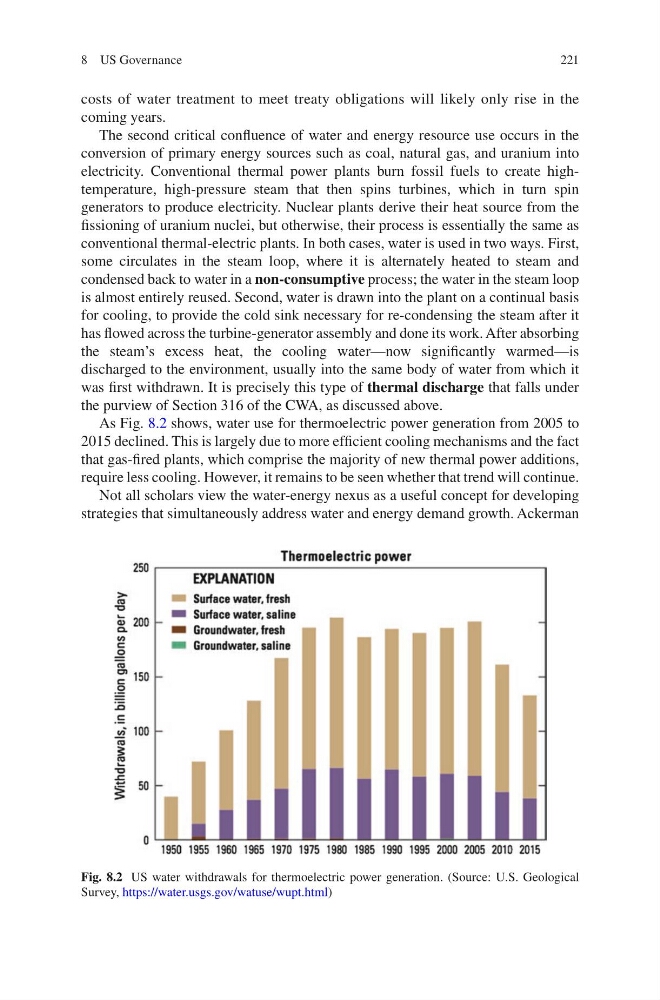
As Fig. 8.2 shows, water use for thermoelectric power generation from 2005 to
2015 declined. This is largely due to more efficient cooling mechanisms and the fact
that gas-fired plants, which comprise the majority of new thermal power additions,
require less cooling. However, it remains to be seen whether that trend will continue.
Not all scholars view the water-energy nexus as a useful concept for developing
strategies that simultaneously address water and energy demand growth. Ackerman
Fig. 8.2 US water withdrawals for thermoelectric power generation. (Source: U.S. Geological
Survey, https://water.usgs.gov/watuse/wupt.html)
8 US Governance
costs of water treatment to meet treaty obligations will likely only rise in the
coming years.
The second critical confluence of water and energy resource use occurs in the
conversion of primary energy sources such as coal, natural gas, and uranium into
electricity. Conventional thermal power plants burn fossil fuels to create hightemperature, high-pressure steam that then spins turbines, which in turn spin
generators to produce electricity. Nuclear plants derive their heat source from the
fissioning of uranium nuclei, but otherwise, their process is essentially the same as
conventional thermal-electric plants. In both cases, water is used in two ways. First,
some circulates in the steam loop, where it is alternately heated to steam and
condensed back to water in a non-consumptive process; the water in the steam loop
is almost entirely reused. Second, water is drawn into the plant on a continual basis
for cooling, to provide the cold sink necessary for re-condensing the steam after it
has flowed across the turbine-generator assembly and done its work. After absorbing
the steam’s excess heat, the cooling water—now significantly warmed—is
discharged to the environment, usually into the same body of water from which it
was first withdrawn. It is precisely this type of thermal discharge that falls under
the purview of Section 316 of the CWA, as discussed above.
As Fig. 8.2 shows, water use for thermoelectric power generation from 2005 to
2015 declined. This is largely due to more efficient cooling mechanisms and the fact
that gas-fired plants, which comprise the majority of new thermal power additions,
require less cooling. However, it remains to be seen whether that trend will continue.
Not all scholars view the water-energy nexus as a useful concept for developing
strategies that simultaneously address water and energy demand growth. Ackerman
Fig. 8.2 US water withdrawals for thermoelectric power generation. (Source: U.S. Geological
Survey, https://water.usgs.gov/watuse/wupt.html)
8 US Governance