

202
and populous Lower Basin States (California, most of Arizona, and Nevada), and
Mexico. Nearly all of the Colorado River’s water originates in the snowcapped
peaks of Wyoming and Colorado, but far-downstream California and Arizona were
the first to exploit its waters on a large scale. The CRC’s rules ensure that water is
shared equitably according to strict pre-negotiated rules, especially during times of
drought. Pre-negotiated diversions are explicitly allowed, such as the large diversions
of river water to Denver, Phoenix, Tucson, Las Vegas, and Los Angeles, and their
surrounding agricultural operations. Water is not traded or sold in this compact, but
the compact does ensure that downstream users far from the original source of the
water—especially California, Arizona, and (internationally) Mexico—receive water.
Oil and grain are easy to move and trade and are valuable enough to make this
trade profitable. On the other hand, water is relatively massive and voluminous, and
its price is very low (usually zero), so water is not normally traded in quantity. Hardto- trade Resources (like water) may be traded “virtually” by trading goods that
require a lot of that resource to produce. This is analogous to the concept of
embedded energy discussed above.
Virtual Water is the water that was consumed in the production of a good or
service. For instance, a lot of virtual water is traded via grain exports, because grain
is easy to produce in massive quantities in arid regions if you have irrigation water.
Irrigated agriculture accounts for approximately 70% of total water withdrawal, and
about 90% of virtual water flows globally relate to trade in agricultural products.
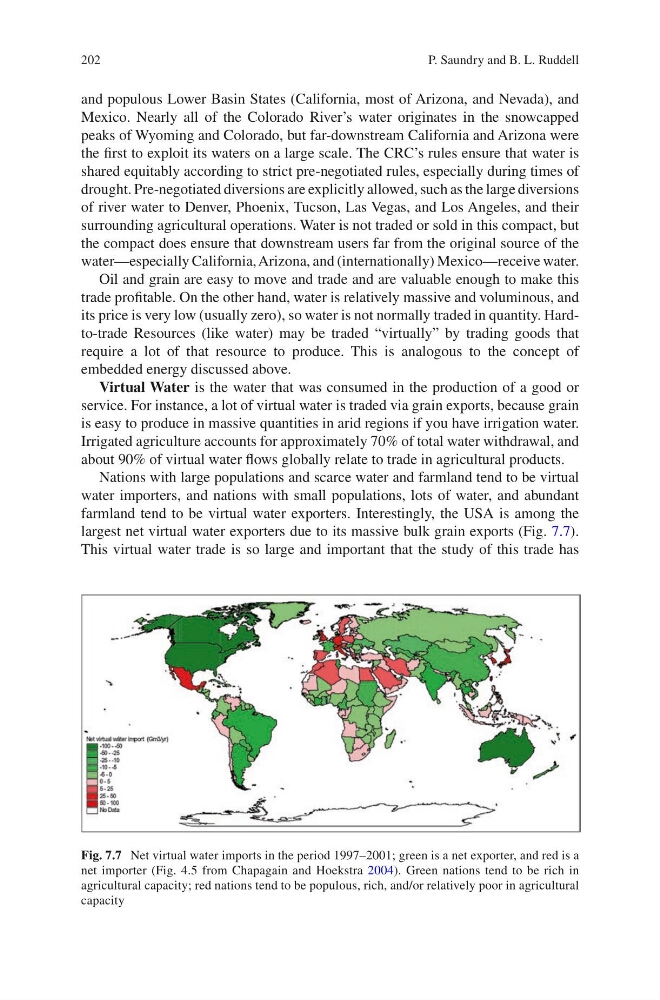
Nations with large populations and scarce water and farmland tend to be virtual
water importers, and nations with small populations, lots of water, and abundant
farmland tend to be virtual water exporters. Interestingly, the USA is among the
largest net virtual water exporters due to its massive bulk grain exports (Fig. 7.7).
This virtual water trade is so large and important that the study of this trade has
Fig. 7.7 Net virtual water imports in the period 1997–2001; green is a net exporter, and red is a
net importer (Fig. 4.5 from Chapagain and Hoekstra 2004). Green nations tend to be rich in
agricultural capacity; red nations tend to be populous, rich, and/or relatively poor in agricultural
capacity
P. Saundry and B. L. Ruddell
and populous Lower Basin States (California, most of Arizona, and Nevada), and
Mexico. Nearly all of the Colorado River’s water originates in the snowcapped
peaks of Wyoming and Colorado, but far-downstream California and Arizona were
the first to exploit its waters on a large scale. The CRC’s rules ensure that water is
shared equitably according to strict pre-negotiated rules, especially during times of
drought. Pre-negotiated diversions are explicitly allowed, such as the large diversions
of river water to Denver, Phoenix, Tucson, Las Vegas, and Los Angeles, and their
surrounding agricultural operations. Water is not traded or sold in this compact, but
the compact does ensure that downstream users far from the original source of the
water—especially California, Arizona, and (internationally) Mexico—receive water.
Oil and grain are easy to move and trade and are valuable enough to make this
trade profitable. On the other hand, water is relatively massive and voluminous, and
its price is very low (usually zero), so water is not normally traded in quantity. Hardto- trade Resources (like water) may be traded “virtually” by trading goods that
require a lot of that resource to produce. This is analogous to the concept of
embedded energy discussed above.
Virtual Water is the water that was consumed in the production of a good or
service. For instance, a lot of virtual water is traded via grain exports, because grain
is easy to produce in massive quantities in arid regions if you have irrigation water.
Irrigated agriculture accounts for approximately 70% of total water withdrawal, and
about 90% of virtual water flows globally relate to trade in agricultural products.
Nations with large populations and scarce water and farmland tend to be virtual
water importers, and nations with small populations, lots of water, and abundant
farmland tend to be virtual water exporters. Interestingly, the USA is among the
largest net virtual water exporters due to its massive bulk grain exports (Fig. 7.7).
This virtual water trade is so large and important that the study of this trade has
Fig. 7.7 Net virtual water imports in the period 1997–2001; green is a net exporter, and red is a
net importer (Fig. 4.5 from Chapagain and Hoekstra 2004). Green nations tend to be rich in
agricultural capacity; red nations tend to be populous, rich, and/or relatively poor in agricultural
capacity
P. Saundry and B. L. Ruddell