

149
7. In the San Antonio region, two 140+ mile long pipelines are being considered
to deliver water from one place to another. If you were appraising their FEW
consequences what types of effects would you consider?
8. Suppose you are evaluating a US case where to generate more energy: 5% of
US cropland and 5% of current grasslands will be diverted to producing energy
crops which use less fertilizer than existing crops but much more than pasture.
Conceptually, could this influence US and global commodity markets? What
about water use and water quality?
9. Suppose we have several Nexus water-related alternatives: build a 150-mile
pipeline, have agriculture shift to more water conserving crops, increase home
appliance water efficiency and change fracking techniques to use less water.
Who makes the decision to adopt the practice in each case and is a public role
needed to provide funds or disseminate information?
10. When you are examining issues regarding water what should you use, mean
water availability, drought availability, flood availability or the distribution of
water availability?
11. Suppose a pipeline is to be built that crosses private lands and some government
lands. Could any externalities be involved?
12. Suppose a consulting firm needs to appraise whether water could be transferred
from agriculture to cities. How would you estimate the value of water to both
parties?
13. Energy prices rose substantially between 2000 and 2011. During that period,
we saw smaller cars and more miles per gallon from new models. Prices have
now gone back down some, and larger cars are again selling. Which two economic concepts above are relevant to these observations?
14. Why should one not only look at the cheapest cost water when making an urban
decision on water supply sources?
15. Why do we worry about policies that increase food prices? Who is affected by
food prices? Also, should we only worry about the average consumer?
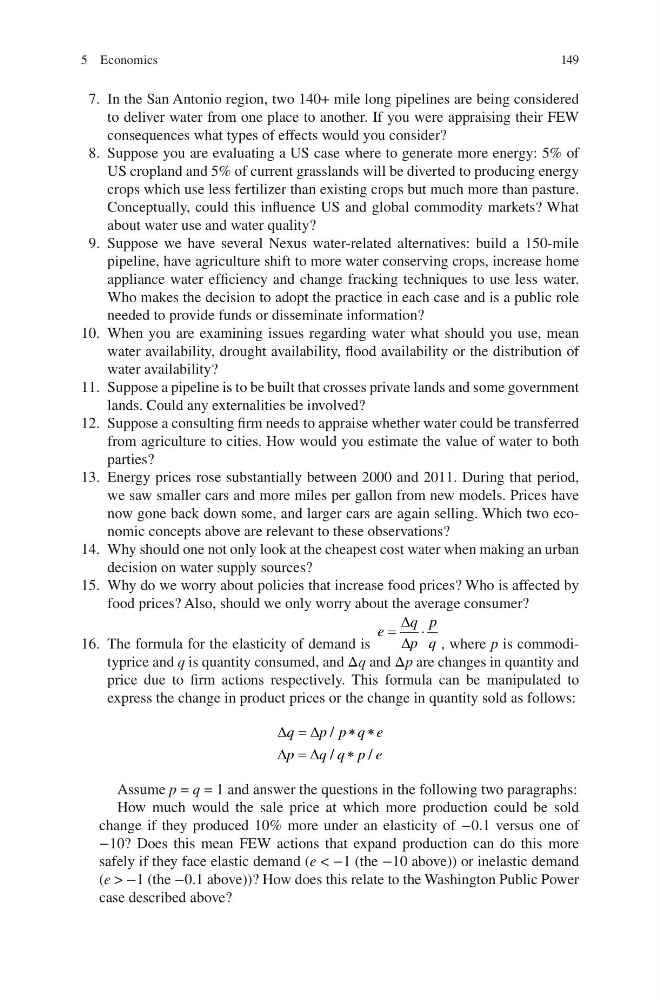
16. The formula for the elasticity of demand is
e
q
p
p
q
'
'
, where p is commodityprice and q is quantity consumed, and Δq and Δp are changes in quantity and
price due to firm actions respectively. This formula can be manipulated to
express the change in product prices or the change in quantity sold as follows:
'
'
'
'
q
p p q e
p
q q p e
/
/
/
Assume p = q = 1 and answer the questions in the following two paragraphs:
How much would the sale price at which more production could be sold
change if they produced 10% more under an elasticity of −0.1 versus one of
−10? Does this mean FEW actions that expand production can do this more
safely if they face elastic demand (e < −1 (the −10 above)) or inelastic demand
(e > −1 (the −0.1 above))? How does this relate to the Washington Public Power
case described above?
5 Economics
7. In the San Antonio region, two 140+ mile long pipelines are being considered
to deliver water from one place to another. If you were appraising their FEW
consequences what types of effects would you consider?
8. Suppose you are evaluating a US case where to generate more energy: 5% of
US cropland and 5% of current grasslands will be diverted to producing energy
crops which use less fertilizer than existing crops but much more than pasture.
Conceptually, could this influence US and global commodity markets? What
about water use and water quality?
9. Suppose we have several Nexus water-related alternatives: build a 150-mile
pipeline, have agriculture shift to more water conserving crops, increase home
appliance water efficiency and change fracking techniques to use less water.
Who makes the decision to adopt the practice in each case and is a public role
needed to provide funds or disseminate information?
10. When you are examining issues regarding water what should you use, mean
water availability, drought availability, flood availability or the distribution of
water availability?
11. Suppose a pipeline is to be built that crosses private lands and some government
lands. Could any externalities be involved?
12. Suppose a consulting firm needs to appraise whether water could be transferred
from agriculture to cities. How would you estimate the value of water to both
parties?
13. Energy prices rose substantially between 2000 and 2011. During that period,
we saw smaller cars and more miles per gallon from new models. Prices have
now gone back down some, and larger cars are again selling. Which two economic concepts above are relevant to these observations?
14. Why should one not only look at the cheapest cost water when making an urban
decision on water supply sources?
15. Why do we worry about policies that increase food prices? Who is affected by
food prices? Also, should we only worry about the average consumer?
16. The formula for the elasticity of demand is
e
q
p
p
q
'
'
, where p is commodityprice and q is quantity consumed, and Δq and Δp are changes in quantity and
price due to firm actions respectively. This formula can be manipulated to
express the change in product prices or the change in quantity sold as follows:
'
'
'
'
q
p p q e
p
q q p e
/
/
/
Assume p = q = 1 and answer the questions in the following two paragraphs:
How much would the sale price at which more production could be sold
change if they produced 10% more under an elasticity of −0.1 versus one of
−10? Does this mean FEW actions that expand production can do this more
safely if they face elastic demand (e < −1 (the −10 above)) or inelastic demand
(e > −1 (the −0.1 above))? How does this relate to the Washington Public Power
case described above?
5 Economics