

120
behavior—composting—would increase the performance of other household FEW
management behaviors. Participants were 284 adult residents of single-family
homes in Costa Mesa, California who were not already composting at baseline.
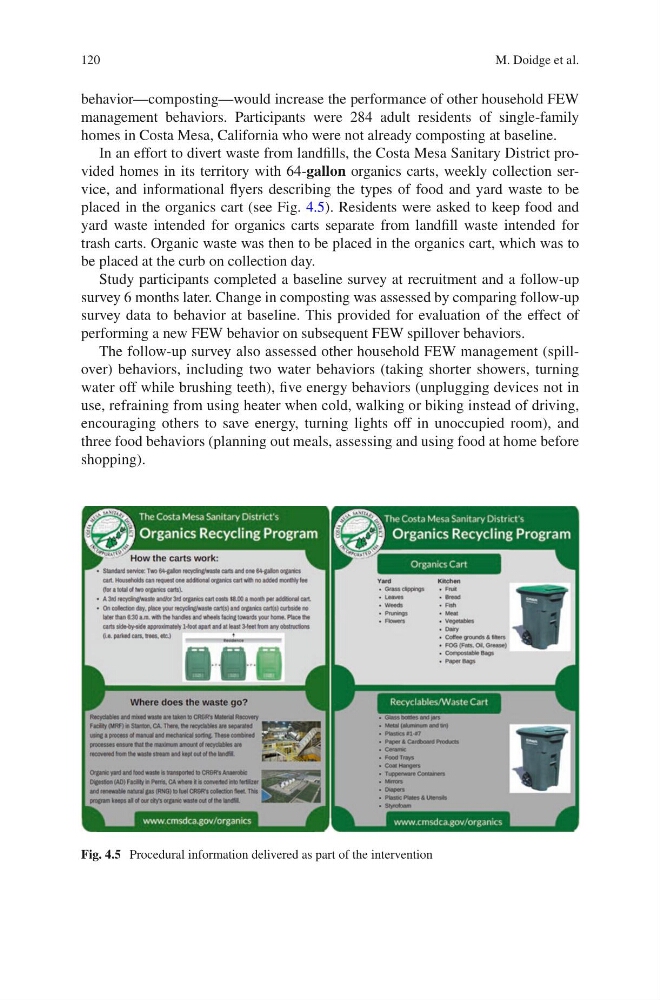
In an effort to divert waste from landfills, the Costa Mesa Sanitary District provided homes in its territory with 64-gallon organics carts, weekly collection service, and informational flyers describing the types of food and yard waste to be
placed in the organics cart (see Fig. 4.5). Residents were asked to keep food and
yard waste intended for organics carts separate from landfill waste intended for
trash carts. Organic waste was then to be placed in the organics cart, which was to
be placed at the curb on collection day.
Study participants completed a baseline survey at recruitment and a follow-up
survey 6 months later. Change in composting was assessed by comparing follow-up
survey data to behavior at baseline. This provided for evaluation of the effect of
performing a new FEW behavior on subsequent FEW spillover behaviors.
The follow-up survey also assessed other household FEW management (spillover) behaviors, including two water behaviors (taking shorter showers, turning
water off while brushing teeth), five energy behaviors (unplugging devices not in
use, refraining from using heater when cold, walking or biking instead of driving,
encouraging others to save energy, turning lights off in unoccupied room), and
three food behaviors (planning out meals, assessing and using food at home before
shopping).
Fig. 4.5 Procedural information delivered as part of the intervention
M. Doidge et al.
behavior—composting—would increase the performance of other household FEW
management behaviors. Participants were 284 adult residents of single-family
homes in Costa Mesa, California who were not already composting at baseline.
In an effort to divert waste from landfills, the Costa Mesa Sanitary District provided homes in its territory with 64-gallon organics carts, weekly collection service, and informational flyers describing the types of food and yard waste to be
placed in the organics cart (see Fig. 4.5). Residents were asked to keep food and
yard waste intended for organics carts separate from landfill waste intended for
trash carts. Organic waste was then to be placed in the organics cart, which was to
be placed at the curb on collection day.
Study participants completed a baseline survey at recruitment and a follow-up
survey 6 months later. Change in composting was assessed by comparing follow-up
survey data to behavior at baseline. This provided for evaluation of the effect of
performing a new FEW behavior on subsequent FEW spillover behaviors.
The follow-up survey also assessed other household FEW management (spillover) behaviors, including two water behaviors (taking shorter showers, turning
water off while brushing teeth), five energy behaviors (unplugging devices not in
use, refraining from using heater when cold, walking or biking instead of driving,
encouraging others to save energy, turning lights off in unoccupied room), and
three food behaviors (planning out meals, assessing and using food at home before
shopping).
Fig. 4.5 Procedural information delivered as part of the intervention
M. Doidge et al.