

52
The third group includes the anthropogenic
effects of social activities. These are mostly the
results of deliberate activities which means not
that humans would be always aware of the consequences of their deliberately performed activity.
Or even though consequences are known humans
often ignore them until the harsh feedbacks bring
them back to their senses.
Humans deliberately modify their natural
environment for their own interest with
increasingly efficient tools as technology develops. Biosphere has been transformed to greatest
extent so far. Breeding of domesticated plant and
animal species has been going on for at least
10,000 years. For a long time natural wildlife was
transformed using artificial selection but in the
twentieth century biotechnology and gene technology were applied (James 1997; Altman 1998).
New species and varieties and even new living
systems have been created: agricultural ecosystems, planted forests, urban ecological systems
and artificially transformed natural life in
extended areas including the transformation of
habitats as well. According to certain estimates
today human- dominated systems cover the
greater part of the Earth’s surface than natural
ecosystems (Ellis and Ramankutty 2008; Ellis
et al. 2010). This justified that these altered living
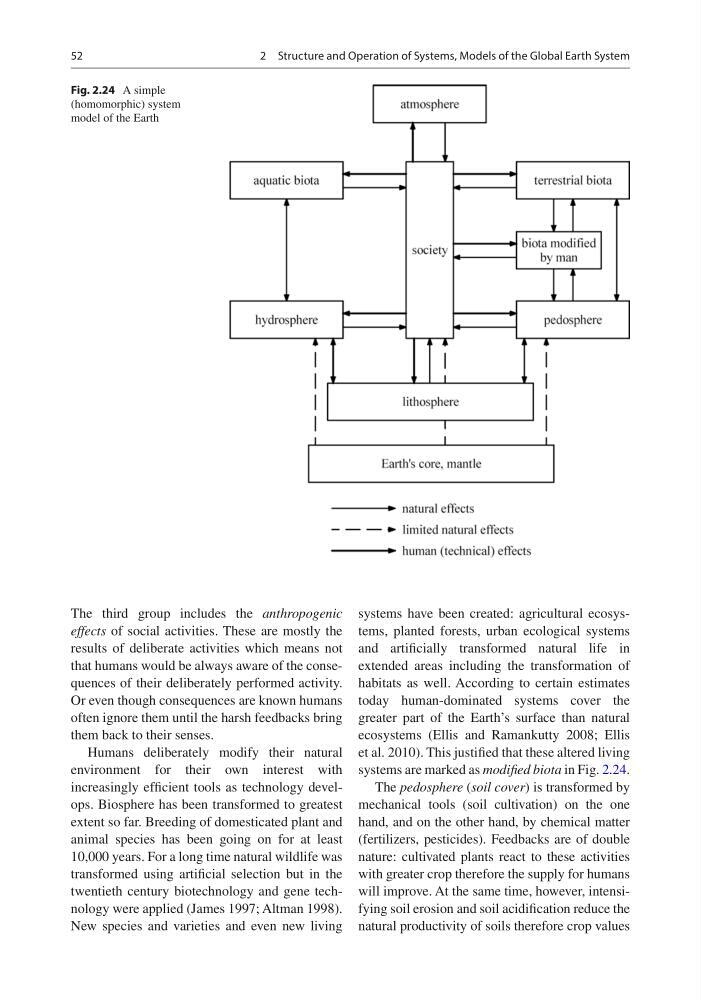
systems are marked as modified biota in Fig. 2.24.
The pedosphere (soil cover) is transformed by
mechanical tools (soil cultivation) on the one
hand, and on the other hand, by chemical matter
(fertilizers, pesticides). Feedbacks are of double
nature: cultivated plants react to these activities
with greater crop therefore the supply for humans
will improve. At the same time, however, intensifying soil erosion and soil acidification reduce the
natural productivity of soils therefore crop values
Fig. 2.24 A simple
(homomorphic) system
model of the Earth
2 Structure and Operation of Systems, Models of the Global Earth System
The third group includes the anthropogenic
effects of social activities. These are mostly the
results of deliberate activities which means not
that humans would be always aware of the consequences of their deliberately performed activity.
Or even though consequences are known humans
often ignore them until the harsh feedbacks bring
them back to their senses.
Humans deliberately modify their natural
environment for their own interest with
increasingly efficient tools as technology develops. Biosphere has been transformed to greatest
extent so far. Breeding of domesticated plant and
animal species has been going on for at least
10,000 years. For a long time natural wildlife was
transformed using artificial selection but in the
twentieth century biotechnology and gene technology were applied (James 1997; Altman 1998).
New species and varieties and even new living
systems have been created: agricultural ecosystems, planted forests, urban ecological systems
and artificially transformed natural life in
extended areas including the transformation of
habitats as well. According to certain estimates
today human- dominated systems cover the
greater part of the Earth’s surface than natural
ecosystems (Ellis and Ramankutty 2008; Ellis
et al. 2010). This justified that these altered living
systems are marked as modified biota in Fig. 2.24.
The pedosphere (soil cover) is transformed by
mechanical tools (soil cultivation) on the one
hand, and on the other hand, by chemical matter
(fertilizers, pesticides). Feedbacks are of double
nature: cultivated plants react to these activities
with greater crop therefore the supply for humans
will improve. At the same time, however, intensifying soil erosion and soil acidification reduce the
natural productivity of soils therefore crop values
Fig. 2.24 A simple
(homomorphic) system
model of the Earth
2 Structure and Operation of Systems, Models of the Global Earth System