

40
characteristics of chaotic systems have to be
regarded again. According to Edward Lorenz,
any points of chaotic systems could be sensitivity
(instability) points effects on which may make
the behaviour of the entire system incalculable
(Gleick 1988). This statement is important
because the numerous activities of the society
influence the global Earth system and these
affects can be traced at any point of the planet
and extent of the consequences of anthropogenic
effects matters. Disturbing instability points (if
there are any) would have more serious consequences than disturbing other areas.
It is an important question whether any points
of the Earth could be sensitivity point or not even
from practical environmental protection point of
view. If any point can be instable then human
activities pose a continuous threat everywhere as
they may trigger unwanted processes or oversized turbulences. The majority of scientists
studying global environmental processes consider that there are important sensitivity points
and areas on Earth and not every point is equally
sensitive.
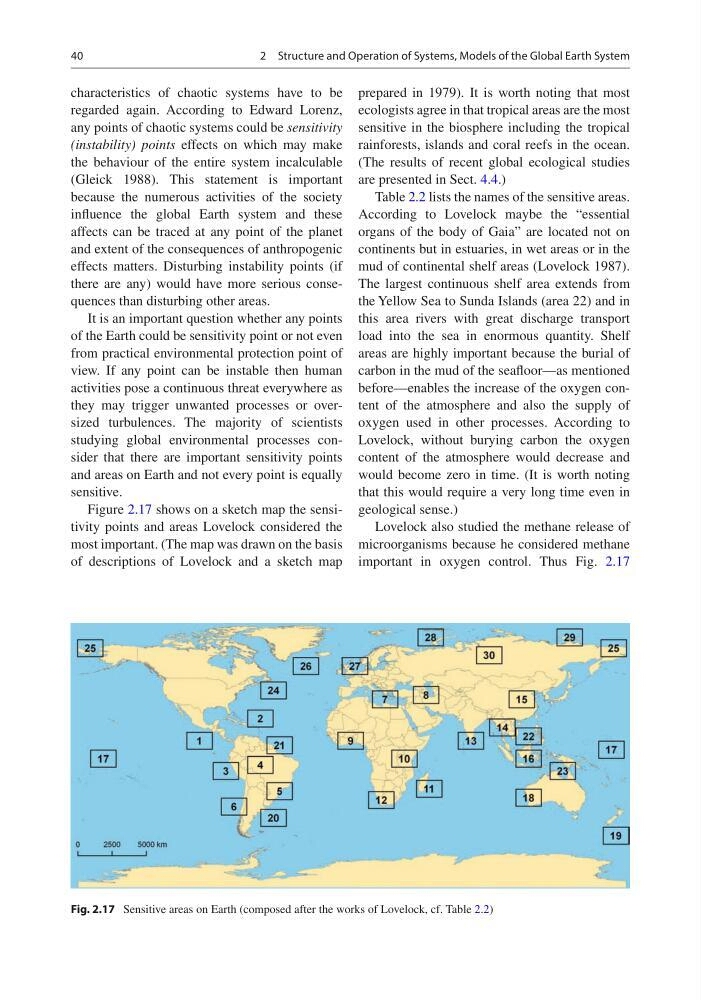
Figure 2.17 shows on a sketch map the sensitivity points and areas Lovelock considered the
most important. (The map was drawn on the basis
of descriptions of Lovelock and a sketch map
prepared in 1979). It is worth noting that most
ecologists agree in that tropical areas are the most
sensitive in the biosphere including the tropical
rainforests, islands and coral reefs in the ocean.
(The results of recent global ecological studies
are presented in Sect. 4.4.)
Table 2.2 lists the names of the sensitive areas.
According to Lovelock maybe the “essential
organs of the body of Gaia” are located not on
continents but in estuaries, in wet areas or in the
mud of continental shelf areas (Lovelock 1987).
The largest continuous shelf area extends from
the Yellow Sea to Sunda Islands (area 22) and in
this area rivers with great discharge transport
load into the sea in enormous quantity. Shelf
areas are highly important because the burial of
carbon in the mud of the seafloor—as mentioned
before—enables the increase of the oxygen content of the atmosphere and also the supply of
oxygen used in other processes. According to
Lovelock, without burying carbon the oxygen
content of the atmosphere would decrease and
would become zero in time. (It is worth noting
that this would require a very long time even in
geological sense.)
Lovelock also studied the methane release of
microorganisms because he considered methane
important in oxygen control. Thus Fig. 2.17
Fig. 2.17 Sensitive areas on Earth (composed after the works of Lovelock, cf. Table 2.2)
2 Structure and Operation of Systems, Models of the Global Earth System
characteristics of chaotic systems have to be
regarded again. According to Edward Lorenz,
any points of chaotic systems could be sensitivity
(instability) points effects on which may make
the behaviour of the entire system incalculable
(Gleick 1988). This statement is important
because the numerous activities of the society
influence the global Earth system and these
affects can be traced at any point of the planet
and extent of the consequences of anthropogenic
effects matters. Disturbing instability points (if
there are any) would have more serious consequences than disturbing other areas.
It is an important question whether any points
of the Earth could be sensitivity point or not even
from practical environmental protection point of
view. If any point can be instable then human
activities pose a continuous threat everywhere as
they may trigger unwanted processes or oversized turbulences. The majority of scientists
studying global environmental processes consider that there are important sensitivity points
and areas on Earth and not every point is equally
sensitive.
Figure 2.17 shows on a sketch map the sensitivity points and areas Lovelock considered the
most important. (The map was drawn on the basis
of descriptions of Lovelock and a sketch map
prepared in 1979). It is worth noting that most
ecologists agree in that tropical areas are the most
sensitive in the biosphere including the tropical
rainforests, islands and coral reefs in the ocean.
(The results of recent global ecological studies
are presented in Sect. 4.4.)
Table 2.2 lists the names of the sensitive areas.
According to Lovelock maybe the “essential
organs of the body of Gaia” are located not on
continents but in estuaries, in wet areas or in the
mud of continental shelf areas (Lovelock 1987).
The largest continuous shelf area extends from
the Yellow Sea to Sunda Islands (area 22) and in
this area rivers with great discharge transport
load into the sea in enormous quantity. Shelf
areas are highly important because the burial of
carbon in the mud of the seafloor—as mentioned
before—enables the increase of the oxygen content of the atmosphere and also the supply of
oxygen used in other processes. According to
Lovelock, without burying carbon the oxygen
content of the atmosphere would decrease and
would become zero in time. (It is worth noting
that this would require a very long time even in
geological sense.)
Lovelock also studied the methane release of
microorganisms because he considered methane
important in oxygen control. Thus Fig. 2.17
Fig. 2.17 Sensitive areas on Earth (composed after the works of Lovelock, cf. Table 2.2)
2 Structure and Operation of Systems, Models of the Global Earth System