

34
As a result, the subducting plate has a roll-back
effect moving the subduction zone towards the
ocean and forming back-arc basins of tensional
origin like in the case of the oceanic plate subducting along the western margin of the Pacific
Ocean.
Along the shores of Central and South
America the subducting oceanic plate is still
warmer therefore its density is not so great thus
no roll-back effect occurs and island-arcs are not
formed. Instead this zone is characterised by
strong compression, high velocity of plate movement and relatively flat subduction.
A significant portion of the seismic energy of
the Earth is released along subducting plates.
This released energy is several magnitudes higher
than the energy produced by humans; moreover,
the potential energy of the entire nuclear arsenal
(the energy released by exploding all nuclear and
hydrogen bombs) is eclipsed by it. Its destructive
effects on the society, especially human lives and
the economy are great. Negative effects are also
increased by the fact that along the shores of the
Pacific Ocean, in the seismically most active
regions of Earth (“ring of fire”) population density is generally high, there are a high number of
cities and infrastructure is developed. Extremely
great earthquakes are more frequent in the subduction zone of the east Pacific region (western
coast of South America) than at island-arc systems. (Effects on the society are discussed in
Sect. 3.2.2.)
Modern seismic tomography yielding threedimensional images helped scientists to further
develop the traditional theory of plate tectonics
and give more accurate explanations for the processes inside the Earth. Without going into too
much detail the new global geodynamic model is
outlined below.
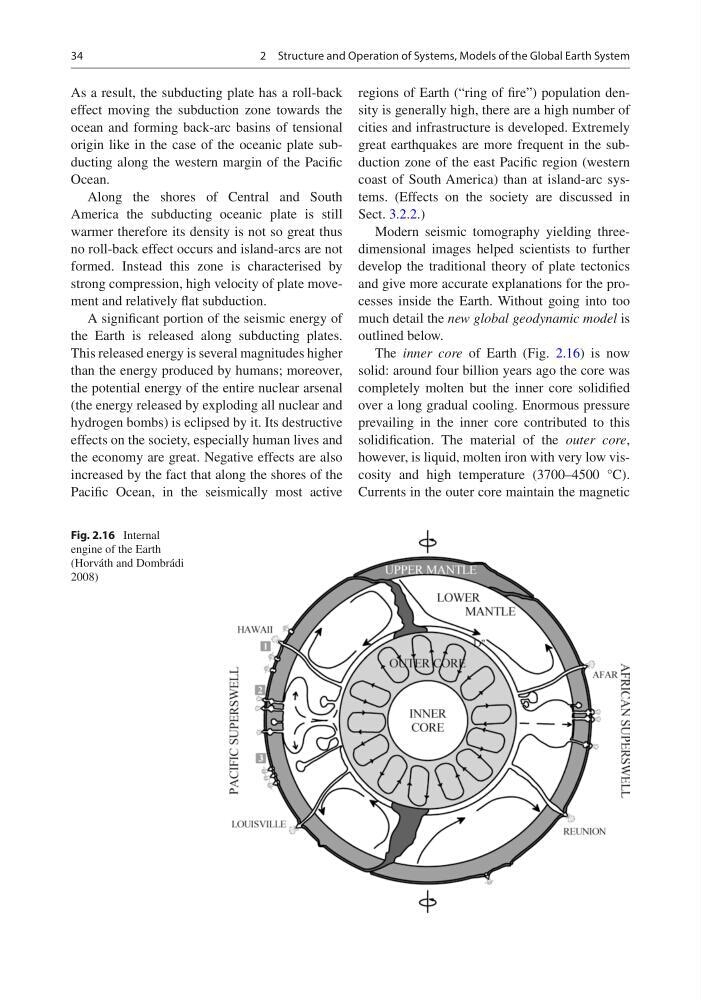
The inner core of Earth (Fig. 2.16) is now
solid: around four billion years ago the core was
completely molten but the inner core solidified
over a long gradual cooling. Enormous pressure
prevailing in the inner core contributed to this
solidification. The material of the outer core,
however, is liquid, molten iron with very low viscosity and high temperature (3700–4500 °C).
Currents in the outer core maintain the magnetic
Fig. 2.16 Internal
engine of the Earth
(Horváth and Dombrádi
2008)
2 Structure and Operation of Systems, Models of the Global Earth System
As a result, the subducting plate has a roll-back
effect moving the subduction zone towards the
ocean and forming back-arc basins of tensional
origin like in the case of the oceanic plate subducting along the western margin of the Pacific
Ocean.
Along the shores of Central and South
America the subducting oceanic plate is still
warmer therefore its density is not so great thus
no roll-back effect occurs and island-arcs are not
formed. Instead this zone is characterised by
strong compression, high velocity of plate movement and relatively flat subduction.
A significant portion of the seismic energy of
the Earth is released along subducting plates.
This released energy is several magnitudes higher
than the energy produced by humans; moreover,
the potential energy of the entire nuclear arsenal
(the energy released by exploding all nuclear and
hydrogen bombs) is eclipsed by it. Its destructive
effects on the society, especially human lives and
the economy are great. Negative effects are also
increased by the fact that along the shores of the
Pacific Ocean, in the seismically most active
regions of Earth (“ring of fire”) population density is generally high, there are a high number of
cities and infrastructure is developed. Extremely
great earthquakes are more frequent in the subduction zone of the east Pacific region (western
coast of South America) than at island-arc systems. (Effects on the society are discussed in
Sect. 3.2.2.)
Modern seismic tomography yielding threedimensional images helped scientists to further
develop the traditional theory of plate tectonics
and give more accurate explanations for the processes inside the Earth. Without going into too
much detail the new global geodynamic model is
outlined below.
The inner core of Earth (Fig. 2.16) is now
solid: around four billion years ago the core was
completely molten but the inner core solidified
over a long gradual cooling. Enormous pressure
prevailing in the inner core contributed to this
solidification. The material of the outer core,
however, is liquid, molten iron with very low viscosity and high temperature (3700–4500 °C).
Currents in the outer core maintain the magnetic
Fig. 2.16 Internal
engine of the Earth
(Horváth and Dombrádi
2008)
2 Structure and Operation of Systems, Models of the Global Earth System