

15
space, gas particles from the atmosphere, etc.)
Earth. At the same time, Earth is a living system
as well, at least on the basis of the operation of
certain spheres (lithosphere, hydrosphere, pedosphere, atmosphere and biosphere developed as a
result of the interaction of the former ones with
life). In natural conditions (without human activities) multicellular living beings could not leave
Earth for space because they could not bear conditions in the central or top zone of the atmosphere. This is not happening today because such
living beings cannot reach such heights in the
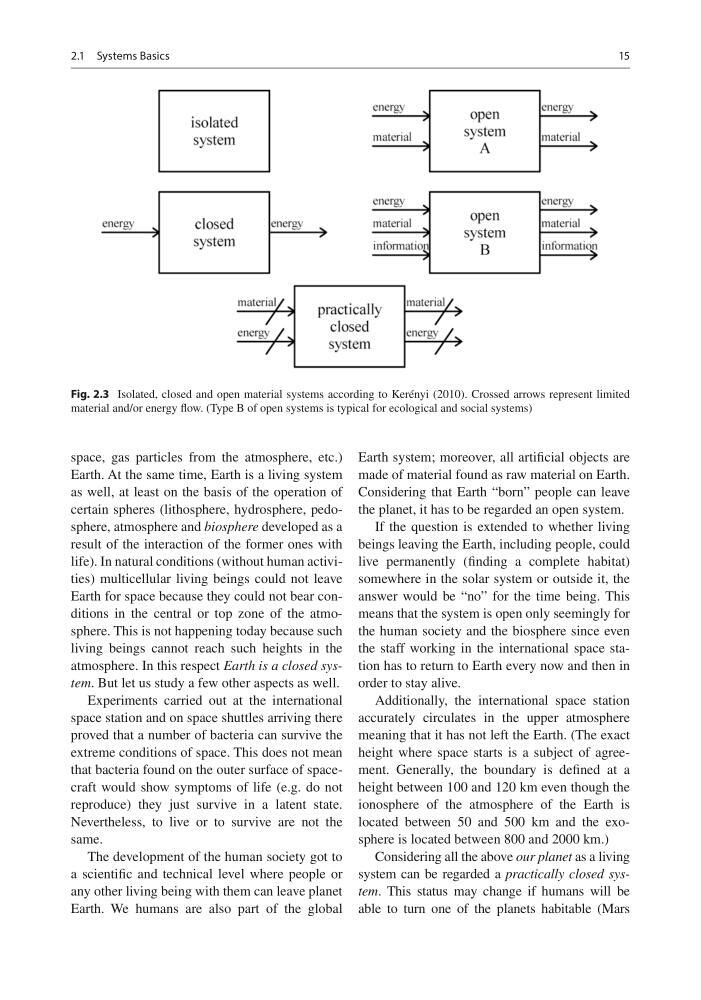
atmosphere. In this respect Earth is a closed system. But let us study a few other aspects as well.
Experiments carried out at the international
space station and on space shuttles arriving there
proved that a number of bacteria can survive the
extreme conditions of space. This does not mean
that bacteria found on the outer surface of spacecraft would show symptoms of life (e.g. do not
reproduce) they just survive in a latent state.
Nevertheless, to live or to survive are not the
same.
The development of the human society got to
a scientific and technical level where people or
any other living being with them can leave planet
Earth. We humans are also part of the global
Earth system; moreover, all artificial objects are
made of material found as raw material on Earth.
Considering that Earth “born” people can leave
the planet, it has to be regarded an open system.
If the question is extended to whether living
beings leaving the Earth, including people, could
live permanently (finding a complete habitat)
somewhere in the solar system or outside it, the
answer would be “no” for the time being. This
means that the system is open only seemingly for
the human society and the biosphere since even
the staff working in the international space station has to return to Earth every now and then in
order to stay alive.
Additionally, the international space station
accurately circulates in the upper atmosphere
meaning that it has not left the Earth. (The exact
height where space starts is a subject of agreement. Generally, the boundary is defined at a
height between 100 and 120 km even though the
ionosphere of the atmosphere of the Earth is
located between 50 and 500 km and the exosphere is located between 800 and 2000 km.)
Considering all the above our planet as a living
system can be regarded a practically closed system. This status may change if humans will be
able to turn one of the planets habitable (Mars
Fig. 2.3 Isolated, closed and open material systems according to Kerényi (2010). Crossed arrows represent limited
material and/or energy flow. (Type B of open systems is typical for ecological and social systems)
2.1 Systems Basics
space, gas particles from the atmosphere, etc.)
Earth. At the same time, Earth is a living system
as well, at least on the basis of the operation of
certain spheres (lithosphere, hydrosphere, pedosphere, atmosphere and biosphere developed as a
result of the interaction of the former ones with
life). In natural conditions (without human activities) multicellular living beings could not leave
Earth for space because they could not bear conditions in the central or top zone of the atmosphere. This is not happening today because such
living beings cannot reach such heights in the
atmosphere. In this respect Earth is a closed system. But let us study a few other aspects as well.
Experiments carried out at the international
space station and on space shuttles arriving there
proved that a number of bacteria can survive the
extreme conditions of space. This does not mean
that bacteria found on the outer surface of spacecraft would show symptoms of life (e.g. do not
reproduce) they just survive in a latent state.
Nevertheless, to live or to survive are not the
same.
The development of the human society got to
a scientific and technical level where people or
any other living being with them can leave planet
Earth. We humans are also part of the global
Earth system; moreover, all artificial objects are
made of material found as raw material on Earth.
Considering that Earth “born” people can leave
the planet, it has to be regarded an open system.
If the question is extended to whether living
beings leaving the Earth, including people, could
live permanently (finding a complete habitat)
somewhere in the solar system or outside it, the
answer would be “no” for the time being. This
means that the system is open only seemingly for
the human society and the biosphere since even
the staff working in the international space station has to return to Earth every now and then in
order to stay alive.
Additionally, the international space station
accurately circulates in the upper atmosphere
meaning that it has not left the Earth. (The exact
height where space starts is a subject of agreement. Generally, the boundary is defined at a
height between 100 and 120 km even though the
ionosphere of the atmosphere of the Earth is
located between 50 and 500 km and the exosphere is located between 800 and 2000 km.)
Considering all the above our planet as a living
system can be regarded a practically closed system. This status may change if humans will be
able to turn one of the planets habitable (Mars
Fig. 2.3 Isolated, closed and open material systems according to Kerényi (2010). Crossed arrows represent limited
material and/or energy flow. (Type B of open systems is typical for ecological and social systems)
2.1 Systems Basics