

255
were published in a book with the title “The second curve”, and the key objectives of the published view are summarised in the followings
with some additions of the authors.
The authors note that contrary to the rather
technocrat social transition envisioned by
Stevenson (2011) in his book, Handy (2015)
describes a much more versatile transformation
taking into account besides new technologies, the
changes of the economic environment, the role of
human imagination and intuition, the development of education and the role of governments
and even of families in the transformation.
The starting point of Handy is that if the world
around us changes we have to change with it,
even more, dramatic changes in the whole society
are necessary. (The authors of the present book
mentioned before that the basic characteristics
and feelings of people have not changed for thousands of years. It is more likely in the case of
Handy’s opinion that certain characteristics are
slightly more accentuated than others in the modern world: intellectual abilities of people are used
in greater ratio than thousands of years ago; we
have to learn to use modern devices, new forms
of communication, etc. Yet, basic human characteristics, feelings, like love, hate, lust for power,
helpfulness, selfishness, etc. remain).
According to the idea of Handy, the change
has to begin started before the end of the previous
progress phase. That is already today. Such
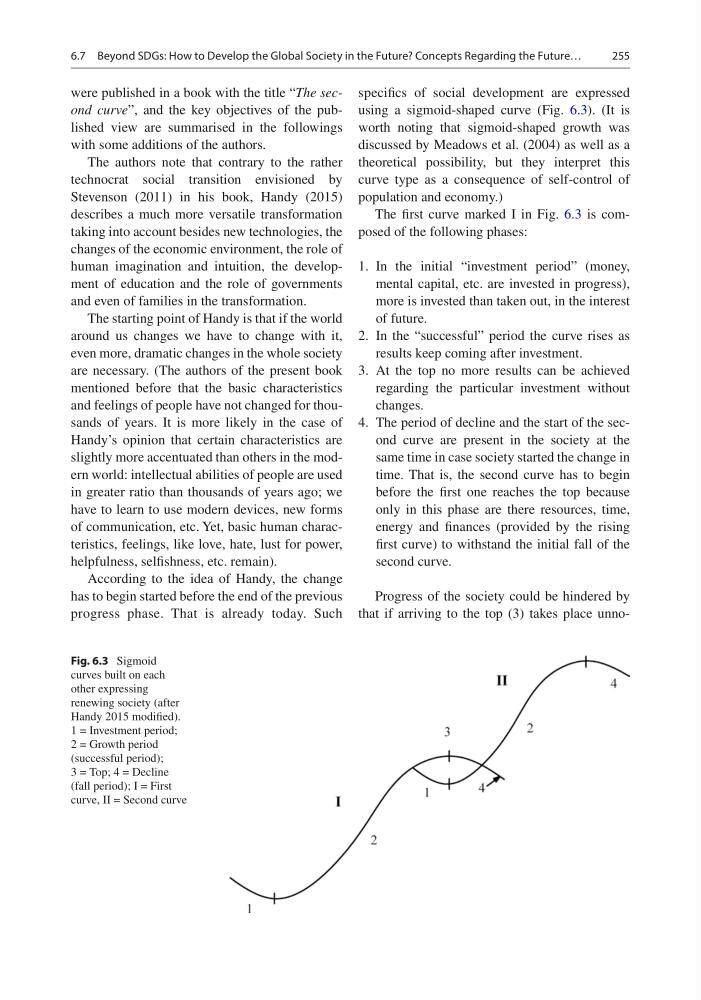
specifics of social development are expressed
using a sigmoid-shaped curve (Fig. 6.3). (It is
worth noting that sigmoid-shaped growth was
discussed by Meadows et al. (2004) as well as a
theoretical possibility, but they interpret this
curve type as a consequence of self-control of
population and economy.)
The first curve marked I in Fig. 6.3 is composed of the following phases:
1. In the initial “investment period” (money,
mental capital, etc. are invested in progress),
more is invested than taken out, in the interest
of future.
2. In the “successful” period the curve rises as
results keep coming after investment.
3. At the top no more results can be achieved
regarding the particular investment without
changes.
4. The period of decline and the start of the second curve are present in the society at the
same time in case society started the change in
time. That is, the second curve has to begin
before the first one reaches the top because
only in this phase are there resources, time,
energy and finances (provided by the rising
first curve) to withstand the initial fall of the
second curve.
Progress of the society could be hindered by
that if arriving to the top (3) takes place unnoFig. 6.3 Sigmoid
curves built on each
other expressing
renewing society (after
Handy 2015 modified).
1 = Investment period;
2 = Growth period
(successful period);
3 = Top; 4 = Decline
(fall period); I = First
curve, II = Second curve
6.7 Beyond SDGs: How to Develop the Global Society in the Future? Concepts Regarding the Future…
were published in a book with the title “The second curve”, and the key objectives of the published view are summarised in the followings
with some additions of the authors.
The authors note that contrary to the rather
technocrat social transition envisioned by
Stevenson (2011) in his book, Handy (2015)
describes a much more versatile transformation
taking into account besides new technologies, the
changes of the economic environment, the role of
human imagination and intuition, the development of education and the role of governments
and even of families in the transformation.
The starting point of Handy is that if the world
around us changes we have to change with it,
even more, dramatic changes in the whole society
are necessary. (The authors of the present book
mentioned before that the basic characteristics
and feelings of people have not changed for thousands of years. It is more likely in the case of
Handy’s opinion that certain characteristics are
slightly more accentuated than others in the modern world: intellectual abilities of people are used
in greater ratio than thousands of years ago; we
have to learn to use modern devices, new forms
of communication, etc. Yet, basic human characteristics, feelings, like love, hate, lust for power,
helpfulness, selfishness, etc. remain).
According to the idea of Handy, the change
has to begin started before the end of the previous
progress phase. That is already today. Such
specifics of social development are expressed
using a sigmoid-shaped curve (Fig. 6.3). (It is
worth noting that sigmoid-shaped growth was
discussed by Meadows et al. (2004) as well as a
theoretical possibility, but they interpret this
curve type as a consequence of self-control of
population and economy.)
The first curve marked I in Fig. 6.3 is composed of the following phases:
1. In the initial “investment period” (money,
mental capital, etc. are invested in progress),
more is invested than taken out, in the interest
of future.
2. In the “successful” period the curve rises as
results keep coming after investment.
3. At the top no more results can be achieved
regarding the particular investment without
changes.
4. The period of decline and the start of the second curve are present in the society at the
same time in case society started the change in
time. That is, the second curve has to begin
before the first one reaches the top because
only in this phase are there resources, time,
energy and finances (provided by the rising
first curve) to withstand the initial fall of the
second curve.
Progress of the society could be hindered by
that if arriving to the top (3) takes place unnoFig. 6.3 Sigmoid
curves built on each
other expressing
renewing society (after
Handy 2015 modified).
1 = Investment period;
2 = Growth period
(successful period);
3 = Top; 4 = Decline
(fall period); I = First
curve, II = Second curve
6.7 Beyond SDGs: How to Develop the Global Society in the Future? Concepts Regarding the Future…