

247
refuse violence but fanatics fight their war against
“unbelievers” (Kafir in Arabic) with modern
weapons and commit suicide attacks in developed western states in the name of Allah (Islamic
State for example).
A major concern is presented by the great
abyss between religious doctrines and the behaviour of people referring themselves as religious
that can be often experienced. Christians should
live according to the teachings of Jesus. The
wealth of Christian churches or decisions of
Christian politicians hitting poor social groups
and supporting wealthy people increasing in this
way the rift between poor and rich people sharply
contradict the above. Followers frequently not
even notice such contradictions.
Despite all these contradictions, measures of
church leaders like the encyclical of Pope Francis
on environmental protection issued in 2015 are
considered useful by the authors. Climate change
is a topic in the focus of the above document of
almost two hundred pages. Regarding this, the
Pope asks not only Christians to do every effort
in order to avoid global warming but every sensible person of any religion. Surely many people
listen to the guidance given by the Pope; however, the effectiveness of the encyclical was
reduced significantly by certain Christian politicians who sharply criticised the words of the
Pope. Republican believers must have been troubled by the opposing opinions. A worldwide survey carried out several times since the 1980s
revealed that 62% of the people consider right
that religious leaders let their voice heard in environmental issues (Gardner 2010).
According to Pan Yue, Chinese deputy minister of environmental protection, Confucianism,
Taoism and Buddhism are effective tools in preventing environmental crisis (Gardner 2010). A
group of Taoist masters searched solutions to
avoid climate change in 2008. Their recommendations included—among others—the supply of
churches with solar energy and the establishment
of a Taoist environmental protection network.
The concept of making buildings greener and
saving energy is also popular in American religious communities.
The UN tries to encourage the efforts of
churches in environmental protection. Together
with an English civil organisation, the
Environment—Churches
and
Christian
Organisations encouraged churches to compose
seven-year climate and environmental protection
plans. Several churches acted accordingly by
2009 timing to the climate conference of UN in
Copenhagen.
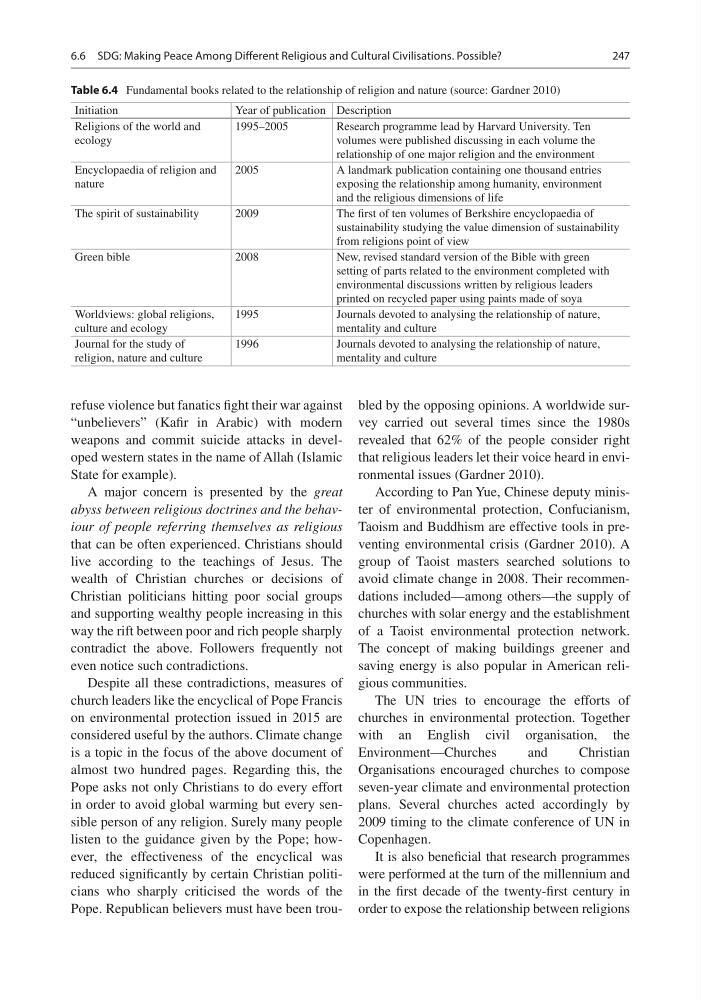
It is also beneficial that research programmes
were performed at the turn of the millennium and
in the first decade of the twenty-first century in
order to expose the relationship between religions
Table 6.4 Fundamental books related to the relationship of religion and nature (source: Gardner 2010)
Initiation
Year of publication Description
Religions of the world and
ecology
1995–2005
Research programme lead by Harvard University. Ten
volumes were published discussing in each volume the
relationship of one major religion and the environment
Encyclopaedia of religion and
nature
2005
A landmark publication containing one thousand entries
exposing the relationship among humanity, environment
and the religious dimensions of life
The spirit of sustainability
2009
The first of ten volumes of Berkshire encyclopaedia of
sustainability studying the value dimension of sustainability
from religions point of view
Green bible
2008
New, revised standard version of the Bible with green
setting of parts related to the environment completed with
environmental discussions written by religious leaders
printed on recycled paper using paints made of soya
Worldviews: global religions,
culture and ecology
1995
Journals devoted to analysing the relationship of nature,
mentality and culture
Journal for the study of
religion, nature and culture
1996
Journals devoted to analysing the relationship of nature,
mentality and culture
6.6 SDG: Making Peace Among Different Religious and Cultural Civilisations. Possible?
refuse violence but fanatics fight their war against
“unbelievers” (Kafir in Arabic) with modern
weapons and commit suicide attacks in developed western states in the name of Allah (Islamic
State for example).
A major concern is presented by the great
abyss between religious doctrines and the behaviour of people referring themselves as religious
that can be often experienced. Christians should
live according to the teachings of Jesus. The
wealth of Christian churches or decisions of
Christian politicians hitting poor social groups
and supporting wealthy people increasing in this
way the rift between poor and rich people sharply
contradict the above. Followers frequently not
even notice such contradictions.
Despite all these contradictions, measures of
church leaders like the encyclical of Pope Francis
on environmental protection issued in 2015 are
considered useful by the authors. Climate change
is a topic in the focus of the above document of
almost two hundred pages. Regarding this, the
Pope asks not only Christians to do every effort
in order to avoid global warming but every sensible person of any religion. Surely many people
listen to the guidance given by the Pope; however, the effectiveness of the encyclical was
reduced significantly by certain Christian politicians who sharply criticised the words of the
Pope. Republican believers must have been troubled by the opposing opinions. A worldwide survey carried out several times since the 1980s
revealed that 62% of the people consider right
that religious leaders let their voice heard in environmental issues (Gardner 2010).
According to Pan Yue, Chinese deputy minister of environmental protection, Confucianism,
Taoism and Buddhism are effective tools in preventing environmental crisis (Gardner 2010). A
group of Taoist masters searched solutions to
avoid climate change in 2008. Their recommendations included—among others—the supply of
churches with solar energy and the establishment
of a Taoist environmental protection network.
The concept of making buildings greener and
saving energy is also popular in American religious communities.
The UN tries to encourage the efforts of
churches in environmental protection. Together
with an English civil organisation, the
Environment—Churches
and
Christian
Organisations encouraged churches to compose
seven-year climate and environmental protection
plans. Several churches acted accordingly by
2009 timing to the climate conference of UN in
Copenhagen.
It is also beneficial that research programmes
were performed at the turn of the millennium and
in the first decade of the twenty-first century in
order to expose the relationship between religions
Table 6.4 Fundamental books related to the relationship of religion and nature (source: Gardner 2010)
Initiation
Year of publication Description
Religions of the world and
ecology
1995–2005
Research programme lead by Harvard University. Ten
volumes were published discussing in each volume the
relationship of one major religion and the environment
Encyclopaedia of religion and
nature
2005
A landmark publication containing one thousand entries
exposing the relationship among humanity, environment
and the religious dimensions of life
The spirit of sustainability
2009
The first of ten volumes of Berkshire encyclopaedia of
sustainability studying the value dimension of sustainability
from religions point of view
Green bible
2008
New, revised standard version of the Bible with green
setting of parts related to the environment completed with
environmental discussions written by religious leaders
printed on recycled paper using paints made of soya
Worldviews: global religions,
culture and ecology
1995
Journals devoted to analysing the relationship of nature,
mentality and culture
Journal for the study of
religion, nature and culture
1996
Journals devoted to analysing the relationship of nature,
mentality and culture
6.6 SDG: Making Peace Among Different Religious and Cultural Civilisations. Possible?