

237
school would be retained, pupils learn the specifics of their native tongue, the powerful pieces of
their national literature, the history, culture, traditions of their nation and the geographical conditions of their country. Besides the above,
conventional basics are also emphasised that are
completed with informatics and PC basics and
also with primary education of at least one foreign language.
Later, upper classes further deepen their knowledge of digitalisation apart from the basics of natural sciences and learn also the basics of programming.
Students interpret the consequences of anthropogenic effects on the natural environment based on
systems thinking (taking age specifics and already
learnt knowledge into account). Learning the most
important event of world history is closed with discussing the lessons related to the present.
Approaching the present in learning history emphasis has to be placed on the fact that countries (different societies) can only tackle the most serious
problems of humanity in cooperation.
One guiding yarn for moral education should
be coexistence, cooperation and empathy not
only regarding those living in our immediate surroundings but also people of different nationality,
religion and skin colour. Maybe the empathic and
tolerant generation educated in the schools of the
new mentality will be able to accept the diversity
of the human race while searching for common
values and to realise sustainable development
bearing in mind the fundamental common interests of the human society. This, of course, is only
a hope, an optimistic approach. Long-term global
education development programmes would be
required for the above, the realisation of which
would be encouraged by grassroots initiatives.
Besides increasing mental load on students,
their physical education and teaching a healthy
lifestyle also have to be cared for because the
digital revolution brings a lifestyle lacking
motion that could result in the development of
new endemics. Sport is most suitable for hindering the development of these diseases.
Methods applied in the new modern school
have to be developed as well. The authors wish
not to detail the developments but one increasingly popular, revolutionary method is mentioned
here, education using virtual reality that could be
very effective in learning complex processes.
When using this method, the students have to be
repeatedly reminded that they apply a simulation
of the real world where faults have no real, possibly dangerous consequences. The method could
be useful in bringing the everyday life of people
living with permanent disabilities or those living
in different cultures increasing in this way their
capability of empathy.
Most education experts agree in that future
schools have to place emphasis not on the content
of education but skills and abilities that can be
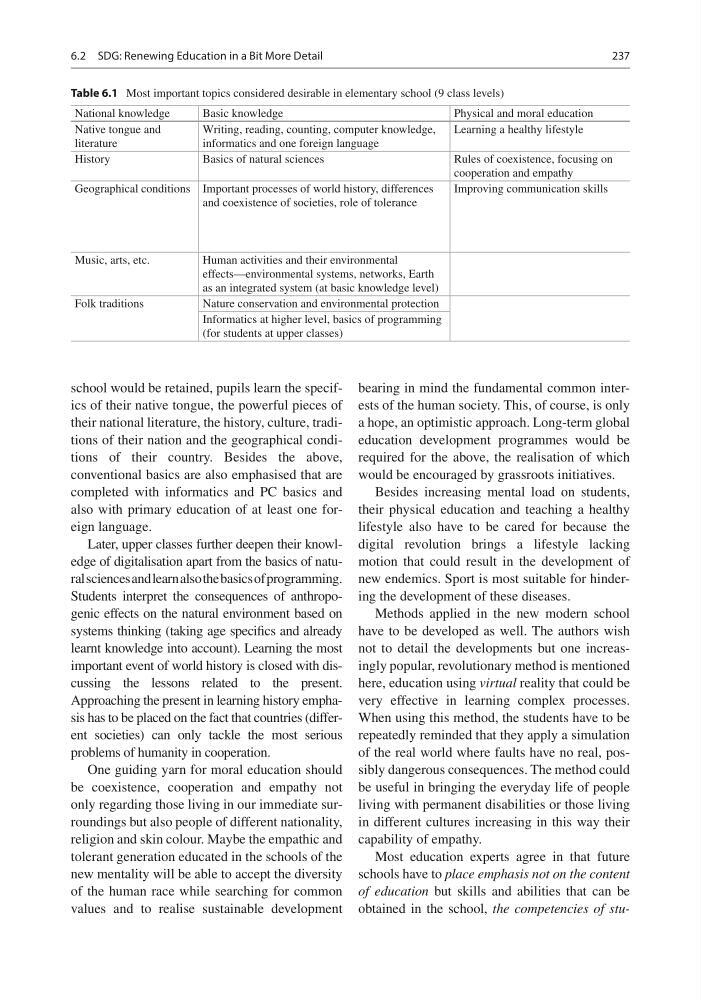
obtained in the school, the competencies of stuTable 6.1 Most important topics considered desirable in elementary school (9 class levels)
National knowledge
Basic knowledge
Physical and moral education
Native tongue and
literature
Writing, reading, counting, computer knowledge,
informatics and one foreign language
Learning a healthy lifestyle
History
Basics of natural sciences
Rules of coexistence, focusing on
cooperation and empathy
Geographical conditions Important processes of world history, differences
and coexistence of societies, role of tolerance
Improving communication skills
Music, arts, etc.
Human activities and their environmental
effects—environmental systems, networks, Earth
as an integrated system (at basic knowledge level)
Folk traditions
Nature conservation and environmental protection
Informatics at higher level, basics of programming
(for students at upper classes)
6.2 SDG: Renewing Education in a Bit More Detail
school would be retained, pupils learn the specifics of their native tongue, the powerful pieces of
their national literature, the history, culture, traditions of their nation and the geographical conditions of their country. Besides the above,
conventional basics are also emphasised that are
completed with informatics and PC basics and
also with primary education of at least one foreign language.
Later, upper classes further deepen their knowledge of digitalisation apart from the basics of natural sciences and learn also the basics of programming.
Students interpret the consequences of anthropogenic effects on the natural environment based on
systems thinking (taking age specifics and already
learnt knowledge into account). Learning the most
important event of world history is closed with discussing the lessons related to the present.
Approaching the present in learning history emphasis has to be placed on the fact that countries (different societies) can only tackle the most serious
problems of humanity in cooperation.
One guiding yarn for moral education should
be coexistence, cooperation and empathy not
only regarding those living in our immediate surroundings but also people of different nationality,
religion and skin colour. Maybe the empathic and
tolerant generation educated in the schools of the
new mentality will be able to accept the diversity
of the human race while searching for common
values and to realise sustainable development
bearing in mind the fundamental common interests of the human society. This, of course, is only
a hope, an optimistic approach. Long-term global
education development programmes would be
required for the above, the realisation of which
would be encouraged by grassroots initiatives.
Besides increasing mental load on students,
their physical education and teaching a healthy
lifestyle also have to be cared for because the
digital revolution brings a lifestyle lacking
motion that could result in the development of
new endemics. Sport is most suitable for hindering the development of these diseases.
Methods applied in the new modern school
have to be developed as well. The authors wish
not to detail the developments but one increasingly popular, revolutionary method is mentioned
here, education using virtual reality that could be
very effective in learning complex processes.
When using this method, the students have to be
repeatedly reminded that they apply a simulation
of the real world where faults have no real, possibly dangerous consequences. The method could
be useful in bringing the everyday life of people
living with permanent disabilities or those living
in different cultures increasing in this way their
capability of empathy.
Most education experts agree in that future
schools have to place emphasis not on the content
of education but skills and abilities that can be
obtained in the school, the competencies of stuTable 6.1 Most important topics considered desirable in elementary school (9 class levels)
National knowledge
Basic knowledge
Physical and moral education
Native tongue and
literature
Writing, reading, counting, computer knowledge,
informatics and one foreign language
Learning a healthy lifestyle
History
Basics of natural sciences
Rules of coexistence, focusing on
cooperation and empathy
Geographical conditions Important processes of world history, differences
and coexistence of societies, role of tolerance
Improving communication skills
Music, arts, etc.
Human activities and their environmental
effects—environmental systems, networks, Earth
as an integrated system (at basic knowledge level)
Folk traditions
Nature conservation and environmental protection
Informatics at higher level, basics of programming
(for students at upper classes)
6.2 SDG: Renewing Education in a Bit More Detail