

4
ent capital types is limited, and the most
important elements of natural capital cannot be
included in exchange. The authors consider this
interpretation slightly more reasonable, however, the key is the particular substitution of sustainable measures. It is also fundamental to
know the basis on which the more important and
less important elements of natural capital are
identified.
On the contrary, in “strong sustainability” no
capital substitution is possible. This idea would
strictly limit the access of the society to natural
resources and the number and extent of conflicts
would be significantly increased especially in the
countries of the Third World.
Besides the above qualitative characterisation
of sustainability interpretations, public economists defined weak and strong sustainability
based on equations (Kerekes 2007). The Hicks–
Page–Hartwick–Solow approach makes it possible to give an equation to sustainability (Pearce
and Atkinson 1992).
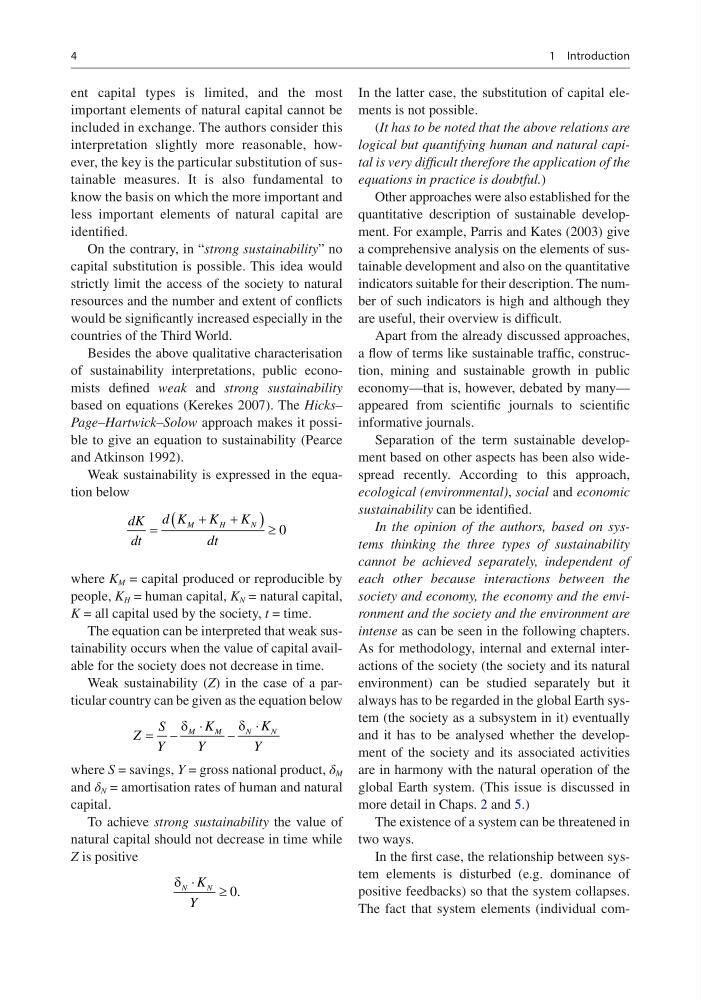
Weak sustainability is expressed in the equation below
dK
dt
d K
K
K
dt
M
H
N
=
+
+
(
) ≥ 0
where K M = capital produced or reproducible by
people, K H = human capital, K N = natural capital,
K = all capital used by the society, t = time.
The equation can be interpreted that weak sustainability occurs when the value of capital available for the society does not decrease in time.
Weak sustainability (Z) in the case of a particular country can be given as the equation below
Z
S
Y
K
Y
K
Y
M
M
N
N
=
⋅
⋅
–
–
δ
δ
where S = savings, Y = gross national product, δ M
and δ N = amortisation rates of human and natural
capital.
To achieve strong sustainability the value of
natural capital should not decrease in time while
Z is positive
δ N N
K
Y
⋅
≥ 0.
In the latter case, the substitution of capital elements is not possible.
(It has to be noted that the above relations are
logical but quantifying human and natural capital is very difficult therefore the application of the
equations in practice is doubtful.)
Other approaches were also established for the
quantitative description of sustainable development. For example, Parris and Kates (2003) give
a comprehensive analysis on the elements of sustainable development and also on the quantitative
indicators suitable for their description. The number of such indicators is high and although they
are useful, their overview is difficult.
Apart from the already discussed approaches,
a flow of terms like sustainable traffic, construction, mining and sustainable growth in public
economy—that is, however, debated by many—
appeared from scientific journals to scientific
informative journals.
Separation of the term sustainable development based on other aspects has been also widespread recently. According to this approach,
ecological (environmental), social and economic
sustainability can be identified.
In the opinion of the authors, based on systems thinking the three types of sustainability
cannot be achieved separately, independent of
each other because interactions between the
society and economy, the economy and the environment and the society and the environment are
intense as can be seen in the following chapters.
As for methodology, internal and external interactions of the society (the society and its natural
environment) can be studied separately but it
always has to be regarded in the global Earth system (the society as a subsystem in it) eventually
and it has to be analysed whether the development of the society and its associated activities
are in harmony with the natural operation of the
global Earth system. (This issue is discussed in
more detail in Chaps. 2 and 5.)
The existence of a system can be threatened in
two ways.
In the first case, the relationship between system elements is disturbed (e.g. dominance of
positive feedbacks) so that the system collapses.
The fact that system elements (individual com1 Introduction
ent capital types is limited, and the most
important elements of natural capital cannot be
included in exchange. The authors consider this
interpretation slightly more reasonable, however, the key is the particular substitution of sustainable measures. It is also fundamental to
know the basis on which the more important and
less important elements of natural capital are
identified.
On the contrary, in “strong sustainability” no
capital substitution is possible. This idea would
strictly limit the access of the society to natural
resources and the number and extent of conflicts
would be significantly increased especially in the
countries of the Third World.
Besides the above qualitative characterisation
of sustainability interpretations, public economists defined weak and strong sustainability
based on equations (Kerekes 2007). The Hicks–
Page–Hartwick–Solow approach makes it possible to give an equation to sustainability (Pearce
and Atkinson 1992).
Weak sustainability is expressed in the equation below
dK
dt
d K
K
K
dt
M
H
N
=
+
+
(
) ≥ 0
where K M = capital produced or reproducible by
people, K H = human capital, K N = natural capital,
K = all capital used by the society, t = time.
The equation can be interpreted that weak sustainability occurs when the value of capital available for the society does not decrease in time.
Weak sustainability (Z) in the case of a particular country can be given as the equation below
Z
S
Y
K
Y
K
Y
M
M
N
N
=
⋅
⋅
–
–
δ
δ
where S = savings, Y = gross national product, δ M
and δ N = amortisation rates of human and natural
capital.
To achieve strong sustainability the value of
natural capital should not decrease in time while
Z is positive
δ N N
K
Y
⋅
≥ 0.
In the latter case, the substitution of capital elements is not possible.
(It has to be noted that the above relations are
logical but quantifying human and natural capital is very difficult therefore the application of the
equations in practice is doubtful.)
Other approaches were also established for the
quantitative description of sustainable development. For example, Parris and Kates (2003) give
a comprehensive analysis on the elements of sustainable development and also on the quantitative
indicators suitable for their description. The number of such indicators is high and although they
are useful, their overview is difficult.
Apart from the already discussed approaches,
a flow of terms like sustainable traffic, construction, mining and sustainable growth in public
economy—that is, however, debated by many—
appeared from scientific journals to scientific
informative journals.
Separation of the term sustainable development based on other aspects has been also widespread recently. According to this approach,
ecological (environmental), social and economic
sustainability can be identified.
In the opinion of the authors, based on systems thinking the three types of sustainability
cannot be achieved separately, independent of
each other because interactions between the
society and economy, the economy and the environment and the society and the environment are
intense as can be seen in the following chapters.
As for methodology, internal and external interactions of the society (the society and its natural
environment) can be studied separately but it
always has to be regarded in the global Earth system (the society as a subsystem in it) eventually
and it has to be analysed whether the development of the society and its associated activities
are in harmony with the natural operation of the
global Earth system. (This issue is discussed in
more detail in Chaps. 2 and 5.)
The existence of a system can be threatened in
two ways.
In the first case, the relationship between system elements is disturbed (e.g. dominance of
positive feedbacks) so that the system collapses.
The fact that system elements (individual com1 Introduction