

184
rays with shorter wave length through and absorb
in significant extent the long wave rays, i.e. heat
waves of the Earth surface. As a result, the atmosphere warms near the surface while the upper
atmosphere cools.
The majority of atmospheric aerosols trigger
an opposite effect. These colloid-sized (smaller
than 500 nm) liquid drops and solid particles
reduce greenhouse effects; however, the mechanism of their effects still holds much uncertainty.
Fleecy clouds (cirrocumulus) occurring at great
height, for example, intensify warming (positive
feedback) while greater short wave ray reflecting
capacity of clouds with increased water vapour
content has a cooling effect (negative feedback).
Potentially increasing amount of solid particle
above oceans—condensation nuclei—cause the
growth of small cloud droplets resulting in again
a negative feedback.
Rapid increase of the amount of greenhouse
gases as a result of certain human activities is the
most decisive factor in the future pattern of
Earth’s climate (IPCC 2015). The average atmospheric concentration of carbon dioxide which is
emitted in largest quantity into the atmosphere
among greenhouse gases increased from 280 ppm
before the industrial revolution to over 400 ppm
accounting for an increase of almost 43%.
Climate is influenced by several factors other
than atmospheric gases and aerosols. The climatic system is very complicated, multiply complex system, the subsystems of which include the
atmosphere, oceans, continent surfaces, cryosphere (ice sheets) and the biosphere. The state
of the climate is determined by their interaction.
The system is operated by the energy of solar
radiation arriving to the planet as a result of astronomical factors (radiation of the Sun, orbit of the
Earth and other movements of the planet).
Practically the arriving energy is distributed both
in space and time by the climatic system forming
in this way the mosaic pattern of the climate of
Earth.
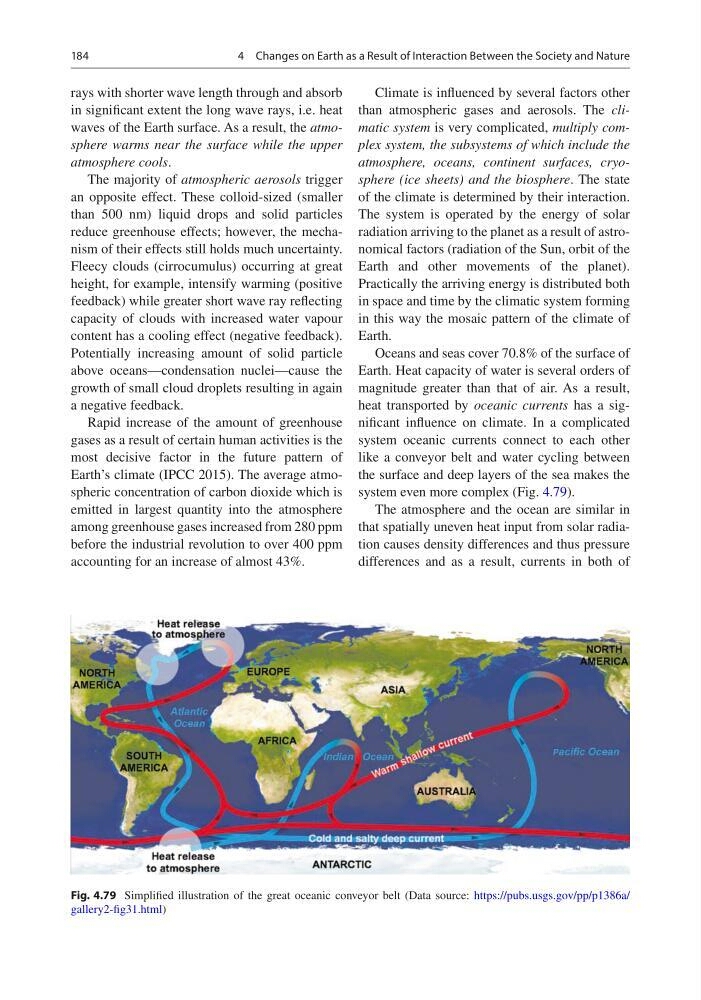
Oceans and seas cover 70.8% of the surface of
Earth. Heat capacity of water is several orders of
magnitude greater than that of air. As a result,
heat transported by oceanic currents has a significant influence on climate. In a complicated
system oceanic currents connect to each other
like a conveyor belt and water cycling between
the surface and deep layers of the sea makes the
system even more complex (Fig. 4.79).
The atmosphere and the ocean are similar in
that spatially uneven heat input from solar radiation causes density differences and thus pressure
differences and as a result, currents in both of
Fig. 4.79 Simplified illustration of the great oceanic conveyor belt (Data source: https://pubs.usgs.gov/pp/p1386a/
gallery2-fig31.html)
4 Changes on Earth as a Result of Interaction Between the Society and Nature
rays with shorter wave length through and absorb
in significant extent the long wave rays, i.e. heat
waves of the Earth surface. As a result, the atmosphere warms near the surface while the upper
atmosphere cools.
The majority of atmospheric aerosols trigger
an opposite effect. These colloid-sized (smaller
than 500 nm) liquid drops and solid particles
reduce greenhouse effects; however, the mechanism of their effects still holds much uncertainty.
Fleecy clouds (cirrocumulus) occurring at great
height, for example, intensify warming (positive
feedback) while greater short wave ray reflecting
capacity of clouds with increased water vapour
content has a cooling effect (negative feedback).
Potentially increasing amount of solid particle
above oceans—condensation nuclei—cause the
growth of small cloud droplets resulting in again
a negative feedback.
Rapid increase of the amount of greenhouse
gases as a result of certain human activities is the
most decisive factor in the future pattern of
Earth’s climate (IPCC 2015). The average atmospheric concentration of carbon dioxide which is
emitted in largest quantity into the atmosphere
among greenhouse gases increased from 280 ppm
before the industrial revolution to over 400 ppm
accounting for an increase of almost 43%.
Climate is influenced by several factors other
than atmospheric gases and aerosols. The climatic system is very complicated, multiply complex system, the subsystems of which include the
atmosphere, oceans, continent surfaces, cryosphere (ice sheets) and the biosphere. The state
of the climate is determined by their interaction.
The system is operated by the energy of solar
radiation arriving to the planet as a result of astronomical factors (radiation of the Sun, orbit of the
Earth and other movements of the planet).
Practically the arriving energy is distributed both
in space and time by the climatic system forming
in this way the mosaic pattern of the climate of
Earth.
Oceans and seas cover 70.8% of the surface of
Earth. Heat capacity of water is several orders of
magnitude greater than that of air. As a result,
heat transported by oceanic currents has a significant influence on climate. In a complicated
system oceanic currents connect to each other
like a conveyor belt and water cycling between
the surface and deep layers of the sea makes the
system even more complex (Fig. 4.79).
The atmosphere and the ocean are similar in
that spatially uneven heat input from solar radiation causes density differences and thus pressure
differences and as a result, currents in both of
Fig. 4.79 Simplified illustration of the great oceanic conveyor belt (Data source: https://pubs.usgs.gov/pp/p1386a/
gallery2-fig31.html)
4 Changes on Earth as a Result of Interaction Between the Society and Nature