

153
tem leading to one of the greatest ecological
catastrophes of recent decades.
According to Hungarian environmental
regulations effective in 2000 water had to be
regarded contaminated if 0.1 mg/L or more
cyanide could be measured in it. The concentration of cyanides in the Szamos and in the
Hungarian section of Tisza permanently
exceeded 10 mg/L, i.e. it was 100-fold of the
limit; however, in certain places and in certain
water samples 400 mg/L concentration (4000fold of the limit) was also measured.
Fish were dead in masses near the
Romanian and Hungarian border on fourth
February. Before the pollution reached the
mouth of a major canal (Main Eastern Canal)
the lock gates were closed in order to protect
the drinking water of the second most populous city in Hungary (Debrecen) and life in the
canal. (Drinking water for the 210,000 inhabitants of the city was partly supplied from the
Main Eastern Canal branching off Tisza
River.) Similar measures were taken at the
gates of the lock of the artificial Tisza Lake
and this proved to be an important action
regarding the regeneration of life in the Tisza
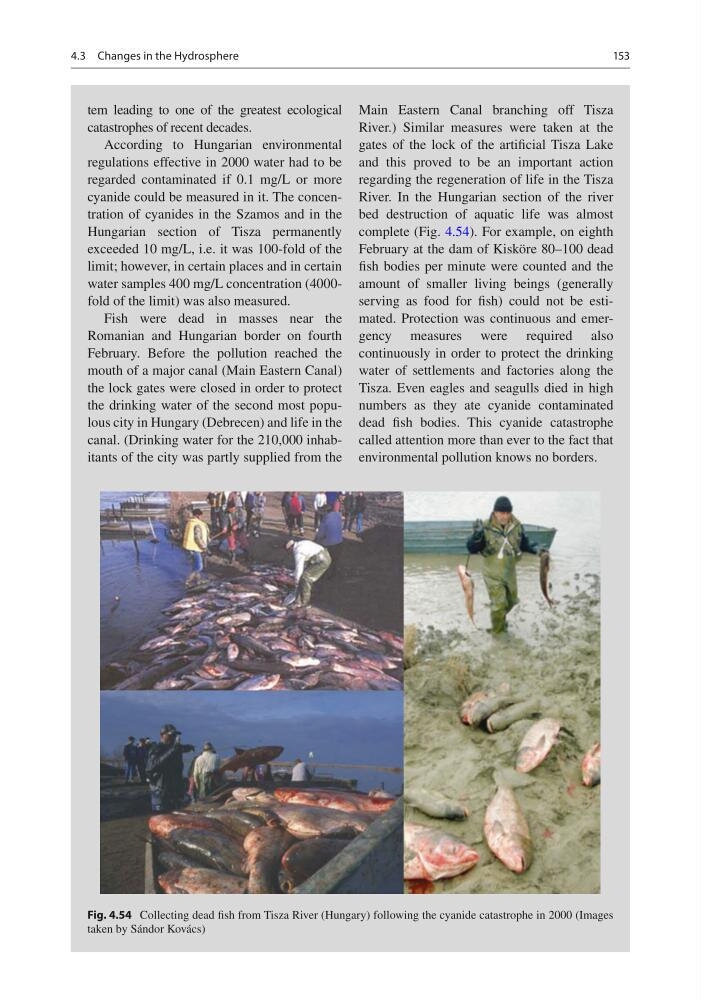
River. In the Hungarian section of the river
bed destruction of aquatic life was almost
complete (Fig. 4.54). For example, on eighth
February at the dam of Kisköre 80–100 dead
fish bodies per minute were counted and the
amount of smaller living beings (generally
serving as food for fish) could not be estimated. Protection was continuous and emergency measures were required also
continuously in order to protect the drinking
water of settlements and factories along the
Tisza. Even eagles and seagulls died in high
numbers as they ate cyanide contaminated
dead fish bodies. This cyanide catastrophe
called attention more than ever to the fact that
environmental pollution knows no borders.
Fig. 4.54 Collecting dead fish from Tisza River (Hungary) following the cyanide catastrophe in 2000 (Images
taken by Sándor Kovács)
4.3 Changes in the Hydrosphere
tem leading to one of the greatest ecological
catastrophes of recent decades.
According to Hungarian environmental
regulations effective in 2000 water had to be
regarded contaminated if 0.1 mg/L or more
cyanide could be measured in it. The concentration of cyanides in the Szamos and in the
Hungarian section of Tisza permanently
exceeded 10 mg/L, i.e. it was 100-fold of the
limit; however, in certain places and in certain
water samples 400 mg/L concentration (4000fold of the limit) was also measured.
Fish were dead in masses near the
Romanian and Hungarian border on fourth
February. Before the pollution reached the
mouth of a major canal (Main Eastern Canal)
the lock gates were closed in order to protect
the drinking water of the second most populous city in Hungary (Debrecen) and life in the
canal. (Drinking water for the 210,000 inhabitants of the city was partly supplied from the
Main Eastern Canal branching off Tisza
River.) Similar measures were taken at the
gates of the lock of the artificial Tisza Lake
and this proved to be an important action
regarding the regeneration of life in the Tisza
River. In the Hungarian section of the river
bed destruction of aquatic life was almost
complete (Fig. 4.54). For example, on eighth
February at the dam of Kisköre 80–100 dead
fish bodies per minute were counted and the
amount of smaller living beings (generally
serving as food for fish) could not be estimated. Protection was continuous and emergency measures were required also
continuously in order to protect the drinking
water of settlements and factories along the
Tisza. Even eagles and seagulls died in high
numbers as they ate cyanide contaminated
dead fish bodies. This cyanide catastrophe
called attention more than ever to the fact that
environmental pollution knows no borders.
Fig. 4.54 Collecting dead fish from Tisza River (Hungary) following the cyanide catastrophe in 2000 (Images
taken by Sándor Kovács)
4.3 Changes in the Hydrosphere