

151
lakes there increased by about 20% due to increased
water supply. Former saline depressions were filled
with water in several places, however, the water of
such lakes is not suitable for human consumption.
In the long term the melting of glaciers is not beneficial because the water supply of the major rivers
in Southeast Asia could decrease later.
Recently using water systems that have not
been utilised before is on the agenda. Such are the
water network of the major tropical rivers like the
Mekong and Amazonas. In these areas dam construction and its consequences can be regarded a
major ecological experiment (Butler 2012). In
lowland areas covered by rainforest the water
dammed up floods vast areas while a host of living beings die and enormous amount of organic
matter becomes flooded in the reservoir. The degradation of this organic matter releases methane
which is a well-known greenhouse gas thus the
electric energy produced by the water power plant
will not be “green energy”. Fertile silt is not
spread onto the soil any more below the dam thus
farmers need to use more fertilisers and some carbon is released from the soil in the form of carbon
dioxide adding also to atmospheric greenhouse
gases. Deforestation in the drainage basin results
in intensified soil degradation (to a greater rate
than in the temperate climate zone) thus siltation
of the reservoirs is faster. At the same time less
sediment load reaches the river deltas resulting in
their erosion and saline water could enter deep
into fresh water areas. In the drainage basin of the
river with greatest discharge on Earth the construction of 150 dams is going on or has been
completed. Regarding Mekong River further 11
dams are planned to be built by 2030 apart from
the already existing ones while 77 is planned to
be built in its drainage basin (Butler 2012). It is
hard to estimate the changes in the above water
systems and in the rainforest environment if all
the planned establishments will start to operate.
Many water systems on Earth are shared
between several countries and generally the socalled upriver countries are in the favourable situation as they can use the major part of the water
of the rivers and downriver countries could
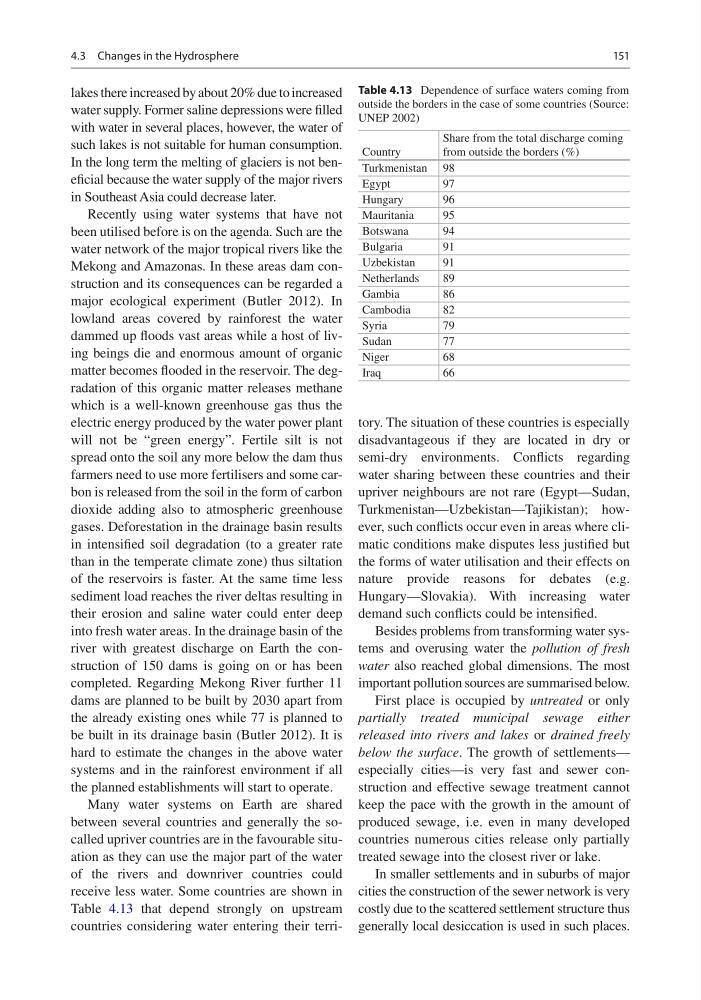
receive less water. Some countries are shown in
Table 4.13 that depend strongly on upstream
countries considering water entering their territory. The situation of these countries is especially
disadvantageous if they are located in dry or
semi-dry environments. Conflicts regarding
water sharing between these countries and their
upriver neighbours are not rare (Egypt—Sudan,
Turkmenistan—Uzbekistan—Tajikistan); however, such conflicts occur even in areas where climatic conditions make disputes less justified but
the forms of water utilisation and their effects on
nature provide reasons for debates (e.g.
Hungary—Slovakia). With increasing water
demand such conflicts could be intensified.
Besides problems from transforming water systems and overusing water the pollution of fresh
water also reached global dimensions. The most
important pollution sources are summarised below.
First place is occupied by untreated or only
partially treated municipal sewage either
released into rivers and lakes or drained freely
below the surface. The growth of settlements—
especially cities—is very fast and sewer construction and effective sewage treatment cannot
keep the pace with the growth in the amount of
produced sewage, i.e. even in many developed
countries numerous cities release only partially
treated sewage into the closest river or lake.
In smaller settlements and in suburbs of major
cities the construction of the sewer network is very
costly due to the scattered settlement structure thus
generally local desiccation is used in such places.
Table 4.13 Dependence of surface waters coming from
outside the borders in the case of some countries (Source:
UNEP 2002)
Country
Share from the total discharge coming
from outside the borders (%)
Turkmenistan 98
Egypt
97
Hungary
96
Mauritania
95
Botswana
94
Bulgaria
91
Uzbekistan
91
Netherlands
89
Gambia
86
Cambodia
82
Syria
79
Sudan
77
Niger
68
Iraq
66
4.3 Changes in the Hydrosphere
lakes there increased by about 20% due to increased
water supply. Former saline depressions were filled
with water in several places, however, the water of
such lakes is not suitable for human consumption.
In the long term the melting of glaciers is not beneficial because the water supply of the major rivers
in Southeast Asia could decrease later.
Recently using water systems that have not
been utilised before is on the agenda. Such are the
water network of the major tropical rivers like the
Mekong and Amazonas. In these areas dam construction and its consequences can be regarded a
major ecological experiment (Butler 2012). In
lowland areas covered by rainforest the water
dammed up floods vast areas while a host of living beings die and enormous amount of organic
matter becomes flooded in the reservoir. The degradation of this organic matter releases methane
which is a well-known greenhouse gas thus the
electric energy produced by the water power plant
will not be “green energy”. Fertile silt is not
spread onto the soil any more below the dam thus
farmers need to use more fertilisers and some carbon is released from the soil in the form of carbon
dioxide adding also to atmospheric greenhouse
gases. Deforestation in the drainage basin results
in intensified soil degradation (to a greater rate
than in the temperate climate zone) thus siltation
of the reservoirs is faster. At the same time less
sediment load reaches the river deltas resulting in
their erosion and saline water could enter deep
into fresh water areas. In the drainage basin of the
river with greatest discharge on Earth the construction of 150 dams is going on or has been
completed. Regarding Mekong River further 11
dams are planned to be built by 2030 apart from
the already existing ones while 77 is planned to
be built in its drainage basin (Butler 2012). It is
hard to estimate the changes in the above water
systems and in the rainforest environment if all
the planned establishments will start to operate.
Many water systems on Earth are shared
between several countries and generally the socalled upriver countries are in the favourable situation as they can use the major part of the water
of the rivers and downriver countries could
receive less water. Some countries are shown in
Table 4.13 that depend strongly on upstream
countries considering water entering their territory. The situation of these countries is especially
disadvantageous if they are located in dry or
semi-dry environments. Conflicts regarding
water sharing between these countries and their
upriver neighbours are not rare (Egypt—Sudan,
Turkmenistan—Uzbekistan—Tajikistan); however, such conflicts occur even in areas where climatic conditions make disputes less justified but
the forms of water utilisation and their effects on
nature provide reasons for debates (e.g.
Hungary—Slovakia). With increasing water
demand such conflicts could be intensified.
Besides problems from transforming water systems and overusing water the pollution of fresh
water also reached global dimensions. The most
important pollution sources are summarised below.
First place is occupied by untreated or only
partially treated municipal sewage either
released into rivers and lakes or drained freely
below the surface. The growth of settlements—
especially cities—is very fast and sewer construction and effective sewage treatment cannot
keep the pace with the growth in the amount of
produced sewage, i.e. even in many developed
countries numerous cities release only partially
treated sewage into the closest river or lake.
In smaller settlements and in suburbs of major
cities the construction of the sewer network is very
costly due to the scattered settlement structure thus
generally local desiccation is used in such places.
Table 4.13 Dependence of surface waters coming from
outside the borders in the case of some countries (Source:
UNEP 2002)
Country
Share from the total discharge coming
from outside the borders (%)
Turkmenistan 98
Egypt
97
Hungary
96
Mauritania
95
Botswana
94
Bulgaria
91
Uzbekistan
91
Netherlands
89
Gambia
86
Cambodia
82
Syria
79
Sudan
77
Niger
68
Iraq
66
4.3 Changes in the Hydrosphere