

136
Table 4.9 One estimate of global water distribution (numbers are rounded) (Source: Shiklomanov 1993)
Water source
Water volume in km
3
% of freshwater
% of total water
Oceans, seas and bays
1,338,000,000
–
96.5
Ice caps, glaciers, permanent snow
24,064,000
68.7
1.74
Groundwater
23,400,000
–
1.69
Fresh
10,530,000
30.1
0.76
Saline
12,870,000
–
0.93
Soil moisture
16,500
0.05
0.001
Ground ice, permafrost
300,000
0.86
0.022
Lakes
176,400
–
0.013
Fresh
91,000
0.26
0.007
Saline
85,400
–
0.006
Atmosphere
12,900
0.04
0.001
Swamp water
11,470
0.03
0.0008
Rivers
2120
0.006
0.0002
Biological water
1120
0.003
0.0001
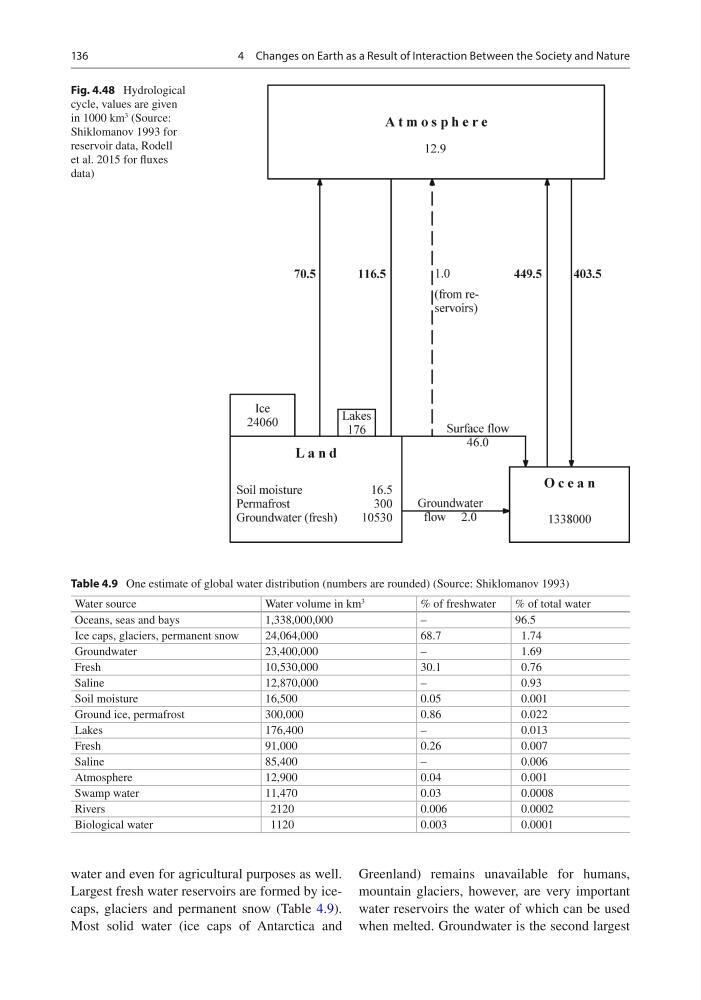
Fig. 4.48 Hydrological
cycle, values are given
in 1000 km
3 (Source:
Shiklomanov 1993 for
reservoir data, Rodell
et al. 2015 for fluxes
data)
water and even for agricultural purposes as well.
Largest fresh water reservoirs are formed by icecaps, glaciers and permanent snow (Table 4.9).
Most solid water (ice caps of Antarctica and
Greenland) remains unavailable for humans,
mountain glaciers, however, are very important
water reservoirs the water of which can be used
when melted. Groundwater is the second largest
4 Changes on Earth as a Result of Interaction Between the Society and Nature
Table 4.9 One estimate of global water distribution (numbers are rounded) (Source: Shiklomanov 1993)
Water source
Water volume in km
3
% of freshwater
% of total water
Oceans, seas and bays
1,338,000,000
–
96.5
Ice caps, glaciers, permanent snow
24,064,000
68.7
1.74
Groundwater
23,400,000
–
1.69
Fresh
10,530,000
30.1
0.76
Saline
12,870,000
–
0.93
Soil moisture
16,500
0.05
0.001
Ground ice, permafrost
300,000
0.86
0.022
Lakes
176,400
–
0.013
Fresh
91,000
0.26
0.007
Saline
85,400
–
0.006
Atmosphere
12,900
0.04
0.001
Swamp water
11,470
0.03
0.0008
Rivers
2120
0.006
0.0002
Biological water
1120
0.003
0.0001
Fig. 4.48 Hydrological
cycle, values are given
in 1000 km
3 (Source:
Shiklomanov 1993 for
reservoir data, Rodell
et al. 2015 for fluxes
data)
water and even for agricultural purposes as well.
Largest fresh water reservoirs are formed by icecaps, glaciers and permanent snow (Table 4.9).
Most solid water (ice caps of Antarctica and
Greenland) remains unavailable for humans,
mountain glaciers, however, are very important
water reservoirs the water of which can be used
when melted. Groundwater is the second largest
4 Changes on Earth as a Result of Interaction Between the Society and Nature