

121
Since soil degradation caused by mining and
other industrial activities was discussed in Sect.
4.1 the effects of agriculture on soils will be presented below.
From food supply point of view effects on the
soils of agricultural areas are highly important.
The following serious degradation types can be
caused by human activities reducing the fertility
of the soils or threatening the ecological conditions of waters: water and wind erosion, acidification, accumulation of slow decaying pesticides,
secondary salinisation, organic matter loss, structure deterioration and soil compaction. Applying
too much N and P fertilisers is not useful because
if these fertilisers are washed out of the soil or
enter water together with eroded soil particles
they cause eutrophication (proliferation of
aquatic plants) and result in no increase of crop
yield. Water and wind erosion have the most significant consequences.
Erosion due to intense precipitation on completely vegetation free (e.g. immediately after
sowing) or partly covered cultivated sloping areas
could intensify extremely (even by several magnitudes) compared to erosion on areas covered by
continuous vegetation. This intense soil degradation caused by human activities is called accelerated or anthropogenic erosion. Its effects hold
enormous risks. Soil generation cannot keep the
pace of soil degradation in such areas; therefore,
the soil layer thins at a variable but generally
rapid rate and could become completely destroyed
in extreme cases. Plant cultivation has to be abandoned in such sites and anthropogenic deterioration could only be regenerated naturally over
centuries or even thousands of years. Sloping
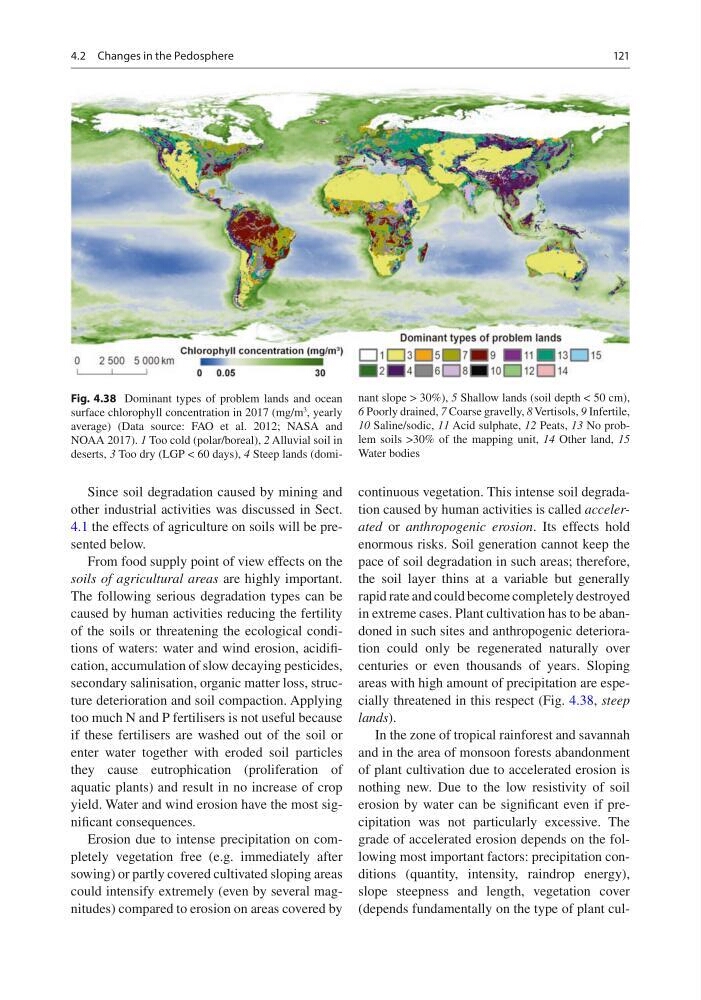
areas with high amount of precipitation are especially threatened in this respect (Fig. 4.38, steep
lands).
In the zone of tropical rainforest and savannah
and in the area of monsoon forests abandonment
of plant cultivation due to accelerated erosion is
nothing new. Due to the low resistivity of soil
erosion by water can be significant even if precipitation was not particularly excessive. The
grade of accelerated erosion depends on the following most important factors: precipitation conditions (quantity, intensity, raindrop energy),
slope steepness and length, vegetation cover
(depends fundamentally on the type of plant culFig. 4.38 Dominant types of problem lands and ocean
surface chlorophyll concentration in 2017 (mg/m
3
, yearly
average) (Data source: FAO et al. 2012; NASA and
NOAA 2017). 1 Too cold (polar/boreal), 2 Alluvial soil in
deserts, 3 Too dry (LGP < 60 days), 4 Steep lands (dominant slope > 30%), 5 Shallow lands (soil depth < 50 cm),
6 Poorly drained, 7 Coarse gravelly, 8 Vertisols, 9 Infertile,
10 Saline/sodic, 11 Acid sulphate, 12 Peats, 13 No problem soils >30% of the mapping unit, 14 Other land, 15
Water bodies
4.2 Changes in the Pedosphere
Since soil degradation caused by mining and
other industrial activities was discussed in Sect.
4.1 the effects of agriculture on soils will be presented below.
From food supply point of view effects on the
soils of agricultural areas are highly important.
The following serious degradation types can be
caused by human activities reducing the fertility
of the soils or threatening the ecological conditions of waters: water and wind erosion, acidification, accumulation of slow decaying pesticides,
secondary salinisation, organic matter loss, structure deterioration and soil compaction. Applying
too much N and P fertilisers is not useful because
if these fertilisers are washed out of the soil or
enter water together with eroded soil particles
they cause eutrophication (proliferation of
aquatic plants) and result in no increase of crop
yield. Water and wind erosion have the most significant consequences.
Erosion due to intense precipitation on completely vegetation free (e.g. immediately after
sowing) or partly covered cultivated sloping areas
could intensify extremely (even by several magnitudes) compared to erosion on areas covered by
continuous vegetation. This intense soil degradation caused by human activities is called accelerated or anthropogenic erosion. Its effects hold
enormous risks. Soil generation cannot keep the
pace of soil degradation in such areas; therefore,
the soil layer thins at a variable but generally
rapid rate and could become completely destroyed
in extreme cases. Plant cultivation has to be abandoned in such sites and anthropogenic deterioration could only be regenerated naturally over
centuries or even thousands of years. Sloping
areas with high amount of precipitation are especially threatened in this respect (Fig. 4.38, steep
lands).
In the zone of tropical rainforest and savannah
and in the area of monsoon forests abandonment
of plant cultivation due to accelerated erosion is
nothing new. Due to the low resistivity of soil
erosion by water can be significant even if precipitation was not particularly excessive. The
grade of accelerated erosion depends on the following most important factors: precipitation conditions (quantity, intensity, raindrop energy),
slope steepness and length, vegetation cover
(depends fundamentally on the type of plant culFig. 4.38 Dominant types of problem lands and ocean
surface chlorophyll concentration in 2017 (mg/m
3
, yearly
average) (Data source: FAO et al. 2012; NASA and
NOAA 2017). 1 Too cold (polar/boreal), 2 Alluvial soil in
deserts, 3 Too dry (LGP < 60 days), 4 Steep lands (dominant slope > 30%), 5 Shallow lands (soil depth < 50 cm),
6 Poorly drained, 7 Coarse gravelly, 8 Vertisols, 9 Infertile,
10 Saline/sodic, 11 Acid sulphate, 12 Peats, 13 No problem soils >30% of the mapping unit, 14 Other land, 15
Water bodies
4.2 Changes in the Pedosphere