

116
advice, society organisation guidance, and the
development of education would be necessary for
the city to start the road towards sustainable
development. It has to be mentioned that around
one billion people in cities worldwide lack
healthy water supply and drained dwelling places
(Satterthwaite and McGranahan 2007).
Tijuana is an industrialising large city of a
moderately developed country (Mexico). Due to
its different conditions Tijuana faces different
problems than Accra. Factories emitting toxic and
polluting materials cause significant problems,
efficiency of production is not too good and the
energy consumption of industrial factories is very
high. All the above cause significant air pollution
that wears down the health of inhabitants; therefore, health expenses are high. Profitable industrial production, however, makes environmental
and public health measures possible. In the long
term, however, industrial factories in the city have
to change technologies to more environmental
friendly ones and more effective energy utilisation has to be achieved. (Many cities in China and
India struggle with similar problems.)
Singapore is a modern, prosperous major city
and a city-state at the same time. Its economy is
dominated by services (giving 67% of the GDP),
and it can provide a high living standard for its
citizens proved also by its rank on the basis of
Human Development Index (HDI) compared to
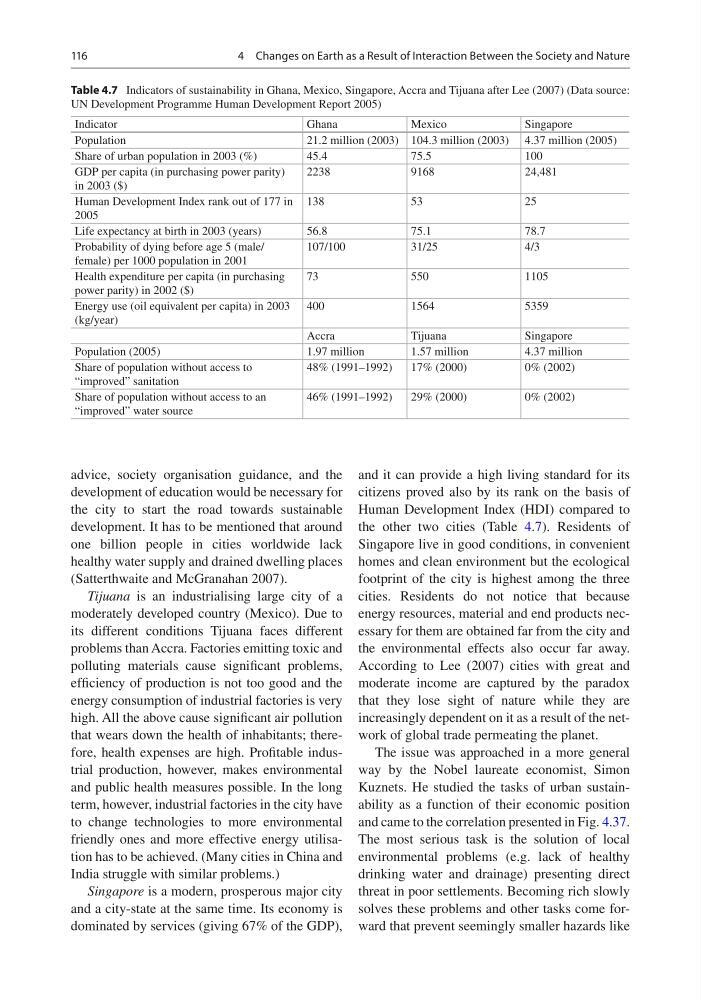
the other two cities (Table 4.7). Residents of
Singapore live in good conditions, in convenient
homes and clean environment but the ecological
footprint of the city is highest among the three
cities. Residents do not notice that because
energy resources, material and end products necessary for them are obtained far from the city and
the environmental effects also occur far away.
According to Lee (2007) cities with great and
moderate income are captured by the paradox
that they lose sight of nature while they are
increasingly dependent on it as a result of the network of global trade permeating the planet.
The issue was approached in a more general
way by the Nobel laureate economist, Simon
Kuznets. He studied the tasks of urban sustainability as a function of their economic position
and came to the correlation presented in Fig. 4.37.
The most serious task is the solution of local
environmental problems (e.g. lack of healthy
drinking water and drainage) presenting direct
threat in poor settlements. Becoming rich slowly
solves these problems and other tasks come forward that prevent seemingly smaller hazards like
Table 4.7 Indicators of sustainability in Ghana, Mexico, Singapore, Accra and Tijuana after Lee (2007) (Data source:
UN Development Programme Human Development Report 2005)
Indicator
Ghana
Mexico
Singapore
Population
21.2 million (2003) 104.3 million (2003) 4.37 million (2005)
Share of urban population in 2003 (%)
45.4
75.5
100
GDP per capita (in purchasing power parity)
in 2003 ($)
2238
9168
24,481
Human Development Index rank out of 177 in
2005
138
53
25
Life expectancy at birth in 2003 (years)
56.8
75.1
78.7
Probability of dying before age 5 (male/
female) per 1000 population in 2001
107/100
31/25
4/3
Health expenditure per capita (in purchasing
power parity) in 2002 ($)
73
550
1105
Energy use (oil equivalent per capita) in 2003
(kg/year)
400
1564
5359
Accra
Tijuana
Singapore
Population (2005)
1.97 million
1.57 million
4.37 million
Share of population without access to
“improved” sanitation
48% (1991–1992)
17% (2000)
0% (2002)
Share of population without access to an
“improved” water source
46% (1991–1992)
29% (2000)
0% (2002)
4 Changes on Earth as a Result of Interaction Between the Society and Nature
advice, society organisation guidance, and the
development of education would be necessary for
the city to start the road towards sustainable
development. It has to be mentioned that around
one billion people in cities worldwide lack
healthy water supply and drained dwelling places
(Satterthwaite and McGranahan 2007).
Tijuana is an industrialising large city of a
moderately developed country (Mexico). Due to
its different conditions Tijuana faces different
problems than Accra. Factories emitting toxic and
polluting materials cause significant problems,
efficiency of production is not too good and the
energy consumption of industrial factories is very
high. All the above cause significant air pollution
that wears down the health of inhabitants; therefore, health expenses are high. Profitable industrial production, however, makes environmental
and public health measures possible. In the long
term, however, industrial factories in the city have
to change technologies to more environmental
friendly ones and more effective energy utilisation has to be achieved. (Many cities in China and
India struggle with similar problems.)
Singapore is a modern, prosperous major city
and a city-state at the same time. Its economy is
dominated by services (giving 67% of the GDP),
and it can provide a high living standard for its
citizens proved also by its rank on the basis of
Human Development Index (HDI) compared to
the other two cities (Table 4.7). Residents of
Singapore live in good conditions, in convenient
homes and clean environment but the ecological
footprint of the city is highest among the three
cities. Residents do not notice that because
energy resources, material and end products necessary for them are obtained far from the city and
the environmental effects also occur far away.
According to Lee (2007) cities with great and
moderate income are captured by the paradox
that they lose sight of nature while they are
increasingly dependent on it as a result of the network of global trade permeating the planet.
The issue was approached in a more general
way by the Nobel laureate economist, Simon
Kuznets. He studied the tasks of urban sustainability as a function of their economic position
and came to the correlation presented in Fig. 4.37.
The most serious task is the solution of local
environmental problems (e.g. lack of healthy
drinking water and drainage) presenting direct
threat in poor settlements. Becoming rich slowly
solves these problems and other tasks come forward that prevent seemingly smaller hazards like
Table 4.7 Indicators of sustainability in Ghana, Mexico, Singapore, Accra and Tijuana after Lee (2007) (Data source:
UN Development Programme Human Development Report 2005)
Indicator
Ghana
Mexico
Singapore
Population
21.2 million (2003) 104.3 million (2003) 4.37 million (2005)
Share of urban population in 2003 (%)
45.4
75.5
100
GDP per capita (in purchasing power parity)
in 2003 ($)
2238
9168
24,481
Human Development Index rank out of 177 in
2005
138
53
25
Life expectancy at birth in 2003 (years)
56.8
75.1
78.7
Probability of dying before age 5 (male/
female) per 1000 population in 2001
107/100
31/25
4/3
Health expenditure per capita (in purchasing
power parity) in 2002 ($)
73
550
1105
Energy use (oil equivalent per capita) in 2003
(kg/year)
400
1564
5359
Accra
Tijuana
Singapore
Population (2005)
1.97 million
1.57 million
4.37 million
Share of population without access to
“improved” sanitation
48% (1991–1992)
17% (2000)
0% (2002)
Share of population without access to an
“improved” water source
46% (1991–1992)
29% (2000)
0% (2002)
4 Changes on Earth as a Result of Interaction Between the Society and Nature